1919 · CLOSE READING
The Equinox (Volume III, Number I)
The Equinox (Volume III, Number I) (1919), PDF p. 293
Original page
Enlarge ↗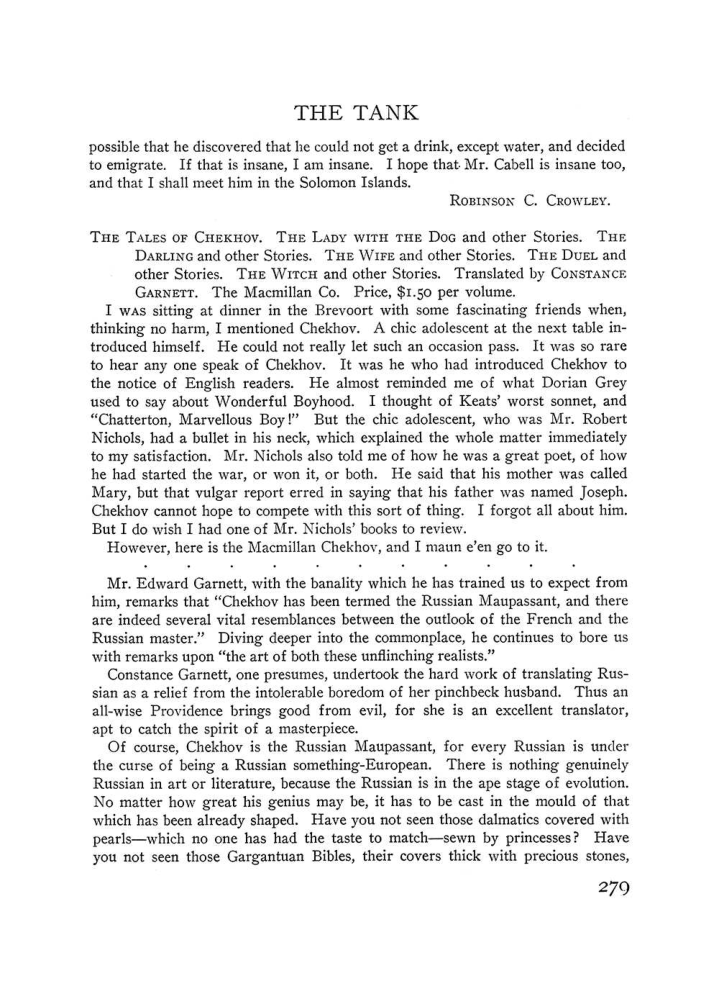
Highlights use the original PDF text layer. OCR-only matches may not be visible on the scan.
Transcription
Download text ↓raw extractionoriginal embedded textReview: unreviewed
THE TANK
possible that he discovered that he could not get a drink, except water, and decided
to emigrate. If that is insane, I am insane. I hope that Mr. Cabell is insane too,
and that I shall meet him in the Solomon Islands.
Rosinson C. CrowLey.
Tue Tares or Cuexuov. Tue Lapy with tHE Doc and other Stories. Tue
Dartinc and other Stories. Tue Wire and other Stories. Tue Duet and
other Stories. Tue Wircu and other Stories. Translated by Constance
Garnett. The Macmillan Co. Price, $1.50 per volume.
I was sitting at dinner in the Brevoort with some fascinating friends when,
thinking no harm, I mentioned Chekhov. A chic adolescent at the next table in-
troduced himself. He could not really let such an occasion pass. It was so rare
to hear any one speak of Chekhov. It was he who had introduced Chekhov to
the notice of English readers. He almost reminded me of what Dorian Grey
used to say about Wonderful Boyhood. I thought of Keats’ worst sonnet, and
“Chatterton, Marvellous Boy!” But the chic adolescent, who was Mr. Robert
Nichols, had a bullet in his neck, which explained the whole matter immediately
to my satisfaction. Mr. Nichols also told me of how he was a great poet, of how
he had started the war, or won it, or both. He said that his mother was called
Mary, but that vulgar report erred in saying that his father was named Joseph.
Chekhov cannot hope to compete with this sort of thing. I forgot all about him.
But I do wish I had one of Mr. Nichols’ books to review.
However, hereis the Macmillan Chekhov, and I maun e’en go to it.
Mr. Edward Garnett, with the banality which he has trained us to expect from
him, remarks that “Chekhov has been termed the Russian Maupassant, and there
are indeed several vital resemblances between the outlook of the French and the
Russian master.” Diving deeper into the commonplace, he continues to bore us
with remarks upon “the art of both these unflinching realists.”
Constance Garnett, one presumes, undertook the hard work of translating Rus-
sian as a relief from the intolerable boredom of her pinchbeck husband. Thus an
all-wise Providence brings good from evil, for she is an excellent translator,
apt to catch the spirit of a masterpiece.
Of course, Chekhov is the Russian Maupassant, for every Russian is under
the curse of being a Russian something-European. There is nothing genuinely
Russian in art or literature, because the Russian is in the ape stage of evolution.
No matter how great his genius may be, it has to be cast in the mould of that
which has been already shaped. Have you not seen those dalmatics covered with
pearls—which no one has had the taste to match—sewn by princesses? Have
you not seen those Gargantuan Bibles, their covers thick with precious stones,
279
Page provenance & review flags
Stable page ID: 053f3d738822ceadcedffd98:p00293
Line breaks are preserved. Reading order and OCR accuracy may need review.
Printed page label has not been verified.
- No automated review flags. This does not establish transcription accuracy.