1919 · CLOSE READING
The Equinox (Volume III, Number I)
The Equinox (Volume III, Number I) (1919), PDF p. 294
Original page
Enlarge ↗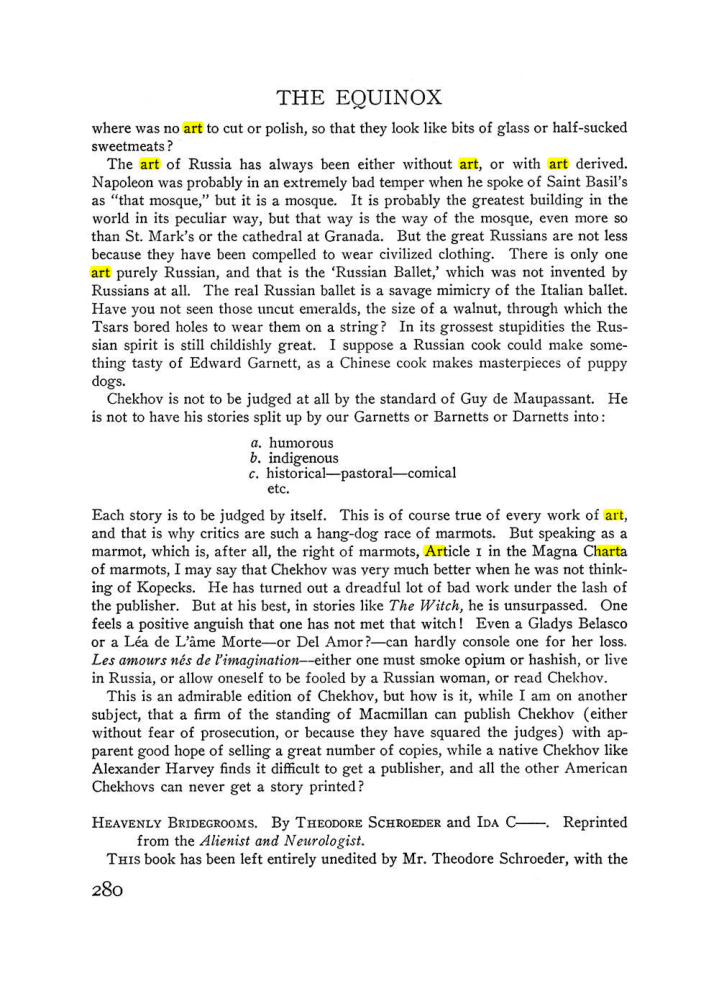
Highlights use the original PDF text layer. OCR-only matches may not be visible on the scan.
Transcription
Download text ↓raw extractionoriginal embedded textReview: unreviewed
THE EQUINOX
where was no art to cut or polish, so that they look like bits of glass or half-sucked
sweetmeats?
The art of Russia has always been either without art, or with art derived.
Napoleon was probably in an extremely bad temper when he spoke of Saint Basil’s
as “that mosque,” but it is a mosque. It is probably the greatest building in the
world in its peculiar way, but that way is the way of the mosque, even more so
than St. Mark’s or the cathedral at Granada. But the great Russians are not less
because they have been compelled to wear civilized clothing. There is only one
art purely Russian, and that is the ‘Russian Ballet,’ which was not invented by
Russians at all. The real Russian ballet is a savage mimicry of the Italian ballet.
Have you not seen those uncut emeralds, the size of a walnut, through which the
Tsars bored holes to wear them on a string? In its grossest stupidities the Rus-
sian spirit is still childishly great. I suppose a Russian cook could make some-
thing tasty of Edward Garnett, as a Chinese cook makes masterpieces of puppy
dogs.
Chekhov is not to be judged at all by the standard of Guy de Maupassant. He
is not to have his stories split up by our Garnetts or Barnetts or Darnetts into:
a, humorous
b. indigenous
¢. historical—pastoral—comical
etc.
Each story is to be judged by itself. This is of course true of every work of art,
and that is why critics are such a hang-dog race of marmots. But speaking as a
marmot, which is, after all, the right of marmots, Article 1 in the Magna Charta
of marmots, I may say that Chekhov was yery much better when he was not think-
ing of Kopecks. He has turned out a dreadful lot of bad work under the lash of
the publisher. But at his best, in stories like The Witch, he is unsurpassed. One
feels a positive anguish that one has not met that witch! Even a Gladys Belasco
or a Léa de L’ame Morte—or Del Amor?—can hardly console one for her loss.
Les amours nés de V'imagination—-either one must smoke opium or hashish, or live
in Russia, or allow oneself to be fooled by a Russian woman, or read Chekhov.
This is an admirable edition of Chekhov, but how is it, while I am on another
subject, that a firm of the standing of Macmillan can publish Chekhov (either
without fear of prosecution, or because they have squared the judges) with ap-
parent good hope of selling a great number of copies, while a native Chekhov like
Alexander Harvey finds it difficult to get a publisher, and all the other American
Chekhovs can never get a story printed?
HEAvENLY Bripecrooms. By THEoporE ScHRoEDER and Ina C——. Reprinted
from the Alienist and Neurologist.
Tuts book has been left entirely unedited by Mr. Theodore Schroeder, with the
280
Page provenance & review flags
Stable page ID: 053f3d738822ceadcedffd98:p00294
Line breaks are preserved. Reading order and OCR accuracy may need review.
Printed page label has not been verified.
- No automated review flags. This does not establish transcription accuracy.