1919 · CLOSE READING
The Equinox (Volume III, Number I)
The Equinox (Volume III, Number I) (1919), PDF p. 304
Original page
Enlarge ↗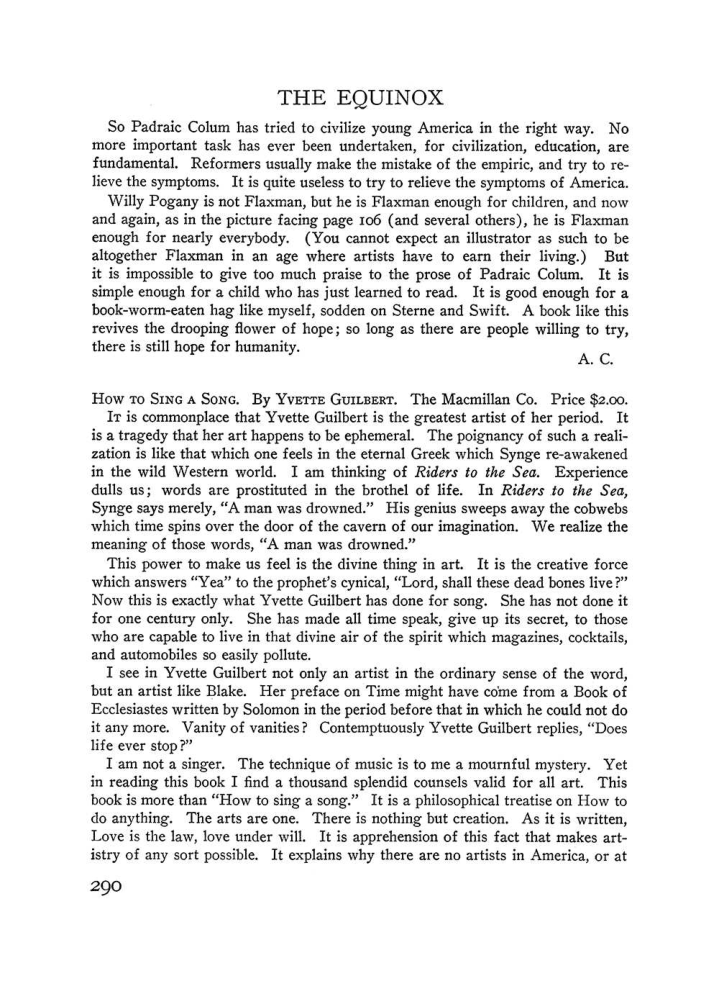
Highlights use the original PDF text layer. OCR-only matches may not be visible on the scan.
Transcription
Download text ↓raw extractionoriginal embedded textReview: unreviewed
THE EQUINOX
So Padraic Colum has tried to civilize young America in the right way. No
more important task has ever been undertaken, for civilization, education, are
fundamental. Reformers usually make the mistake of the empiric, and try to re-
lieve the symptoms. It is quite useless to try to relieve the symptoms of America.
Willy Pogany is not Flaxman, but he is Flaxman enough for children, and now
and again, as in the picture facing page 106 (and several others), he is Flaxman
enough for nearly everybody. (You cannot expect an illustrator as such to be
altogether Flaxman in an age where artists have to earn their living.) But
it is impossible to give too much praise to the prose of Padraic Colum. It is
simple enough for a child who has just learned to read. It is good enough for a
book-worm-eaten hag like myself, sodden on Sterne and Swift. A book like this
revives the drooping flower of hope; so long as there are people willing to try,
there is still hope for humanity. AC
How To Stnc a Sone. By Yverre Guiigert. The Macmillan Co. Price $2.00.
Ir is commonplace that Yvette Guilbert is the greatest artist of her period. It
is a tragedy that her art happens to be ephemeral. The poignancy of such a reali-
zation is like that which one feels in the eternal Greek which Synge re-awakened
in the wild Western world. I am thinking of Riders to the Sea. Experience
dulls us; words are prostituted in the brothel of life. In Riders to the Sea,
Synge says merely, “A man was drowned.” His genius sweeps away the cobwebs
which time spins over the door of the cavern of our imagination. We realize the
meaning of those words, “A man was drowned.”
This power to make us feel is the divine thing in art. It is the creative force
which answers “Yea” to the prophet’s cynical, “Lord, shall these dead bones live?”
Now this is exactly what Yvette Guilbert has done for song. She has not done it
for one century only. She has made all time speak, give up its secret, to those
who are capable to live in that divine air of the spirit which magazines, cocktails,
and automobiles so easily pollute.
I see in Yvette Guilbert not only an artist in the ordinary sense of the word,
but an artist like Blake. Her preface on Time might have come from a Book of
Ecclesiastes written by Solomon in the period before that in which he could not do
it any more. Vanity of vanities? Contemptuously Yvette Guilbert replies, “Does
life ever stop?”
Iam not a singer. The technique of music is to me a mournful mystery. Yet
in reading this book I find a thousand splendid counsels valid for all art. This
book is more than “How to sing a song.” It is a philosophical treatise on How to
do anything. The arts are one. There is nothing but creation. As it is written,
Love is the law, love under will. It is apprehension of this fact that makes art-
istry of any sort possible. It explains why there are no artists in America, or at
290
Page provenance & review flags
Stable page ID: 053f3d738822ceadcedffd98:p00304
Line breaks are preserved. Reading order and OCR accuracy may need review.
Printed page label has not been verified.
- No automated review flags. This does not establish transcription accuracy.