1919 · CLOSE READING
The Equinox (Volume III, Number I)
The Equinox (Volume III, Number I) (1919), PDF p. 308
Original page
Enlarge ↗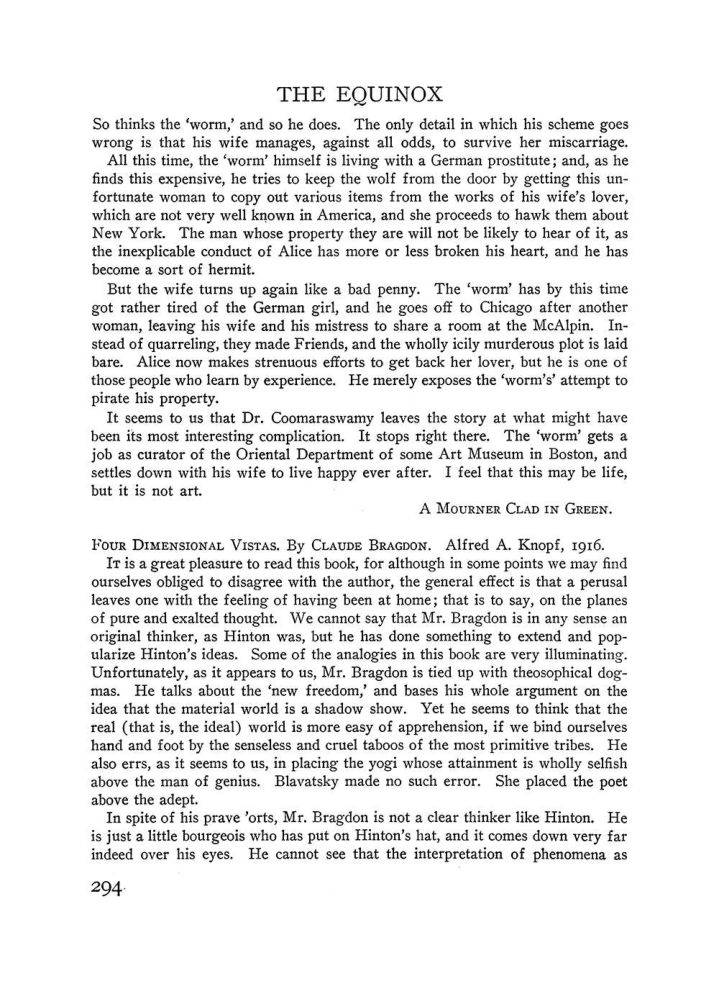
Highlights use the original PDF text layer. OCR-only matches may not be visible on the scan.
Transcription
Download text ↓raw extractionoriginal embedded textReview: unreviewed
THE EQUINOX
So thinks the ‘worm,’ and so he does. The only detail in which his scheme goes
wrong is that his wife manages, against all odds, to survive her miscarriage.
All this time, the ‘worm’ himself is living with a German prostitute; and, as he
finds this expensive, he tries to keep the wolf from the door by getting this un-
fortunate woman to copy out various items from the works of his wife’s lover,
which are not very well known in America, and she proceeds to hawk them about
New York. The man whose property they are will not be likely to hear of it, as
the inexplicable conduct of Alice has more or less broken his heart, and he has
become a sort of hermit.
But the wife turns up again like a bad penny. The ‘worm’ has by this time
got rather tired of the German girl, and he goes off to Chicago after another
woman, leaving his wife and his mistress to share a room at the McAlpin. In-
stead of quarreling, they made Friends, and the wholly icily murderous plot is laid
bare. Alice now makes strenuous efforts to get back her lover, but he is one of
those people who learn by experience. He merely exposes the ‘worm’s’ attempt to
pirate his property.
It seems to us that Dr. Coomaraswamy leaves the story at what might have
been its most interesting complication. It stops right there. The ‘worm’ gets a
job as curator of the Oriental Department of some Art Museum in Boston, and
settles down with his wife to live happy ever after. I feel that this may be life,
but it is not art.
A Mourner Crap In GREEN.
Four Dimensionat Vistas. By CLaupe Bracpon. Alfred A. Knopf, 1916.
Ir is a great pleasure to read this book, for although in some points we may find
ourselves obliged to disagree with the author, the general effect is that a perusal
leaves one with the feeling of having been at home; that is to say, on the planes
of pure and exalted thought. We cannot say that Mr. Bragdon is in any sense an
original thinker, as Hinton was, but he has done something to extend and pop-
ularize Hinton’s ideas. Some of the analogies in this book are very illuminating.
Unfortunately, as it appears to us, Mr. Bragdon is tied up with theosophical dog-
mas. He talks about the ‘new freedom,’ and bases his whole argument on the
idea that the material world is a shadow show. Yet he seems to think that the
real (that is, the ideal) world is more easy of apprehension, if we bind ourselves
hand and foot by the senseless and cruel taboos of the most primitive tribes. He
also errs, as it seems to us, in placing the yogi whose attainment is wholly selfish
above the man of genius. Blavatsky made no such error. She placed the poet
above the adept.
In spite of his prave ’orts, Mr. Bragdon is not a clear thinker like Hinton. He
is just a little bourgeois who has put on Hinton’s hat, and it comes down very far
indeed over his eyes. He cannot see that the interpretation of phenomena as
204
Page provenance & review flags
Stable page ID: 053f3d738822ceadcedffd98:p00308
Line breaks are preserved. Reading order and OCR accuracy may need review.
Printed page label has not been verified.
- No automated review flags. This does not establish transcription accuracy.