1919 · CLOSE READING
The Equinox (Volume III, Number I)
The Equinox (Volume III, Number I) (1919), PDF p. 312
Original page
Enlarge ↗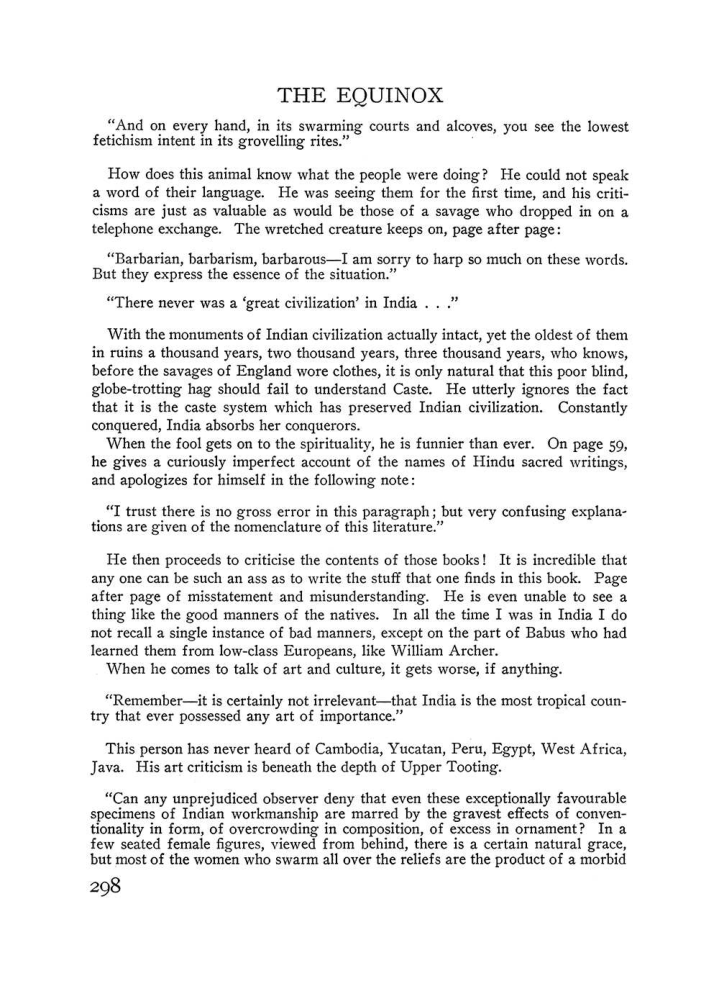
Highlights use the original PDF text layer. OCR-only matches may not be visible on the scan.
Transcription
Download text ↓raw extractionoriginal embedded textReview: unreviewed
THE EQUINOX
“And on every hand, in its swarming courts and alcoves, you see the lowest
fetichism intent in its grovelling rites.”
How does this animal know what the people were doing? He could not speak
a word of their language. He was seeing them for the first time, and his criti-
cisms are just as valuable as would be those of a savage who dropped in on a
telephone exchange. The wretched creature keeps on, page after page:
“Barbarian, barbarism, barbarous—I am sorry to harp so much on these words.
But they express the essence of the situation.”
“There never was a ‘great civilization’ in India . . .”
‘With the monuments of Indian civilization actually intact, yet the oldest of them
in ruins a thousand years, two thousand years, three thousand years, who knows,
before the savages of England wore clothes, it is only natural that this poor blind,
globe-trotting hag should fail to understand Caste. He utterly ignores the fact
that it is the caste system which has preserved Indian civilization. Constantly
conquered, India absorbs her conquerors.
When the fool gets on to the spirituality, he is funnier than ever. On page 59,
he gives a curiously imperfect account of the names of Hindu sacred writings,
and apologizes for himself in the following note:
“T trust thereis no gross error in this paragraph; but very confusing explana-
tions are given of the nomenclature of this literature.”
He then proceeds to criticise the contents of those books! It is incredible that
any one can be such an ass as to write the stuff that one finds in this book. Page
after page of misstatement and misunderstanding. He is even unable to see a
thing like the good manners of the natives. In all the time I was in India I do
not recall a single instance of bad manners, except on the part of Babus who had
learned them from low-class Europeans, like William Archer.
When he comes to talk of art and culture, it gets worse, if anything.
“Remember—it is certainly not irrelevant—that India is the most tropical coun-
try that ever possessed any art of importance.”
This person has never heard of Cambodia, Yucatan, Peru, Egypt, West Africa,
Java. His art criticism is beneath the depth of Upper Tooting.
“Can any unprejudiced observer deny that even these exceptionally favourable
specimens of Indian workmanship are marred by the gravest effects of conven-
tionalityin form, of overcrowdingin composition, of excess in ornament? In a
few seated female figures, viewed from behind, there is a certain natural grace,
but most of the women who swarm all over the reliefs are the product of a morbid
2098
Page provenance & review flags
Stable page ID: 053f3d738822ceadcedffd98:p00312
Line breaks are preserved. Reading order and OCR accuracy may need review.
Printed page label has not been verified.
- No automated review flags. This does not establish transcription accuracy.