1919 · CLOSE READING
The Equinox (Volume III, Number I)
The Equinox (Volume III, Number I) (1919), PDF p. 317
Original page
Enlarge ↗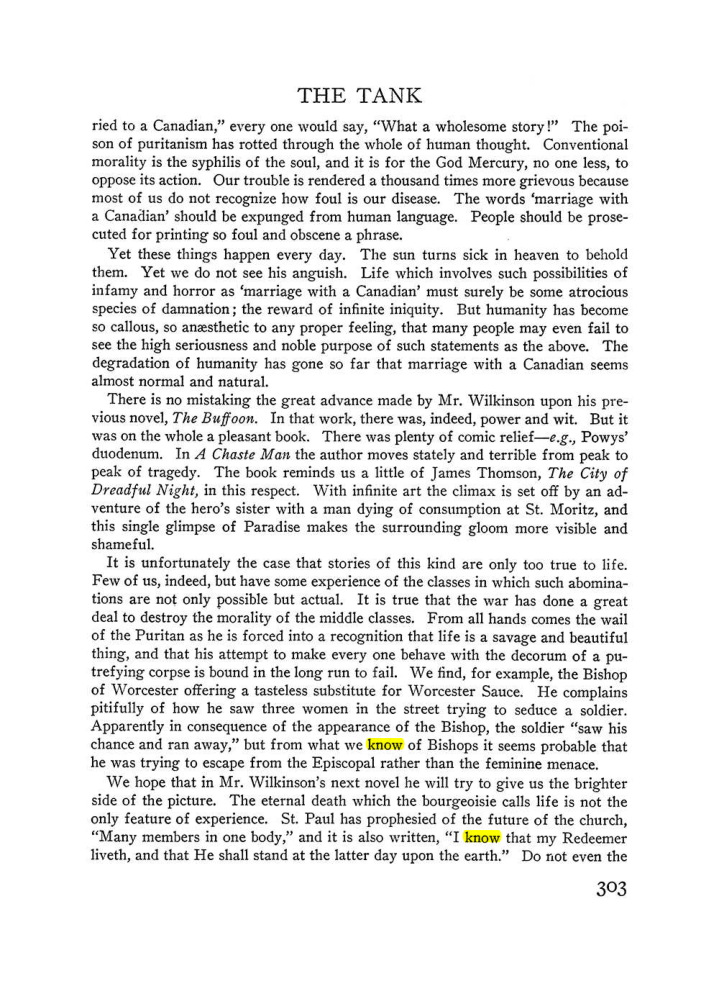
Highlights use the original PDF text layer. OCR-only matches may not be visible on the scan.
Transcription
Download text ↓raw extractionoriginal embedded textReview: unreviewed
THE TANK
ried to a Canadian,” every one would say, “What a wholesome story!” The poi-
son of puritanism has rotted through the whole of human thought. Conventional
morality is the syphilis of the soul, and it is for the God Mercury, no one less, to
oppose its action. Our trouble is rendered a thousand times more grievous because
most of us do not recognize how foul is our disease. The words ‘marriage with
a Canadian’ should be expunged from human language. People should be prose-
cuted for printing so foul and obscene a phrase.
Yet these things happen every day. The sun turns sick in heaven to behold
them. Yet we do not see his anguish. Life which involves such possibilities of
infamy and horror as ‘marriage with a Canadian’ must surely be some atrocious
species of damnation; the reward of infinite iniquity. But humanity has become
so callous, so anzsthetic to any proper feeling, that many people may even fail to
see the high seriousness and noble purpose of such statements as the above. The
degradation of humanity has gone so far that marriage with a Canadian seems
almost normal and natural.
There is no mistaking the great advance made by Mr. Wilkinson upon his pre-
vious novel, The Buffoon. In that work, there was, indeed, power and wit. But it
was on the whole a pleasant book. There was plenty of comic relief—e.g., Powys’
duodenum. In A Chaste Man the author moves stately and terrible from peak to
peak of tragedy. The book reminds us a little of James Thomson, The City of
Dreadful Night, in this respect. With infinite art the climax is set off by an ad-
venture of the hero’s sister with a man dying of consumption at St. Moritz, and
this single glimpse of Paradise makes the surrounding gloom more visible and
shameful.
It is unfortunately the case that stories of this kind are only too true to life.
Few of us, indeed, but have some experience of the classes in which such abomina-
tions are not only possible but actual. It is true that the war has done a great
deal to destroy the morality of the middle classes. From all hands comes the wail
of the Puritan as he is forced into a recognition that life is a savage and beautiful
thing, and that his attempt to make every one behave with the decorum of a pu-
trefying corpse is bound in the long run to fail. We find, for example, the Bishop
of Worcester offering a tasteless substitute for Worcester Sauce. He complains
pitifully of how he saw three women in the street trying to seduce a soldier.
Apparently in consequence of the appearance of the Bishop, the soldier “saw his
chance and ran away,” but from what we know of Bishops it seems probable that
he was trying to escape from the Episcopal rather than the feminine menace.
We hope that in Mr. Wilkinson’s next novel he will try to give us the brighter
side of the picture. The eternal death which the bourgeoisie calls life is not the
only feature of experience. St. Paul has prophesied of the future of the church,
“Many members in one body,” and it is also written, “I know that my Redeemer
liveth, and that He shall stand at the latter day upon the earth.” Do not even the
303
Page provenance & review flags
Stable page ID: 053f3d738822ceadcedffd98:p00317
Line breaks are preserved. Reading order and OCR accuracy may need review.
Printed page label has not been verified.
- No automated review flags. This does not establish transcription accuracy.