1919 · CLOSE READING
The Equinox (Volume III, Number I)
The Equinox (Volume III, Number I) (1919), PDF p. 388
Original page
Enlarge ↗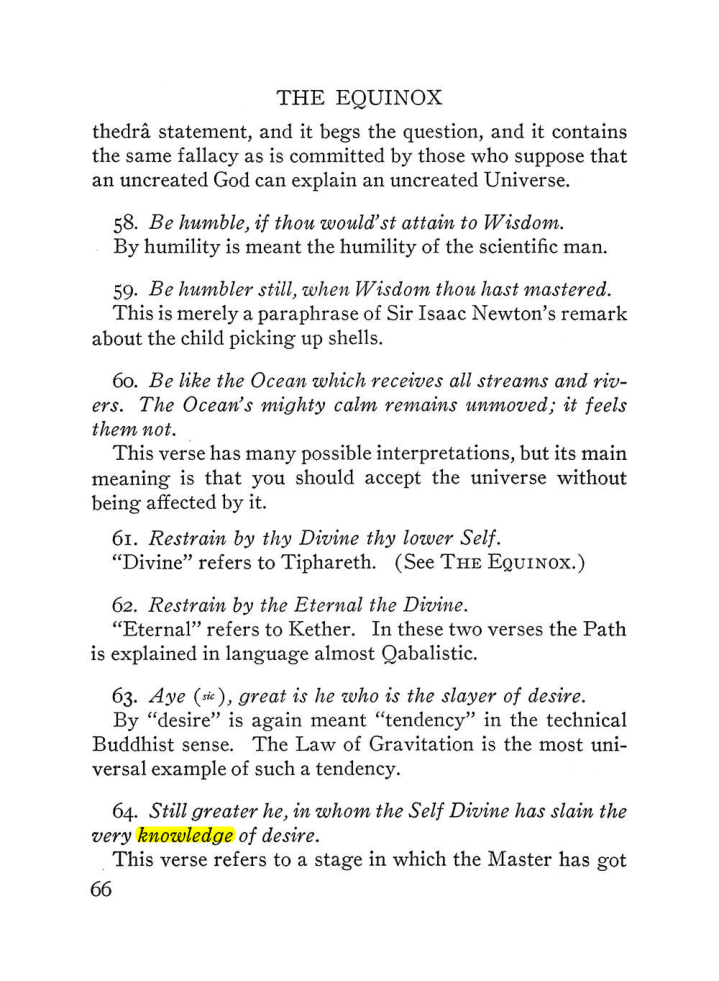
Highlights use the original PDF text layer. OCR-only matches may not be visible on the scan.
Transcription
Download text ↓raw extractionoriginal embedded textReview: unreviewed
THE EQUINOX
thedra statement, and it begs the question, and it contains
the same fallacy as is committed by those who suppose that
an uncreated God can explain an uncreated Universe.
58. Be humble, if thou would’st attain to Wisdom.
By humility is meant the humility of the scientific man.
59. Be humbler still, when Wisdom thou hast mastered.
This is merely a paraphrase of Sir Isaac Newton’s remark
about the child picking up shells.
60. Be like the Ocean which receives all streams and riv-
ers. The Ocean’s mighty calm remains unmoved; it feels
them not.
This verse has many possible interpretations, but its main
meaning is that you should accept the universe without
being affected by it.
61. Restrain by thy Divine thy lower Self.
“Divine” refers to Tiphareth. (See THE Equinox.)
62. Restrain by the Eternal the Divine.
“Eternal” refers to Kether. In these two verses the Path
is explained in language almost Qabalistic.
63. Ave (se), great is he who is the slayer of desire.
By “desire” is again meant “tendency” in the technical
Buddhist sense. The Law of Gravitation is the most uni-
versal example of such a tendency.
64. Still greater he, in whom the Self Divine has slain the
very knowledge of desire.
This verse refers to a stage in which the Master has got
66
Page provenance & review flags
Stable page ID: 053f3d738822ceadcedffd98:p00388
Line breaks are preserved. Reading order and OCR accuracy may need review.
Printed page label has not been verified.
- No automated review flags. This does not establish transcription accuracy.