1919 · CLOSE READING
The Equinox (Volume III, Number I)
The Equinox (Volume III, Number I) (1919), PDF p. 398
Original page
Enlarge ↗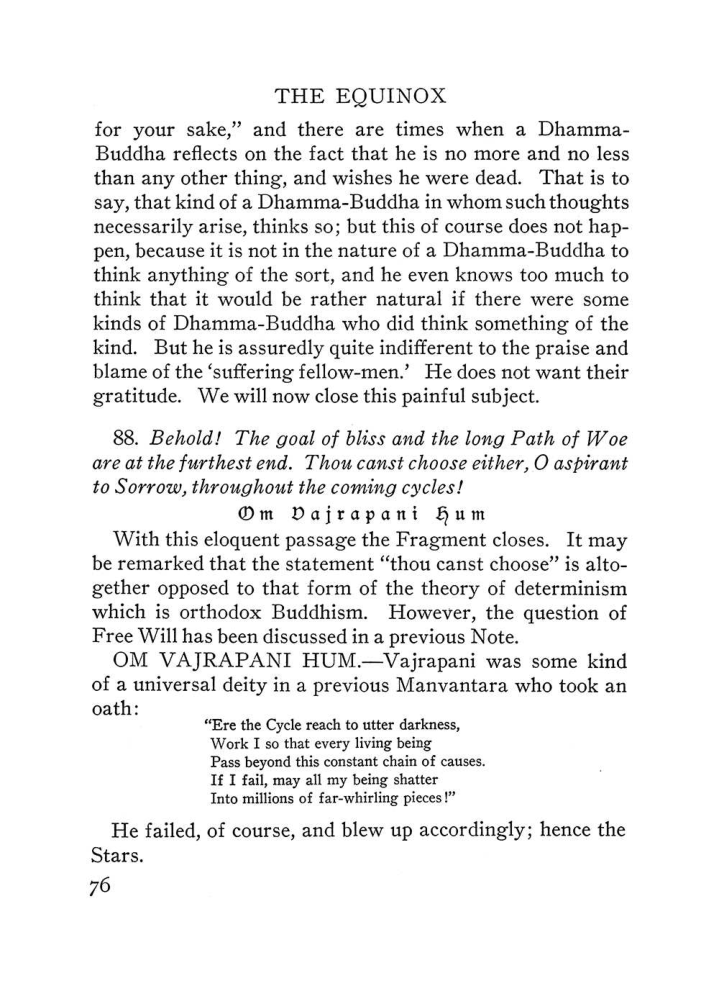
Highlights use the original PDF text layer. OCR-only matches may not be visible on the scan.
Transcription
Download text ↓raw extractionoriginal embedded textReview: unreviewed
THE EQUINOX
for your sake,” and there are times when a Dhamma-
Buddha reflects on the fact that he is no more and no less
than any other thing, and wishes he were dead. That is to
say, that kind of a Dhnamma-Buddha in whom such thoughts
necessarily arise, thinks so; but this of course does not hap-
pen, because it is not in the nature of a Dhamma-Buddha to
think anything of the sort, and he even knows too much to
think that it would be rather natural if there were some
kinds of Dhamma-Buddha who did think something of the
kind. But he is assuredly quite indifferent to the praise and
blame of the ‘suffering fellow-men.’ He does not want their
gratitude. We will now close this painful subject.
88. Behold! The goal of bliss and the long Path of Woe
are at the furthest end. Thou canst choose either, O aspirant
to Sorrow, throughout the coming cycles!
Om Dajrapani Hum
With this eloquent passage the Fragment closes. It may
be remarked that the statement “thou canst choose” is alto-
gether opposed to that form of the theory of determinism
which is orthodox Buddhism. However, the question of
Free Will has been discussed in a previous Note.
OM VAJRAPANI HUM.—Vajrapani was some kind
of a universal deity in a previous Manvantara who took an
oath:
“Ere the Cycle reach to utter darkness,
Work I so that every living being
Pass beyond this constant chain of causes.
If I fail, may all my being shatter
Into millions of far-whirling pieces
Y
He failed, of course, and blew up accordingly; hence the
Stars.
76
Page provenance & review flags
Stable page ID: 053f3d738822ceadcedffd98:p00398
Line breaks are preserved. Reading order and OCR accuracy may need review.
Printed page label has not been verified.
- No automated review flags. This does not establish transcription accuracy.