1913 · CLOSE READING
The Equinox (Volume I, Number X)
The Equinox (Volume I, Number X) (1913), PDF p. 305
Original page
Enlarge ↗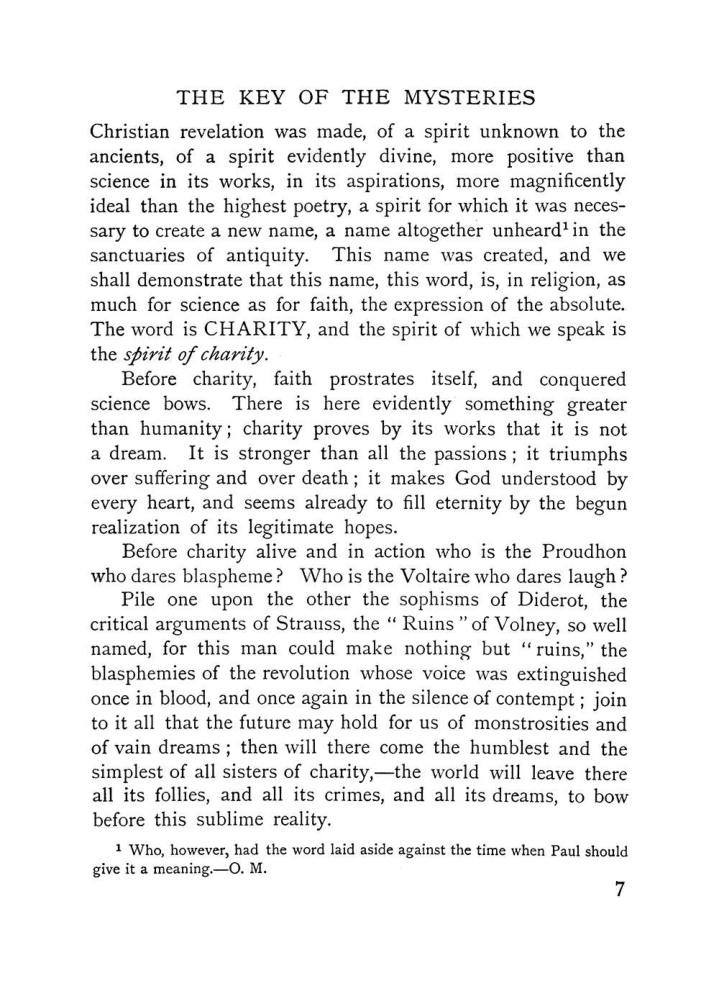
Highlights use the original PDF text layer. OCR-only matches may not be visible on the scan.
Transcription
Download text ↓raw extractionoriginal embedded textReview: unreviewed
THE KEY OF THE MYSTERIES
Christian revelation was made, of a spirit unknown to the
ancients, of a spirit evidently divine, more positive than
science in its works, in its aspirations, more magnificently
ideal than the highest poetry, a spirit for which it was neces-
sary to create a new name, a name altogether unheard*in the
sanctuaries of antiquity. This name was created, and we
shall demonstrate that this name, this word, is, in religion, as
much for science as for faith, the expression of the absolute.
The word is CHARITY, and the spirit of which we speak is
the spirit of charity.
Before charity, faith prostrates itself, and conquered
science bows. There is here evidently something greater
than humanity; charity proves by its works that it is not
a dream. It is stronger than all the passions; it triumphs
over suffering and over death; it makes God understood by
every heart, and seems already to fill eternity by the begun
realization of its legitimate hopes.
Before charity alive and in action who is the Proudhon
who dares blaspheme? Who is the Voltaire who dares laugh?
Pile one upon the other the sophisms of Diderot, the
critical arguments of Strauss, the “ Ruins” of Volney, so well
named, for this man could make nothing but “ruins,” the
blasphemies of the revolution whose voice was extinguished
once in blood, and once again in the silence of contempt; join
to it all that the future may hold for us of monstrosities and
of vain dreams; then will there come the humblest and the
simplest of all sisters of charity,—the world will leave there
all its follies, and all its crimes, and all its dreams, to bow
before this sublime reality.
1 Who, however, had the word laid aside against the time when Paul should
give it a meaning.—O. M.
7
Page provenance & review flags
Stable page ID: 055db0b9f9f14b4b534ea050:p00305
Line breaks are preserved. Reading order and OCR accuracy may need review.
Printed page label has not been verified.
- No automated review flags. This does not establish transcription accuracy.