1913 · CLOSE READING
The Equinox (Volume I, Number X)
The Equinox (Volume I, Number X) (1913), PDF p. 428
Original page
Enlarge ↗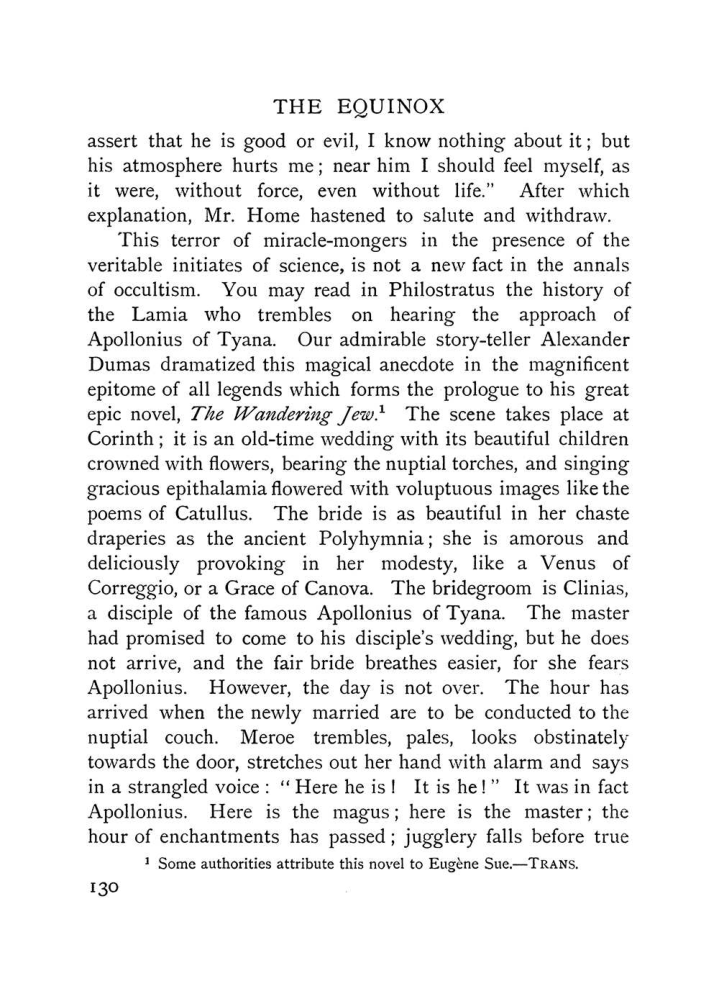
Highlights use the original PDF text layer. OCR-only matches may not be visible on the scan.
Transcription
Download text ↓raw extractionoriginal embedded textReview: unreviewed
THE EQUINOX
assert that he is good or evil, I know nothing about it; but
his atmosphere hurts me; near him I should feel myself, as
it were, without force, even without life.” After which
explanation, Mr. Home hastened to salute and withdraw.
This terror of miracle-mongers in the presence of the
veritable initiates of science, is not a new fact in the annals
of occultism. You may read in Philostratus the history of
the Lamia who trembles on hearing the approach of
Apollonius of Tyana. Our admirable story-teller Alexander
Dumas dramatized this magical anecdote in the magnificent
epitome of all legends which forms the prologue to his great
epic novel, The Wandering Jew.‘ The scene takes place at
Corinth; it is an old-time wedding with its beautiful children
crowned with flowers, bearing the nuptial torches, and singing
gracious epithalamia flowered with voluptuous images like the
poems of Catullus. The bride is as beautiful in her chaste
draperies as the ancient Polyhymnia; she is amorous and
deliciously provoking in her modesty, like a Venus of
Correggio, or a Grace of Canova. The bridegroom is Clinias,
a disciple of the famous Apollonius of Tyana. The master
had promised to come to his disciple’s wedding, but he does
not arrive, and the fair bride breathes easier, for she fears
Apollonius. However, the day is not over. The hour has
arrived when the newly married are to be conducted to the
nuptial couch. Meroe trembles, pales, looks obstinately
towards the door, stretches out her hand with alarm and says
in a strangled voice: “Here he is! It is he!” It was in fact
Apollonius. Here is the magus; here is the master; the
hour of enchantments has passed; jugglery falls before true
1 Some authorities attribute this novel to Eugtne Sue—TRANS.
130
Page provenance & review flags
Stable page ID: 055db0b9f9f14b4b534ea050:p00428
Line breaks are preserved. Reading order and OCR accuracy may need review.
Printed page label has not been verified.
- No automated review flags. This does not establish transcription accuracy.