1913 · CLOSE READING
The Equinox (Volume I, Number X)
The Equinox (Volume I, Number X) (1913), PDF p. 548
Original page
Enlarge ↗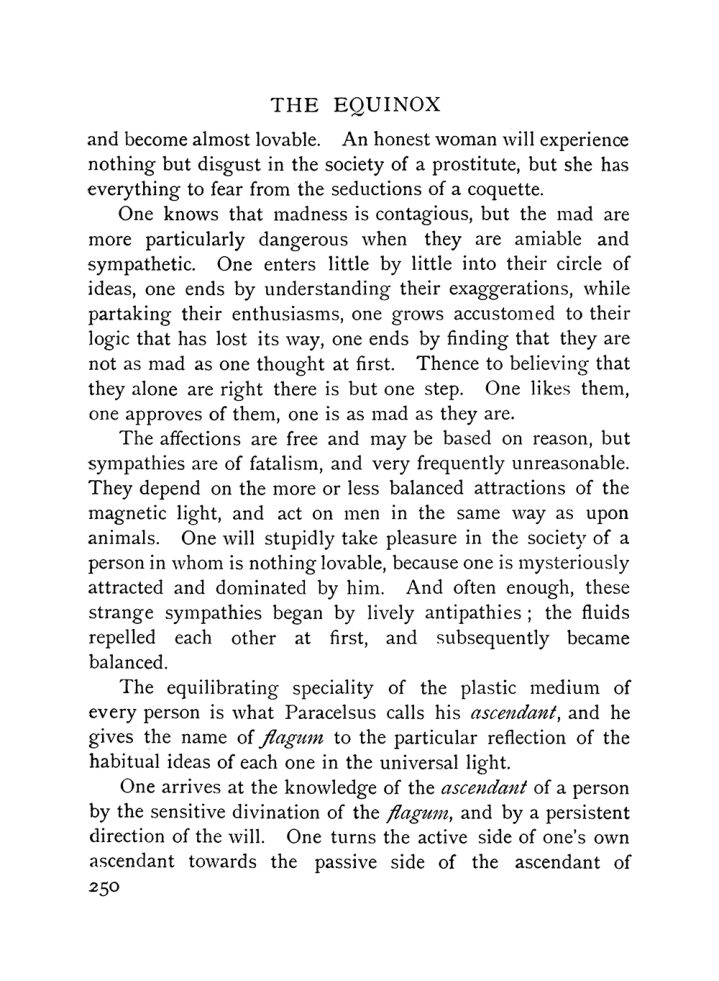
Highlights use the original PDF text layer. OCR-only matches may not be visible on the scan.
Transcription
Download text ↓raw extractionoriginal embedded textReview: unreviewed
THE EQUINOX
and become almost lovable. An honest woman will experience
nothing but disgust in the society of a prostitute, but she has
everything to fear from the seductions of a coquette.
One knows that madness is contagious, but the mad are
more particularly dangerous when they are amiable and
sympathetic. One enters little by little into their circle of
ideas, one ends by understanding their exaggerations, while
partaking their enthusiasms, one grows accustomed to their
logic that has lost its way, one ends by finding that they are
not as mad as one thought at first. Thence to believing that
they alone are right there is but one step. One likes them,
one approves of them, one is as mad as they are.
The affections are free and may be based on reason, but
sympathies are of fatalism, and very frequently unreasonable.
They depend on the more or less balanced attractions of the
magnetic light, and act on men in the same way as upon
animals. One will stupidly take pleasure in the society of a
person in whom is nothing lovable, because one is mysteriously
attracted and dominated by him. And often enough, these
strange sympathies began by lively antipathies; the fluids
repelled each other at first, and subsequently became
balanced.
The equilibrating speciality of the plastic medium of
every person is what Paracelsus calls his ascendant, and he
gives the name of fagum to the particular reflection of the
habitual ideas of each one in the universal light.
One arrives at the knowledge of the ascendant of a person
by the sensitive divination of the fagum, and by a persistent
direction of the will. One turns the active side of one’s own
ascendant towards the passive side of the ascendant of
250
Page provenance & review flags
Stable page ID: 055db0b9f9f14b4b534ea050:p00548
Line breaks are preserved. Reading order and OCR accuracy may need review.
Printed page label has not been verified.
- No automated review flags. This does not establish transcription accuracy.