1913 · CLOSE READING
The Equinox (Volume I, Number X)
The Equinox (Volume I, Number X) (1913), PDF p. 554
Original page
Enlarge ↗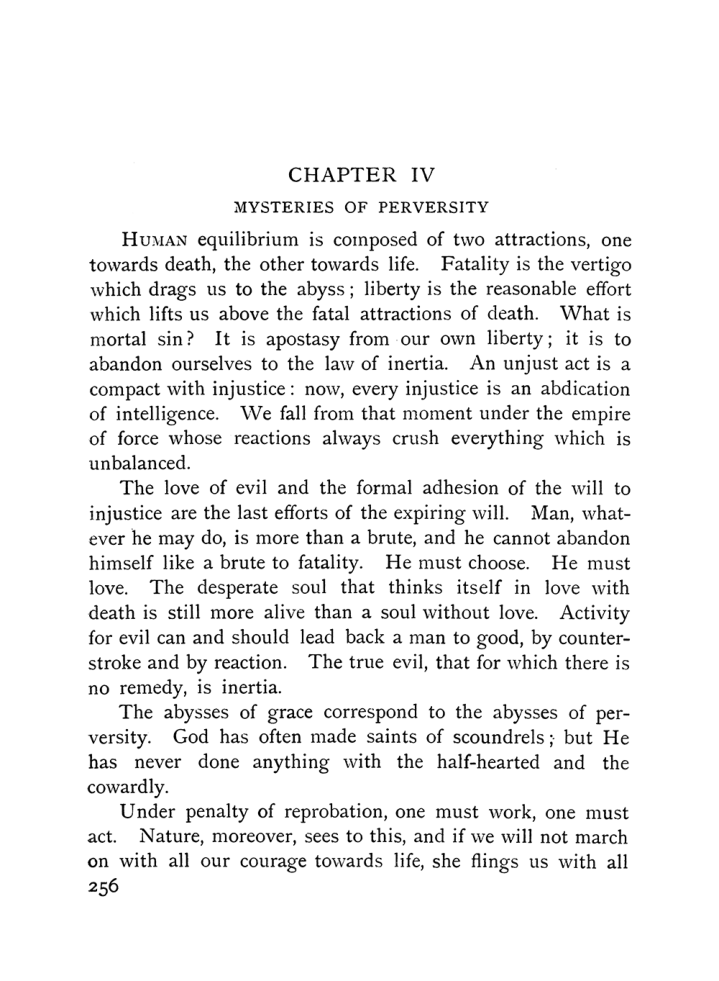
Highlights use the original PDF text layer. OCR-only matches may not be visible on the scan.
Transcription
Download text ↓raw extractionoriginal embedded textReview: unreviewed
CHAPTER IV
MYSTERIES OF PERVERSITY
Human equilibrium is composed of two attractions, one
towards death, the other towards life. Fatality is the vertigo
which drags us to the abyss; liberty is the reasonable effort
which lifts us above the fatal attractions of death. What is
mortal sin? It is apostasy from our own liberty; it is to
abandon ourselves to the law of inertia. An unjust act is a
compact with injustice: now, every injustice is an abdication
of intelligence. We fall from that moment under the empire
of force whose reactions always crush everything which is
unbalanced.
The love of evil and the formal adhesion of the will to
injustice are the last efforts of the expiring will. Man, what-
ever he may do, is more than a brute, and he cannot abandon
himself like a brute to fatality. He must choose. He must
love. The desperate soul that thinks itself in love with
death is still more alive than a soul without love. Activity
for evil can and should lead back a man to good, by counter-
stroke and by reaction. The true evil, that for which there is
no remedy, is inertia.
The abysses of grace correspond to the abysses of per-
versity. God has often made saints of scoundrels; but He
has never done anything with the half-hearted and the
cowardly.
Under penalty of reprobation, one must work, one must
act. Nature, moreover, sees to this, and if we will not march
on with all our courage towards life, she flings us with all
256
Page provenance & review flags
Stable page ID: 055db0b9f9f14b4b534ea050:p00554
Line breaks are preserved. Reading order and OCR accuracy may need review.
Printed page label has not been verified.
- No automated review flags. This does not establish transcription accuracy.