1907 · CLOSE READING
Konx Om Pax
Konx Om Pax (1907), PDF p. 136
Original page
Enlarge ↗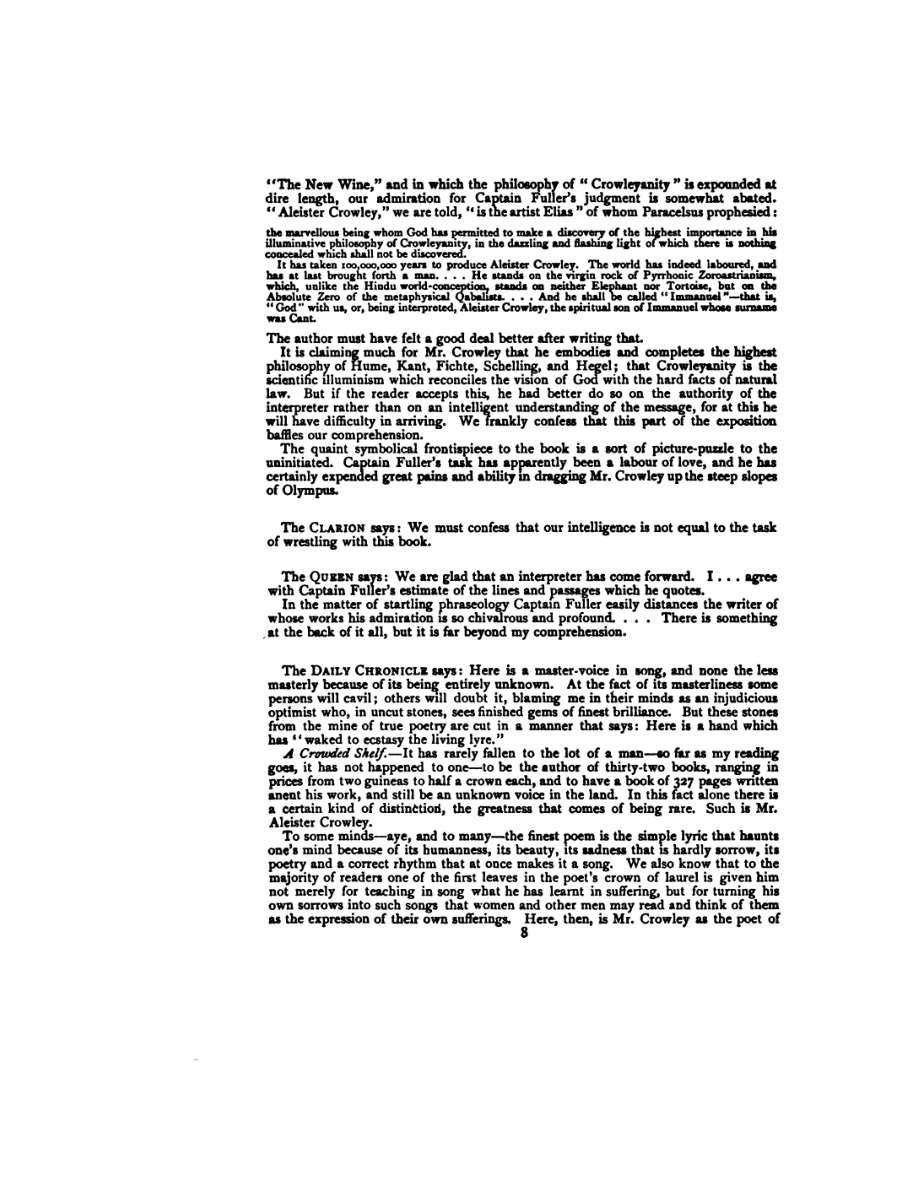
Highlights use the original PDF text layer. OCR-only matches may not be visible on the scan.
Transcription
Download text ↓raw extractionoriginal embedded textReview: unreviewed
“The New Wine," and in which
the philosophy
of “ Crowleyanity
” is expounded
at
dire
length,
our
admiration
for
Ca
tain
Fuller’s
judgment
is somewhat
abated.
“ Aleister
Crowley," we are told, “ ist
e artist Elias ” of whom Paracelsus prophesied:
the marvellous being whom God has permitted to make
a discovery of the hi
hest
im
rtnnce
in his
illuminative
philosophy of Crowleyanit
, in the dazzling and flashing light
0 which
t
ere
is nothing
concealed which shall not be discovereJ
It has taken
100,000,000 years to produce Aleister Crowley.
The world
has
indeed laboured, and
has
at
last
brought forth
a
man.
. . . He stands on
the virgin
rock of Pyrrhonic
Zoroastrianism,
which,
unlike
the
Hindu
world-conce
tion,
stands on
neither Ele hnnt nor Tortoise,
but
on
the
Absolute
Zero of the
metaphysical
abaltsts.
.
. . And
he shall
called “lmmanuel"—that
is,
“
Gog;
with us, or, being
interpreted, Aleister Crowley,
the spiritual
son of Immanuel whose surname
was
nt.
The author must have felt
a
good deal better after writing that.
It
is
claiming
much for Mr. Crowley
that he embodies
and completes
the highest
philosofiphy
of Hume,
Kant, Fichte, Schelling,
and Hegel;
that Crowleyanity
is
the
scienti
c
illuminism
which reconciles the vision of God with the hard facts of natural
law.
But
if
the reader
accepts this,
he had better
do
so on
the
authority
of the
interpreter
rather
than on an intelligent
understanding of the message,
for at this he
will have difficulty
in arriving.
We frankly
confess that this
part of the exposition
bafiies our comprehension.
The quaint
symbolical
frontispiece
to the book
is
a
sort of picture-puzzle
to the
uninitiated.
Ca
tain Fuller's task has apparently
been
a
labour of love, and he has
certainly
expen
ed great pains and ability in dragging Mr. Crowley up the steep slopes
of Olympus.
The CLARION says: We must confess
that our intelligence
is
not equal to the task
of wrestling
with this book.
The QUEEN says: We are glad that an interpreter
has come forward.
I
.
.
.
agree
with Captain
Fuller's estimate of the lines and passages which he quotes.
In the matter of startling
phraseology
Captain
Fuller easily distances
the writer of
whose works his admiration
15 so chivalrous and profound.
.
.
.
There
is
something
at the back of
it
all, but
it
is
far beyond my comprehension.
The DAILY CHRONICLE says:
Here
is
a
master-voice
in
song, and none the less
masterly because
of its being
entirely unknown.
At the fact of its masterliness
some
persons will cavil; others will
doubt
it, blaming
me in their minds
as an injudicious
optimist
who, in uncut stones, sees finished gems of finest brilliance.
But these stones
from
the
mine of true poetry are cut
in
a
manner
that says:
Here
is
a
hand which
has “ waked to ecstasy
the living lyre."
.4 Crowded Shelf —It has
rarely fallen
to the lot of
a
man—so
far as my reading
goes,
it
has
not happened
to one—to
be
the author
of thirty-two
books, ranging
in
prices from two guineas to half
a
crown each, and to have
a
book of 327
pages
written
anent his work, and still be an unknown
voice in the land.
In this fact alone there
is
a certain kind of distinction,
the greatness that
comes
of being
rare.
Such
is
Mr.
Aleister Crowley.
To some minds—aye,
and to many—the
finest poem
is
the simple lyric that haunts
one’s mind because
of its humanness, its beauty, its sadness
that
is
hardly sorrow,
its
poetry and
a
correct rhythm that at once
makes
it
a
song.
We also know that to the
majority
of readers one of the first leaves in the poet’s crown
of laurel
is
given him
not merely
for teaching
in song what he has learnt
in suffering, but
for turning
his
own sorrows into such songs that women and other men may read and think of them
as the expression of their own sufferings.
8Here,
then,
is
Mr. Crowley as the poet of
.._ ___
_
Page provenance & review flags
Stable page ID: 165c7e000028a0d54b2671b6:p00136
Line breaks are preserved. Reading order and OCR accuracy may need review.
Printed page label has not been verified.
- No automated review flags. This does not establish transcription accuracy.