1912 · CLOSE READING
The Equinox (Volume I, Number VIII)
The Equinox (Volume I, Number VIII) (1912), PDF p. 426
Original page
Enlarge ↗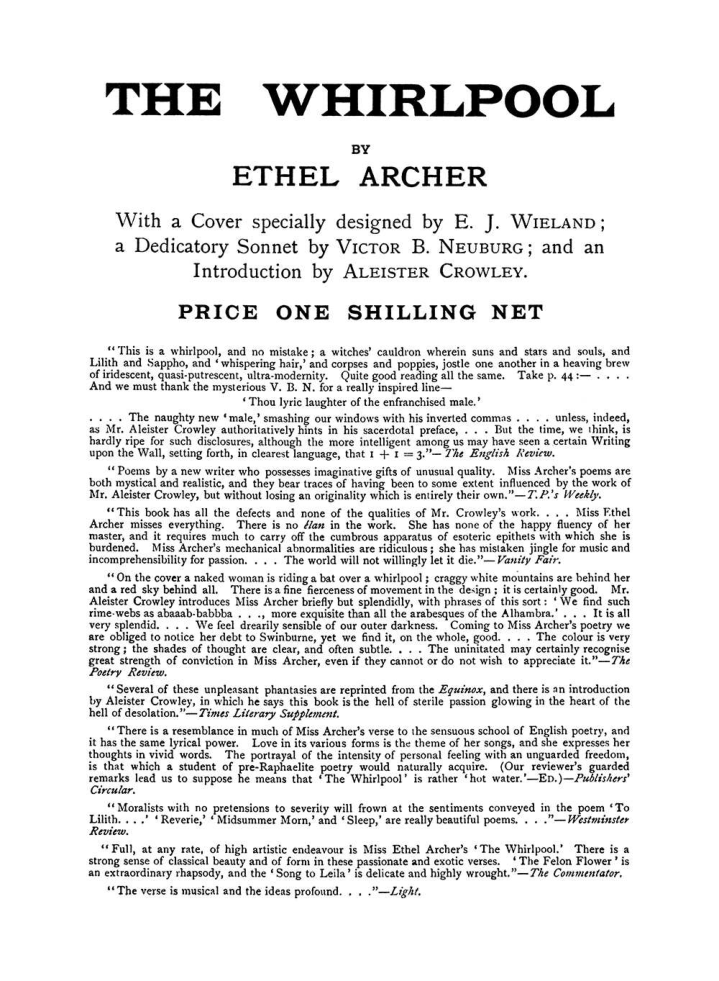
Highlights use the original PDF text layer. OCR-only matches may not be visible on the scan.
Transcription
Download text ↓raw extractionoriginal embedded textReview: unreviewed
THE WHIRLPOOL
BY
ETHEL ARCHER
With a Cover specially designed by E. J. WrELAND;
a Dedicatory Sonnet by Vicror B. NEusurG; and an
Introduction by ALEISTER CROWLEY.
PRICE ONE SHILLING NET
_ {This is a whirlpool, and no mistake; a witches’ cauldron wherein suns and stars and souls, and
Lilith and Sappho, and ‘whispering hair,’ and corpses and poppies, jostle one another in a heaving brew
ofiridescent, quasi-putrescent, ultra-modemity. Quite good reading all the same, Take p. 44:— - « « «
And we must thank the mysterious V. B. N. for a really inspired line—
“Thou lyric laughter of the enfranchised male.’
++... The naughty new ‘male,’ smashing our windows with his inverted commas . . . . unless, indeed,
as Mr. Aleister Crowley authoritatively hints in his sacerdotal preface, . . . But the time, we think, is
hardly ripe for such disclosures, although the more intelligent among us may have seen a certain Writing
upon the Wall, setting forth, in clearest language, that 1 -+ 1 = 3.”— The English Review.
“Poems by a new writer who possesses imaginative gifts of unusual quality. Miss Archer's poems are
both mystical and realistic, and they bear traces of having been to some extent influenced by the work of
Mr, Aleister Crowley, but without losing an originality which is entirely their own.” —7.P.’s Weekly.
“This book has all the defects and none of the qualities of Mr. Crowley’s work. . .. Miss Fthel
Archer misses everything. There is no an in the work. She has none of the happy fluency of her
master, and it requires much to carry off the cumbrous apparatus of esoteric epithets with which she is
burdened. Miss Archer's mechanical abnormalities are ridiculous; she has mistaken jingle for music and
incomprehensibility for passion. . . . The world will not willingly let it die.”— Vanity Fair.
“On the cover a naked woman is riding a bat over a whirlpool ; craggy white mountains are behind her
and a red sky behind all. There isa fine fierceness of movement in the design ; itis certainly good. Mr.
Aleister Crowley introduces Miss Archer briefly but splendidly, with phrases of this sort: ‘We find such
rime-webs
as abaaab-babbba . . ., more exquisite than all the arabesques of the Alhambra.’ . . . It is all
wery splendid. . - . We feel dveatily sensible of our outer darkness. "Coming to Miss Archer's poetry we
are obliged to notice her debt to Swinburne, yet we find it, on the whole, good. . . . The colour is very
strong; the shades of thought are clear, and often subtle. . . . The uninitated may certainly recognise
Qreat strength of conviction in Miss Archer, even if they cannot or do not wish to appreciate it.”—The
Poetry Review,
“Several of these unpleasant phantasies are reprinted from the Zguinox, and there is an introduction
by Aleister Crowley, in which he says this book is the hell of sterile passion glowing in the heart of the
hell of desolation.”— Times Literary Supplement.
“There is a resemblance in much of Miss Archer's verse to the sensuous school of English poetry, and
it has the same lyrical power. Love in its various forms is the theme of her songs, and she expresses her
thoughts in vivid words. The portrayal of the intensity of personal feeling with an unguarded freedom,
is that which a student of pre-Raphaelite poetry would naturally acquire. (Our reviewer's guarded
remarks lead us to suppose he means that ‘The Whirlpool’ is rather “hot water"—Ep.)—Publisher?
ircular.
1! Moralists with no pretensions to severity will frown at the sentiments conveyed in the poem ‘To
Lilith. . . .’ ‘Reverie,’ ‘Midsummer Morn,’ and ‘Sleep,’ are really beautiful poems. . . .”—Westminster
Review.
“Full, at any rate, of high artistic endeavour is Miss Ethel Archer’s ‘The Whirlpool.” There is a
strong sense of classical beauty and of form in these passionate and exotic verses. ‘The Felon Flower’ is
an extraordinary rhapsody, and the ‘Song to Leila’ is delicate and highly wrought.” —7he Commentator.
“The verse is musical and the ideas profound. . . "Light,
Page provenance & review flags
Stable page ID: 17147a1b5fe1cf0542bb4542:p00426
Line breaks are preserved. Reading order and OCR accuracy may need review.
Printed page label has not been verified.
- No automated review flags. This does not establish transcription accuracy.