1907 · CLOSE READING
Collected Works (Vol. III)
Collected Works (Vol. III) (1907), PDF p. 230
Original page
Enlarge ↗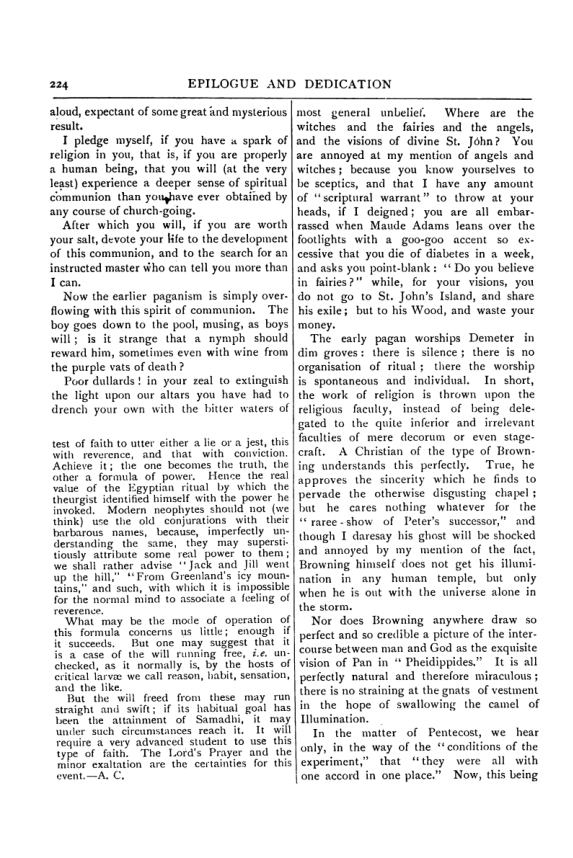
Highlights use the original PDF text layer. OCR-only matches may not be visible on the scan.
Transcription
Download text ↓raw extractionoriginal embedded textReview: unreviewed
224
EPILOGUE AND DEDICATION
aloud, expectant of some great and mysterious
result.
I pledge myself, if you have a spark of
religion in you, that is, if you are properly
a human being, that you will (at the very
least) experience a deeper sense of spiritual
communion than youghave ever obtained by
any course of church-going.
After which you will, if you are worth
your salt, devote your life to the development
of this communion, and to the search for an
instructed master who can tell you more than
I can.
Now the earlier paganism is simply over-
flowing with this spirit of communion. The
boy goes down to the pool, musing, as boys
will; is it strange that a nymph should
reward him, sometimes even with wine from
the purple vats of death?
Poor dullards! in your zeal to extinguish
the light upon our altars you have had to
drench your own with the bitter waters of
test of faith to utter either a lie or a jest, this
with reverence, and that with conviction,
Achieve it; the one becomes the truth, the
other a formula of power. Hence the real
value of the Egyptian ritual by which the
theurgist identified himself with the power he
invoked. Modern neophytes should not (we
think) use the old conjurations with their
barbarous names, because, imperfectly un-
derstanding the same, they may supersti-
tiously attribute some real power to them;
we shall rather advise ‘‘ Jack and Jill went
up the hill,” ‘‘From Greenland's icy moun-
tains,’ and such, with which it is impossible
for the normal mind to associate a feeling of
reverence.
What may be the mode of operation of
this formula concerns us little; enough if
it succeeds. But one may suggest that it
is a case of the will running free, z.e. un-
checked, as it normally is, by the hosts of
critical larvae we call reason, habit, sensation,
and the like.
But the will freed from these may run
straight and swift; if its habitual goal has
been the attainment of Samadhi, it may
under such circumstances reach it. It will
require a very advanced student to use this
type of faith. The Lord's Prayer and the
minor exaltation are the certainties for this
event.—A, C.
most general unbelief. Where are the
witches and the fairies and the angels,
and the visions of divine St. John? You
are annoyed at my mention of angels and
witches; because you know yourselves to
be sceptics, and that I have any amount
of ‘‘scriptural warrant” to throw at your
heads, if I deigned; you are all embar-
rassed when Maude Adams Jeans over the
footlights with a goo-goo accent so ex-
cessive that you die of diabetes in a week,
and asks you point-blank: ‘‘ Do you believe
in fairies?’’ while, for your visions, you
do not go to St. John’s Island, and share
his exile; but to his Wood, and waste your
money.
The early pagan worships Demeter in
dim groves: there is silence; there is no
organisation of ritual; there the worship
is spontaneous and individual. In short,
the work of religion is thrown upon the
religious faculty, instead of being dele-
gated to the quite inferior and irrelevant
faculties of mere decorum or even stage-
craft. A Christian of the type of Brown-
ing understands this perfectly, True, he
approves the sincerity which he finds to
pervade the otherwise disgusting chapel;
but he cares nothing whatever for the
‘Sraree-show of Peter’s successor,” and
though I daresay his ghost will be shocked
and annoyed by my mention of the fact,
Browning himself does not get his illumi-
nation in any human temple, but only
when he is out with the universe alone in
the storm.
Nor does Browning anywhere draw so
perfect and so credible a picture of the inter-
course between man and God as the exquisite
vision of Pan in ‘* Pheidippides.” It is all
perfectly natural and therefore miraculous;
there is no straining at the gnats of vestment
in the hope of swallowing the camel of
Illumination.
In the matter of Pentecost, we hear
only, in the way of the ‘conditions of the
experiment,” that ‘‘they were all with
one accord in one place.” Now, this being
Page provenance & review flags
Stable page ID: 213a7871095c12b173519869:p00230
Line breaks are preserved. Reading order and OCR accuracy may need review.
Printed page label has not been verified.
- No automated review flags. This does not establish transcription accuracy.