1907 · CLOSE READING
Collected Works (Vol. III)
Collected Works (Vol. III) (1907), PDF p. 231
Original page
Enlarge ↗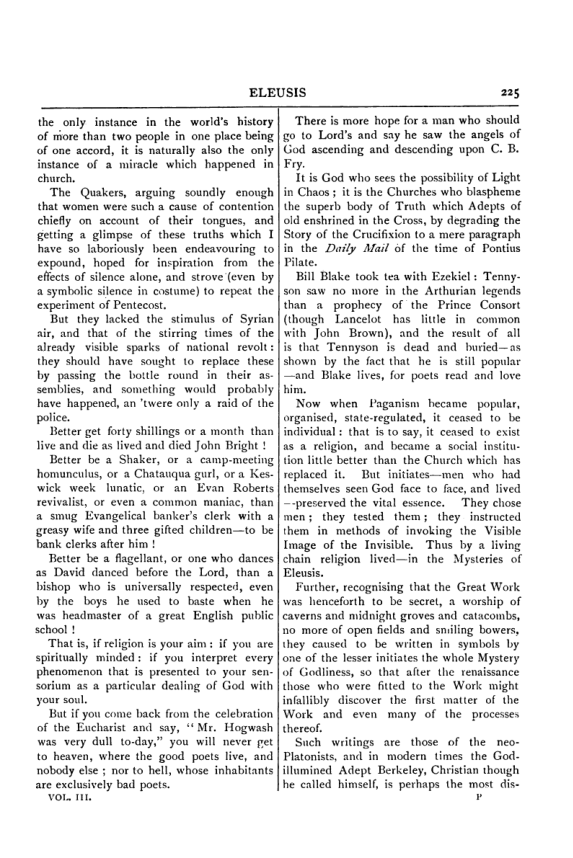
Highlights use the original PDF text layer. OCR-only matches may not be visible on the scan.
Transcription
Download text ↓raw extractionoriginal embedded textReview: unreviewed
ELEUSIS
225
the only instance in the world’s history
of more than two people in one place being
of one accord, it is naturally also the only
instance of a miracle which happened in
church.
The Quakers, arguing soundly enough
that women were such a cause of contention
chiefly on account of their tongues, and
getting a glimpse of these truths which I
have so laboriously been endeavouring to
expound, hoped for inspiration from the
effects of silence alone, and strove (even by
a symbolic silence in costume) to repeat the
experiment of Pentecost.
But they lacked the stimulus of Syrian
air, and that of the stirring times of the
already visible sparks of national revolt:
they should have sought to replace these
by passing the bottle round in their as-
semblies, and something would probably
have happened, an ’twere only a raid of the
police.
Better get forty shillings or a month than
live and die as lived and died John Bright !
Better be a Shaker, or a camp-meeting
homunculus, or a Chatauqua gurl, or a Kes-
wick week lunatic, or an Evan Roberts
revivalist, or even a common maniac, than
a smug Evangelical banker’s clerk with a
greasy wife and three gifted children—to be
bank clerks after him !
Better be a flagellant, or one who dances
as David danced before the Lord, than a
bishop who is universally respected, even
by the boys he used to baste when he
was headmaster of a great English public
school !
That is, if religion is your aim: if you are
spiritually minded: if you interpret every
phenomenon that is presented to your sen-
sorium as a particular dealing of God with
your soul.
But if you come back from the celebration
of the Eucharist and say, ‘‘ Mr. Hogwash
was very dull to-day,” you will never get
to heaven, where the good poets live, and
nobody else ; nor to hell, whose inhabitants
are exclusively bad poets.
There is more hope for a man who should
go to Lord’s and say he saw the angels of
God ascending and descending upon C. B.
Fry.
It is God who sees the possibility of Light
in Chaos ; it is the Churches who blaspheme
the superb body of Truth which Adepts of
old enshrined in the Cross, by degrading the
Story of the Crucifixion to a mere paragraph
in the Dazly Afail of the time of Pontius
Pilate.
Bill Blake took tea with Ezekiel: Tenny-
son saw no more in the Arthurian legends
than a prophecy of the Prince Consort
(though Lancelot has little in common
with John Brown), and the result of all
is that Tennyson is dead and buried—as
shown by the fact that he is still popular
—and Blake lives, for poets read and love
him.
Now when Paganism hecame_ popular,
organised, state-regulated, it ceased to be
individual: that is to say, it ceased to exist
as a religion, and became a social institu-
tion little better than the Church which has
replaced it. But initiates—men who had
themselves seen God face to face, and lived
—-preserved the vital essence. They chose
men; they tested them; they. instructed
them in methods of invoking the Visible
Image of the Invisible. Thus by a living
chain religion lived—in the Mysteries of
Eleusis.
Further, recognising that the Great Work
was henceforth to be secret, a worship of
caverns and midnight groves and catacombs,
no more of open fields and smiling bowers,
they caused to be written in symbols by
one of the lesser initiates the whole Mystery
of Godliness, so that after the renaissance
those who were fitted to the Work might
infallibly discover the first matter of the
Work and even many of the processes
thereof.
Such writings are those of the neo-
Platonists, and in modern times the God-
illumined Adept Berkeley, Christian though
he called himself, is perhaps the most dis-
P
Page provenance & review flags
Stable page ID: 213a7871095c12b173519869:p00231
Line breaks are preserved. Reading order and OCR accuracy may need review.
Printed page label has not been verified.
- No automated review flags. This does not establish transcription accuracy.