1899 · CLOSE READING
Jephthah and Other Mysteries
Jephthah and Other Mysteries (1899), PDF p. 250
Original page
Enlarge ↗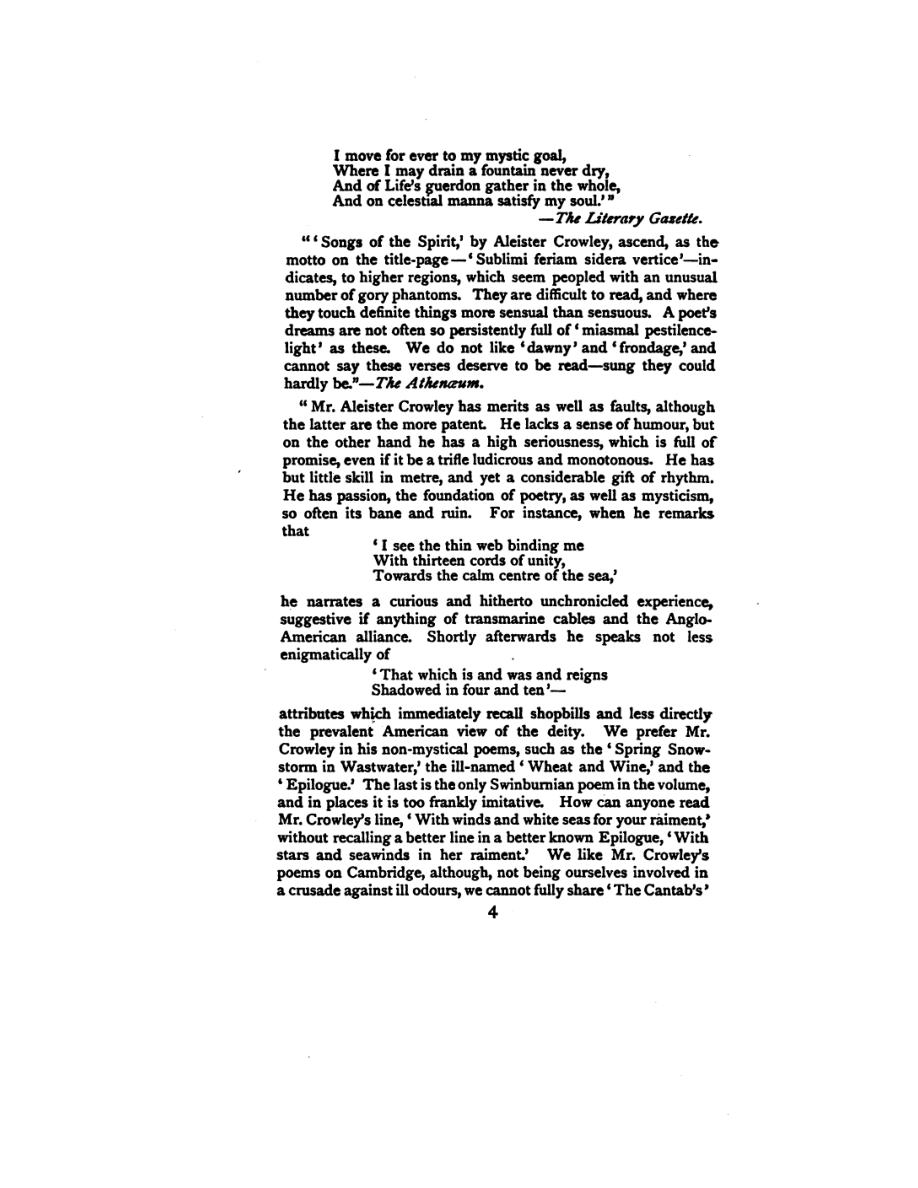
Highlights use the original PDF text layer. OCR-only matches may not be visible on the scan.
Transcription
Download text ↓raw extractionoriginal embedded textReview: unreviewed
I move for ever to my mystic goal,
Where I may drain a fountain never dry,
And of Life’s guerdon gather in the whole,
And on celestial manna satisfy my soul.’ ”
— The Literary Gasette.
““¢ Songs of the Spirit,’ by Aleister Crowley, ascend, as the
motto on the title-page
—‘ Sublimi feriam sidera vertice’—in-
dicates, to higher regions, which seem peopled with an unusual
number of gory phantoms. They are difficult to read, and where
they touch definite things more sensual than sensuous. A poet’s
dreams are not often so persistently full of ‘miasmal pestilence-
light’ as these. We do not like ‘dawny’ and ‘ frondage,’ and
cannot say these verses deserve to be read—sung they could
hardly be."— Zhe Athenzum.
“Mr. Aleister Crowley has merits as well as faults, although
the latter are the more patent. He lacks a sense of humour, but
on the other hand he has a high seriousness, which is full of
promise, even if it be a trifle ludicrous and monotonous. He has
but little skill in metre, and yet a considerable gift of rhythm.
He has passion, the foundation of poetry, as well as mysticism,
so often its bane and ruin. For instance, when he remarks
that
‘I see the thin web binding me
With thirteen cords of unity,
Towards the calm centre of the sea,’
he narrates a curious and hitherto unchronicled experience,
suggestive if anything of transmarine cables and the Anglo-
American alliance. Shortly afterwards he speaks not less
enigmatically of ,
‘That which is and was and reigns
Shadowed in four and ten’—
attributes which immediately recall shopbills and less directly
the prevalent American view of the deity. We prefer Mr.
Crowley in his non-mystical poems, such as the ‘ Spring Snow-
storm in Wastwater,’ the ill-named ‘ Wheat and Wine,’ and the
‘Epilogue.’ The last is the only Swinburnian poem in the volume,
and in places it is too frankly imitative. How can anyone read
Mr. Crowley’s line, ‘ With winds and white seas for your raiment,’
without recalling a better line in a better known Epilogue, ‘ With
stars and seawinds in her raiment.’ We like Mr. Crowley’s
poems on Cambridge, although, not being ourselves involved in
a crusade against ill odours, we cannot fully share ‘ The Cantab’s’
4 .
Page provenance & review flags
Stable page ID: 43d1fabda8a3193c0170817c:p00250
Line breaks are preserved. Reading order and OCR accuracy may need review.
Printed page label has not been verified.
- No automated review flags. This does not establish transcription accuracy.