1929 · CLOSE READING
The Stratagem and Other Stories
The Stratagem and Other Stories (1929), PDF p. 42
Original page
Enlarge ↗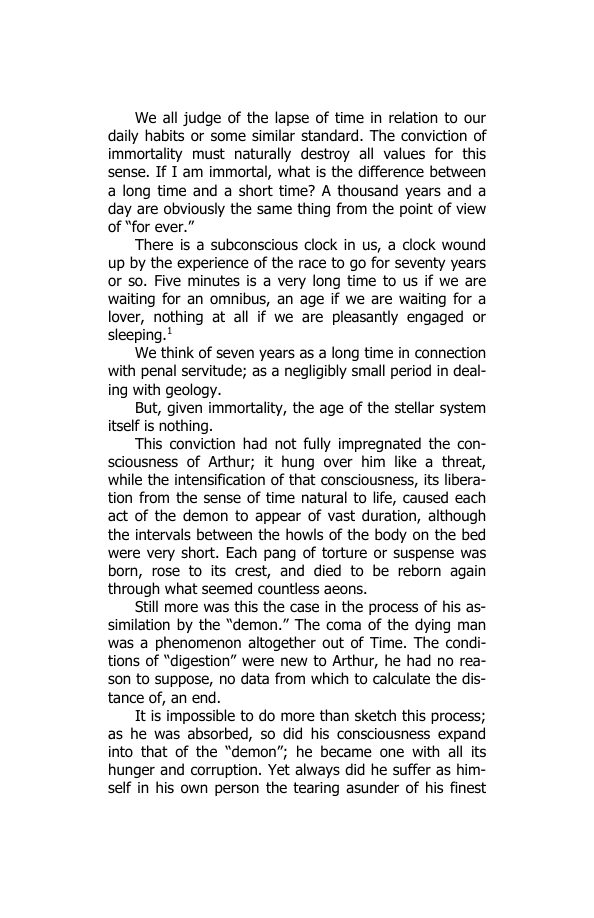
Highlights use the original PDF text layer. OCR-only matches may not be visible on the scan.
Transcription
Download text ↓raw extractionoriginal embedded textReview: unreviewed
We all judge of the lapse of time in relation to our
daily habits or some similar standard. The conviction of
immortality must naturally destroy all values for this
sense. If I am immortal, what is the difference between
a long time and a short time? A thousand years and a
day are obviously the same thing from the point of view
of for ever.
There is a subconscious clock in us, a clock wound
up by the experience of the race to go for seventy years
or so. Five minutes is a very long time to us if we are
waiting for an omnibus, an age if we are waiting for a
lover, nothing at all if we are pleasantly engaged or
sleeping.1
We think of seven years as a long time in connection
with penal servitude; as a negligibly small period in deal-
ing with geology.
But, given immortality, the age of the stellar system
itself is nothing.
This conviction had not fully impregnated the con-
sciousness of Arthur; it hung over him like a threat,
while the intensification of that consciousness, its libera-
tion from the sense of time natural to life, caused each
act of the demon to appear of vast duration, although
the intervals between the howls of the body on the bed
were very short. Each pang of torture or suspense was
born, rose to its crest, and died to be reborn again
through what seemed countless aeons.
Still more was this the case in the process of his as-
similation by the demon. The coma of the dying man
was a phenomenon altogether out of Time. The condi-
tions of digestion were new to Arthur, he had no rea-
son to suppose, no data from which to calculate the dis-
tance of, an end.
It is impossible to do more than sketch this process;
as he was absorbed, so did his consciousness expand
into that of the demon; he became one with all its
hunger and corruption. Yet always did he suffer as him-
self in his own person the tearing asunder of his finest
Page provenance & review flags
Stable page ID: 4489d2463a9a2bbdf4c01099:p00042
Line breaks are preserved. Reading order and OCR accuracy may need review.
Printed page label has not been verified.
- No automated review flags. This does not establish transcription accuracy.