1906 · CLOSE READING
Collected Works (Vol. II)
Collected Works (Vol. II) (1906), PDF p. 147
Original page
Enlarge ↗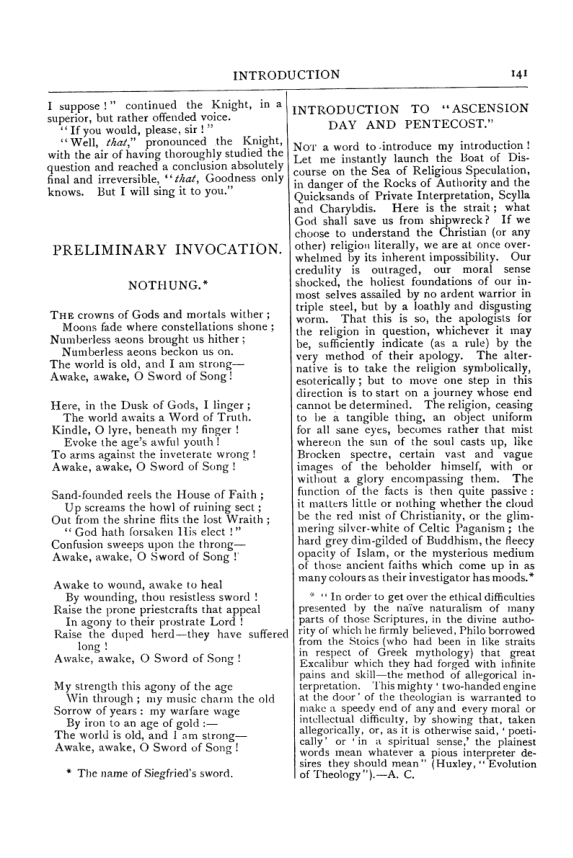
Highlights use the original PDF text layer. OCR-only matches may not be visible on the scan.
Transcription
Download text ↓raw extractionoriginal embedded textReview: unreviewed
INTRODUCTION
14!
I suppose!” continued the Knight, in a
superior, but rather offended voice.
‘“If you would, please, sir!”
‘Well, chat,” pronounced the Knight,
with the air of having thoroughly studied the
question and reached a conclusion absolutely
final and irreversible, ‘‘¢iat, Goodness only
knows. But I will sing it to you.”
PRELIMINARY INVOCATION.
NOTHUNG.*
THE crowns of Gods and mortals wither ;
Moons fade where constellations shone ;
Numberless aeons brought us hither ;
Niumberless aeons beckon us on.
The world is old, and I am strong—
Awake, awake, O Sword of Song!
Here, in the Dusk of Gods, I linger;
The world awaits a Word of Truth.
Kindle, O lyre, beneath my finger !
Evoke the age’s awful youth!
To arms against the inveterate wrong !
Awake, awake, O Sword of Song!
Sand-founded reels the House of Faith ;
Up screams the howl of ruining sect ;
Out from the shrine flits the lost Wraith ;
‘God hath forsaken Ilis elect !”
Confusion sweeps upon the throng—
Awake, awake, O Sword of Song !'
Awake to wound, awake to heal
By wounding, thou resistless sword !
Raise the prone priestcrafts that appeal
In agony to their prostrate Lord !
Raise the duped herd—they have suffered
long !
Awake, awake, O Sword of Song !
My strength this agony of the age
Win through ; my music charm the old
Sorrow of years: my warfare wage
By iron to an age of gold :—
The world is old, and I am strong—
Awake, awake, O Sword of Song !
* The name of Siegfried’s sword.
INTRODUCTION TO ‘! ASCENSION
DAY AND PENTECOST.”
Nor a word to-introduce my introduction!
Let me instantly launch the Boat of Dis-
course on the Sea of Religious Speculation,
in danger of the Rocks of Authority and the
Quicksands of Private Interpretation, Scylla
and Charybdis. Here is the strait; what
God shall save us from shipwreck? If we
choose to understand the Christian (or any
other) religion literally, we are at once over-
whelmed by its inherent impossibility. Our
credulity is outraged, our moral sense
shocked, the holiest foundations of our in-
most selves assailed by no ardent warrior in
triple steel, but by a loathly and disgusting
worm. That this is so, the apologists for
the religion in question, whichever it may
be, sufficiently indicate (as a rule) by the
very method of their apology. The alter-
native is to take the religion symbolically,
esoterically; but to move one step in this
direction is to start on a journey whose end
cannot be determined. The religion, ceasing
to be a tangible thing, an object uniform
for all sane eyes, becomes rather that mist
whereon the sun of the soul casts up, like
Brocken spectre, certain vast and vague
images of the beholder himself, with or
without a glory encompassing them. The
function of the facts is then quite passive:
it matters little or nothing whether the cloud
be the red mist of Christianity, or the glim-
mering silver-white of Celtic Paganism; the
hard grey dim-gilded of Buddhism, the fleecy
opacity of Islam, or the mysterious medium
of those ancient faiths which come up in as
many colours as their investigator has moods.*
“ «Tn order to get over the ethical difficulties
presented by the naive naturalism of many
parts of those Scriptures, in the divine autho-
rity of which he firmly believed, Philo borrowed
from the Stoics (who had been in like straits
in respect of Greek mythology) that great
Excalibur which they had forged with infinite
pains and skill—the method of allegorical in-
terpretation. ‘his mighty ‘ two-handed engine
at the door’ of the theologian is warranted to
make a speedy end of any and every moral or
intellectual difficulty, by showing that, taken
allegorically, or, as it is otherwise said, ‘ poeti-
cally’ or ‘in a spiritual sense,’ the plainest
words mean whatever a pious interpreter de-
sires they should mean” (Huxley, ‘‘ Evolution
of Theology ’’).—A. C.
Page provenance & review flags
Stable page ID: 59a930c2e614ddb0b1a2a000:p00147
Line breaks are preserved. Reading order and OCR accuracy may need review.
Printed page label has not been verified.
- No automated review flags. This does not establish transcription accuracy.