1906 · CLOSE READING
Collected Works (Vol. II)
Collected Works (Vol. II) (1906), PDF p. 200
Original page
Enlarge ↗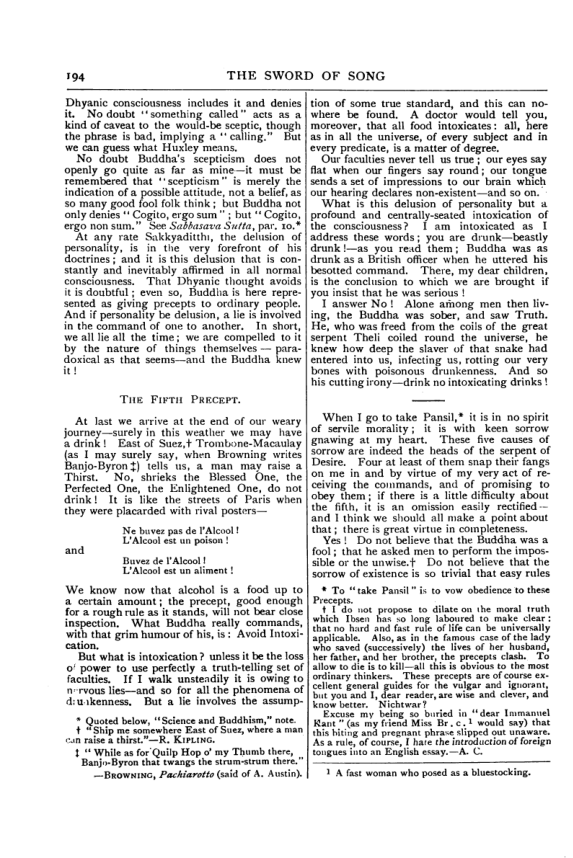
Highlights use the original PDF text layer. OCR-only matches may not be visible on the scan.
Transcription
Download text ↓raw extractionoriginal embedded textReview: unreviewed
194
THE SWORD OF SONG
Dhyanic consciousness includes it and denies
it. No doubt ‘‘something called” acts as a
kind of caveat to the would-be sceptic, though
the phrase is bad, implying a ‘‘ calling.” But
we can guess what Huxley means,
No doubt Buddha's scepticism does not
openly go quite as far as mine—it must be
remembered that ‘‘scepticism” is merely the
indication of a possible attitude, not a belief, as
so many good fool folk think; but Buddha not
only denies ‘‘ Cogito, ergo sum"’ ; but ‘‘ Cogito,
ergo nonsum.” See Sadsasava Sutta, par. 10.*
At any rate Sakkyaditthi, the delusion of
personality, is in the very forefront of his
doctrines; and it is this delusion that is con-
stantly and inevitably affirmed in all normal
consciousness. That Dhyanic thought avoids
it is doubtful; even so, Buddha is here repre-
sented as giving precepts to ordinary people.
And if personality be delusion, a lie is involved
in the command of one to another. In short,
we all lie all the time; we are compelled to it
by the nature of things themselves
— para-
doxical as that seems—and the Buddha knew
it |
THE FIFTH PRECEPT.
At last we arrive at the end of our weary
journey—surely in this weather we may have
a drink! East of Suez,+ Trombone-Macaulay
(as I may surely say, when Browning writes
Banjo-Byron {) tells us, a man may raise a
Thirst. No, shrieks the Blessed One, the
Perfected One, the Enlightened One, do not
drink! It is like the streets of Paris when
they were placarded with rival posters—
Ne buvez pas de |’Alcool !
L’Alcool est un poison !
and
Buvez de |’Alcool !
L’Alcool est un aliment !
We know now that alcohol is a food up to
a certain amount; the precept, good enough
for a rough rule as it stands, will not bear close
inspection. What Buddha really commands,
with that grim humour of his, is: Avoid Intoxi-
cation.
But what is intoxication? unless it be the loss
o! power to use perfectly a truth-telling set of
faculties. If I walk unsteadily it is owing to
nervous lies—and so for all the phenomena of
d:u.ukenness, But a lie involves the assump-
* Quoted below, ‘‘Science and Buddhism,” note.
t “Ship me somewhere East of Suez, where a man
in raise a thirst.”—R. KIPLING.
t ‘* While as for Quilp Hop o’ my Thumb there,
Banjo-Byron that twangs the strum-strum there.
—Browninec, Pachiarotto (said of A. Austin).
tion of some true standard, and this can no-
where be found. A doctor would tell you,
moreover, that all food intoxicates: all, here
as in all the universe, of every subject and in
every predicate, is a matter of degree.
Our faculties never tell us true; our eyes say
flat when our fingers say round; our tongue
sends a set of impressions to our brain which
our hearing declares non-existent—and So on. -
What is this delusion of personality but a
profound and centrally-seated intoxication of
the consciousness? I am intoxicated as I
address these words; you are drunk—beastly
drunk !—as you read them; Buddha was as
drunk as a British officer when he uttered his
besotted command. There, my dear children,
is the conclusion to which we are brought if
you insist that he was serious !
I answer No! Alone among men then liv-
ing, the Buddha was sober, and saw Truth.
He, who was freed from the coils of the great
serpent Theli coiled round the universe, he
knew how deep the slaver of that snake had
entered into us, infecting us, rotting our very
bones with poisonous drunkenness. And so
his cutting irony—drink no intoxicating drinks !
When I go to take Pansil,* it is in no spirit
of servile morality; it is with keen sorrow
gnawing at my heart. ‘These five causes of
sorrow are indeed the heads of the serpent of
Desire. Four at least of them snap their fangs
on me in and by virtue of my very act of re-
ceiving the commands, and of promising to
obey them; if there is a little difficulty about
the fifth, it is an omission easily rectified
--
and I think we should all make a point about
that; there is great virtue in completeness.
Yes! Do not believe that the Buddha was a
fool; that he asked men to perform the impos-
sible or the unwise.t Do not believe that the
sorrow of existence is so trivial that easy rules
* To “take Pansil” is to vow obedience to these
Precepts. ;
t I do not propose to dilate on the moral truth
which Ibsen has so long laboured to make clear:
that no hard and fast rule of life can be universally
applicable. Also, as in the famous case of the lady
who saved (successively) the lives of her husband,
her father, and her brother, the precepts clash. To
allow to die is to kill—all this is obvious to the most
ordinary thinkers. These precepts are of course ex-
cellent general guides for the vulgar and ignorant,
but you and I, dear reader, are wise and clever, and
know better. Nichtwar?
Excuse my being so buried in ‘‘dear Immanuel
Rant ” (as my friend Miss Br.c.1 would say) that
this biting and pregnant phrase slipped out unaware.
As a rule, of course, I hate the introduction of foreign
tongues into an English essay.—A. C.
1 A fast woman who posed as a bluestocking.
Page provenance & review flags
Stable page ID: 59a930c2e614ddb0b1a2a000:p00200
Line breaks are preserved. Reading order and OCR accuracy may need review.
Printed page label has not been verified.
- No automated review flags. This does not establish transcription accuracy.