1906 · CLOSE READING
Collected Works (Vol. II)
Collected Works (Vol. II) (1906), PDF p. 255
Original page
Enlarge ↗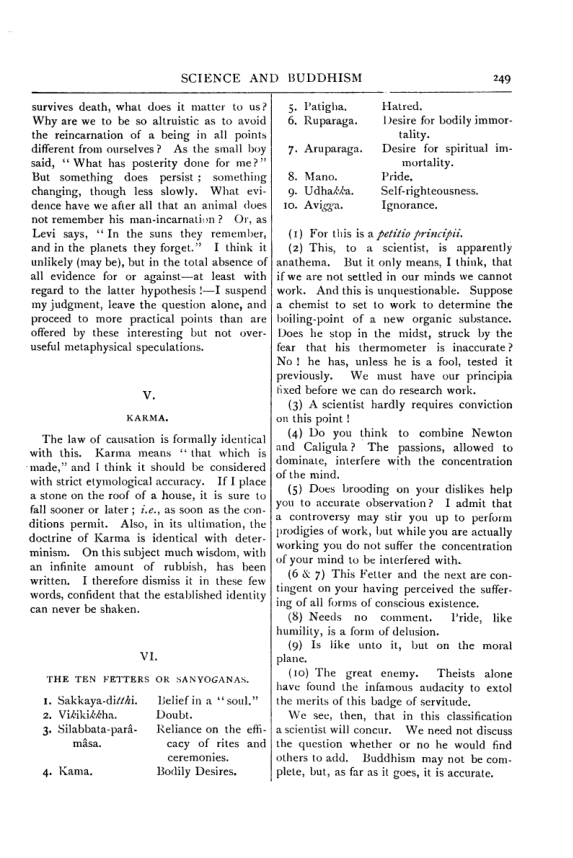
Highlights use the original PDF text layer. OCR-only matches may not be visible on the scan.
Transcription
Download text ↓raw extractionoriginal embedded textReview: unreviewed
SCIENCE AND BUDDHISM 249
survives death, what does it matter to us?| 5. Patigha. Hatred.
Why are we to be so altruistic as to avoid} 6. Ruparaga. Desire for bodily immor-
the reincarnation of a being in all points tality.
different from ourselves? As the small boy} 7. Aruparaga. Desire for spiritual im-
said, ‘‘ What has posterity done for me?” mortality.
But something does persist; something} 8. Mano. Pride.
changing, though less slowly. What evi-| 9. Udhasfa. Self-righteousness.
dence have we afier all that an animal does| I0. Avigga. Ignorance.
not remember his man-incarnation? Or, as
Levi says, ‘‘In the suns they remember,
and in the planets they forget.” I think it
unlikely (may be), but in the total absence of
all evidence for or against—at least with
regard to the latter hypothesis !—I suspend
my judgment, leave the question alone, and
proceed to more practical points than are
offered by these interesting but not over-
useful metaphysical speculations.
V.
KARMA.
The law of causation is formally identical
with this. Karma means ‘‘ that which is
‘made,” and I think it should be considered
with strict etymological accuracy. If I place
a stone on the roof of a house, it is sure to
fall sooner or later; z.¢., as soon as the con-
ditions permit. Also, in its ultimation, the
doctrine of Karma is identical with deter-
minism. On this subject much wisdom, with
an infinite amount of rubbish, has been
written. I therefore dismiss it in these few
words, confident that the established identity
can never be shaken.
VI.
THE TEN FETTERS OR SANYOGANAS.
Lelief
in a ‘‘ soul.”
Doubt.
I. Sakkaya-dié¢/i.
2. Vikiki&hha.
3. Silabbata-para- Reliance on the effi-
masa. cacy of rites and
ceremonies.
4. Kama. Bodily Desires.
(1) For this is a petetzo princtpit.
(2) This, to a scientist, is apparently
anathema. But it only means, I think, that
if we are not settled in our minds we cannot
work. And this is unquestionable. Suppose
a chemist to set to work to determine the
boiling-point of a new organic substance.
Does he stop in the midst, struck by the
fear that his thermometer is inaccurate?
No! he has, unless he is a fool, tested it
previously. We must have our principia
tixed before we can do research work.
(3) A scientist hardly requires conviction
on this point !
(4) Do you think to combine Newton
and Caligula? The passions, allowed to
dominate, interfere with the concentration
of the mind. )
(5) Does brooding on your dislikes help
you to accurate observation? I admit that
a controversy may stir you up to perform
prodigies of work, but while you are actually
working you do not suffer the concentration
of your mind to be interfered with..
(6 & 7) This Fetter and the next are con-
tingent on your having perceived the suffer-
ing of all forms of conscious existence.
(8) Needs no comment. Pride,
humility, is a form of delusion.
(9) Is like unto it, but on the moral
plane.
(10) The great enemy. Theists alone
have found the infamous audacity to extol
the merits of this badge of servitude.
We see, then, that in this classification
a scientist will concur. We need not discuss
the question whether or no he would find
others to add. Buddhism may not be com-
plete, but, as far as it goes, it is accurate.
like
Page provenance & review flags
Stable page ID: 59a930c2e614ddb0b1a2a000:p00255
Line breaks are preserved. Reading order and OCR accuracy may need review.
Printed page label has not been verified.
- No automated review flags. This does not establish transcription accuracy.