1906 · CLOSE READING
Collected Works (Vol. II)
Collected Works (Vol. II) (1906), PDF p. 275
Original page
Enlarge ↗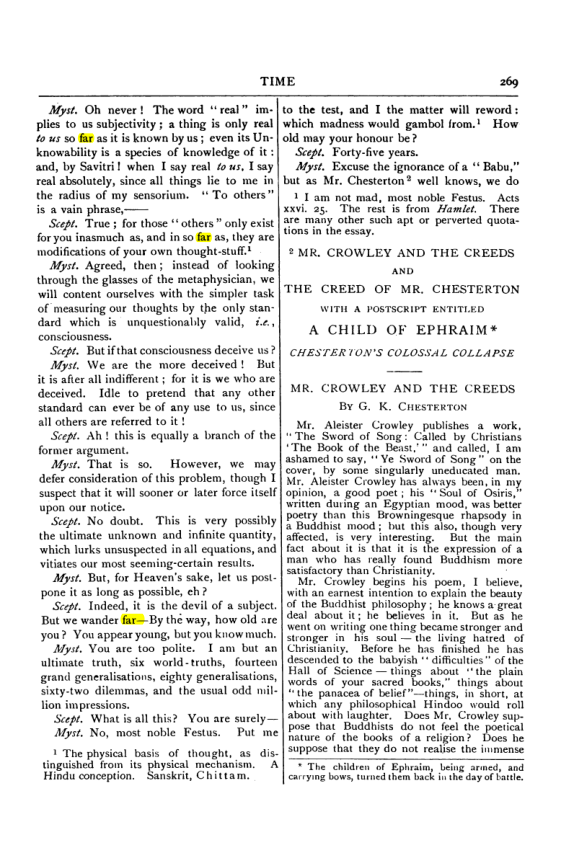
Highlights use the original PDF text layer. OCR-only matches may not be visible on the scan.
Transcription
Download text ↓raw extractionoriginal embedded textReview: unreviewed
TIME
269
Myst. Oh never! The word “real” im-
plies to us subjectivity; a thing is only real
to us so far as it is known by us; even its Un-
knowability is a species of knowledge of it:
and, by Savitri! when I say real Zo us, I say
real absolutely, since all things lie to me in
the radius of my sensorium. ‘‘ To others”
is a vain phrase,
Scept. True; for those ‘‘ others” only exist
for you inasmuch as, and in so far as, they are
modifications of your own thought-stuff.! .
Myst. Agreed, then; instead of looking
through the glasses of the metaphysician, we
will content ourselves with the simpler task
of measuring our thoughts by the only stan-
dard which is unquestionably valid,
consciousness.
Scept. But if that consciousness deceive us ?
Myst. We are the more deceived! But
it is after all indifferent ; for it is we who are
deceived. Idle to pretend that any other
standard can ever be of any use to us, since
all others are referred to it !
Scept. Ah! this is equally a branch of the
former argument.
Myst. That is so. However, we may
defer consideration of this problem, though I
suspect that it will sooner or later force itself
upon our notice.
Scept. No doubt. This is very possibly
the ultimate unknown and infinite quantity,
which lurks unsuspected in all equations, and
vitiates our most seeming-certain results.
Myst. But, for Heaven's sake, let us post-
pone it as long as possible, eh?
Scept. Indeed, it is the devil of a subject.
But we wander far—By the way, how old are
you? You appear young, but you know much.
Myst. You are too polite. I am but an
ultimate truth, six world-truths, fourteen
grand generalisations, eighty generalisations,
sixty-two dilemmas, and the usual odd mil-
lion impressions.
Scept. What is all this? You are surely—
Myst. No, most noble Festus. Put me
1.6. ,
1 The physical basis of thought, as dis-
tinguished from its physical mechanism. A
Hindu conception. Sanskrit, Chittam. |
to the test, and I the matter will reword:
which madness would gambol from.!' How
old may your honour be?
Scept. Forty-five years.
Myst. excuse the ignorance of a ‘‘ Babu,”
but as Mr. Chesterton? well knows, we do
1 I am not mad, most noble Festus. Acts
Xxvil. 25. The rest is from Hamlet. There
are many other such apt or perverted quota-
tions in the essay.
2 MR. CROWLEY AND THE CREEDS
AND
THE CREED OF MR. CHESTERTON
WITH A POSTSCRIPT ENTITLED
A CHILD OF EPHRAIM*
CHESTERTON’S COLOSSAL COLLAPSE
MR. CROWLEY AND THE CREEDS
By G.
Mr. Aleister Crowley publishes a work,
“The Sword of Song: Called by Christians
‘The Book of the Beast,’’’ and called, I am
ashamed to say, ‘‘ Ye Sword of Song” on the
cover, by some singularly uneducated man.
Mr, Aleister Crowley has always been, in my
opinion, a good poet; his ‘‘ Soul of Osiris,”
written during an Egyptian mood, was better
poetry than this Browningesque rhapsody in
a Buddhist mood; but this also, though very
affected, is very interesting. But the main
fact about it is that it is the expression of a
man who has really found Buddhism more
satisfactory than Christianity.
Mr. Crowley begins his poem, I believe,
with an earnest intention to explain the beauty
of the Buddhist philosophy; he knows a great
deal about it; he believes in it. But as he
went on writing one thing became stronger and
stronger in his soul
— the living hatred of
Christianity. Before he has finished he has
descended to the babyish ‘‘ difficulties”’ of the
Hall of Science
— things about ‘‘the plain
words of your sacred books,” things about
“‘the panacea of belief’”—things, in short, at
which any philosophical Hindoo would roll
about with laughter, Does Mr, Crowley sup-
pose that Buddhists do not feel the poetical
nature of the books of a religion? Does he
suppose that they do not realise the inmmense
K.. CHESTERTON
* The children of Ephraim, being armed, and
carrying bows, turned them back in the day of battle.
Page provenance & review flags
Stable page ID: 59a930c2e614ddb0b1a2a000:p00275
Line breaks are preserved. Reading order and OCR accuracy may need review.
Printed page label has not been verified.
- No automated review flags. This does not establish transcription accuracy.