1929 · CLOSE READING
Confessions of Aleister Crowley
Confessions of Aleister Crowley (1929), PDF p. 121
Original page
Enlarge ↗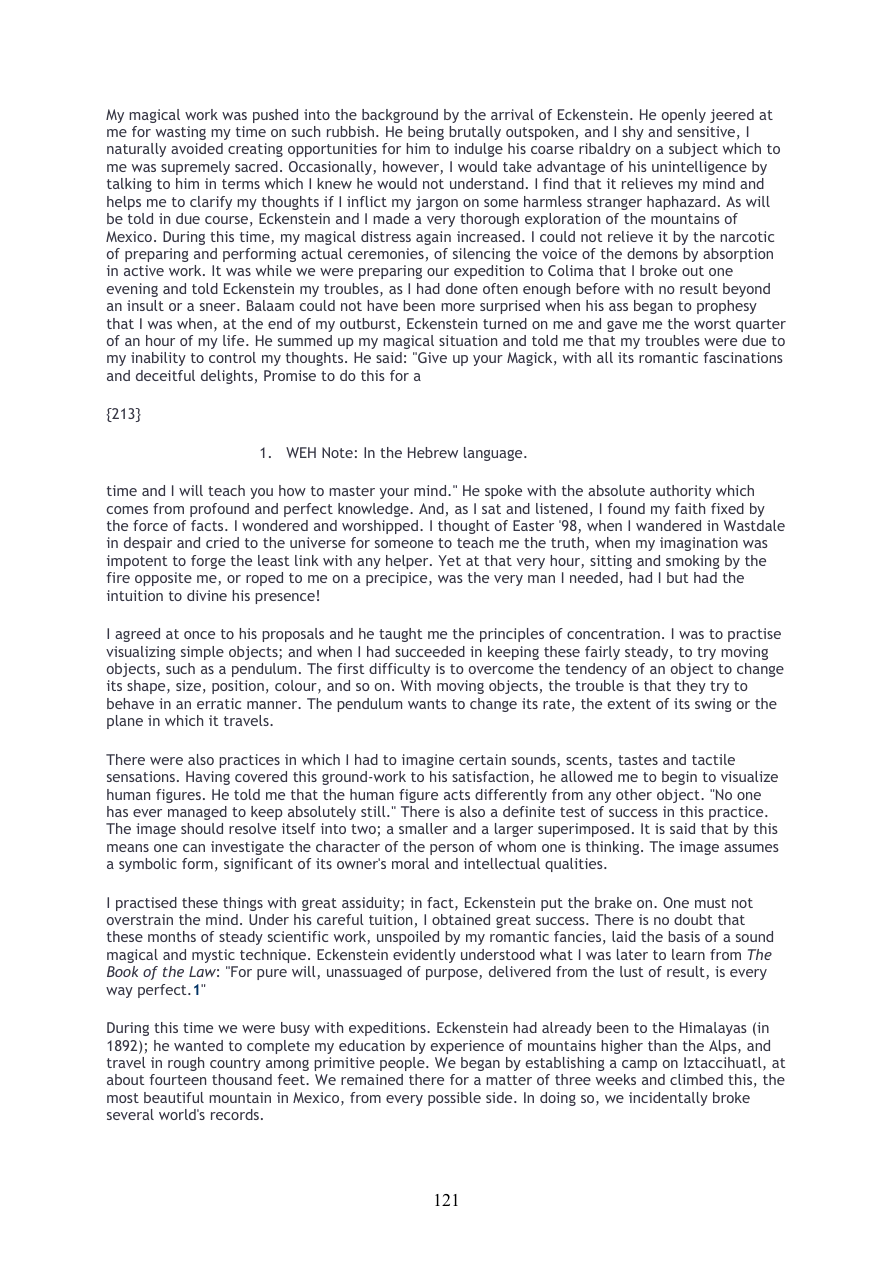
Highlights use the original PDF text layer. OCR-only matches may not be visible on the scan.
Transcription
Download text ↓raw extractionoriginal embedded textReview: unreviewed
121
My magical work was pushed into the background by the arrival of Eckenstein. He openly jeered at
me for wasting my time on such rubbish. He being brutally outspoken, and I shy and sensitive, I
naturally avoided creating opportunities for him to indulge his coarse ribaldry on a subject which to
me was supremely sacred. Occasionally, however, I would take advantage of his unintelligence by
talking to him in terms which I knew he would not understand. I find that it relieves my mind and
helps me to clarify my thoughts if I inflict my jargon on some harmless stranger haphazard. As will
be told in due course, Eckenstein and I made a very thorough exploration of the mountains of
Mexico. During this time, my magical distress again increased. I could not relieve it by the narcotic
of preparing and performing actual ceremonies, of silencing the voice of the demons by absorption
in active work. It was while we were preparing our expedition to Colima that I broke out one
evening and told Eckenstein my troubles, as I had done often enough before with no result beyond
an insult or a sneer. Balaam could not have been more surprised when his ass began to prophesy
that I was when, at the end of my outburst, Eckenstein turned on me and gave me the worst quarter
of an hour of my life. He summed up my magical situation and told me that my troubles were due to
my inability to control my thoughts. He said: "Give up your Magick, with all its romantic fascinations
and deceitful delights, Promise to do this for a
{213}
1. WEH Note: In the Hebrew language.
time and I will teach you how to master your mind." He spoke with the absolute authority which
comes from profound and perfect knowledge. And, as I sat and listened, I found my faith fixed by
the force of facts. I wondered and worshipped. I thought of Easter '98, when I wandered in Wastdale
in despair and cried to the universe for someone to teach me the truth, when my imagination was
impotent to forge the least link with any helper. Yet at that very hour, sitting and smoking by the
fire opposite me, or roped to me on a precipice, was the very man I needed, had I but had the
intuition to divine his presence!
I agreed at once to his proposals and he taught me the principles of concentration. I was to practise
visualizing simple objects; and when I had succeeded in keeping these fairly steady, to try moving
objects, such as a pendulum. The first difficulty is to overcome the tendency of an object to change
its shape, size, position, colour, and so on. With moving objects, the trouble is that they try to
behave in an erratic manner. The pendulum wants to change its rate, the extent of its swing or the
plane in which it travels.
There were also practices in which I had to imagine certain sounds, scents, tastes and tactile
sensations. Having covered this ground-work to his satisfaction, he allowed me to begin to visualize
human figures. He told me that the human figure acts differently from any other object. "No one
has ever managed to keep absolutely still." There is also a definite test of success in this practice.
The image should resolve itself into two; a smaller and a larger superimposed. It is said that by this
means one can investigate the character of the person of whom one is thinking. The image assumes
a symbolic form, significant of its owner's moral and intellectual qualities.
I practised these things with great assiduity; in fact, Eckenstein put the brake on. One must not
overstrain the mind. Under his careful tuition, I obtained great success. There is no doubt that
these months of steady scientific work, unspoiled by my romantic fancies, laid the basis of a sound
magical and mystic technique. Eckenstein evidently understood what I was later to learn from The
Book of the Law: "For pure will, unassuaged of purpose, delivered from the lust of result, is every
way perfect.1"
During this time we were busy with expeditions. Eckenstein had already been to the Himalayas (in
1892); he wanted to complete my education by experience of mountains higher than the Alps, and
travel in rough country among primitive people. We began by establishing a camp on Iztaccihuatl, at
about fourteen thousand feet. We remained there for a matter of three weeks and climbed this, the
most beautiful mountain in Mexico, from every possible side. In doing so, we incidentally broke
several world's records.
Page provenance & review flags
Stable page ID: 5ef44b98d8f9c4af5f6f86e1:p00121
Line breaks are preserved. Reading order and OCR accuracy may need review.
Printed page label has not been verified.
- No automated review flags. This does not establish transcription accuracy.