1929 · CLOSE READING
Confessions of Aleister Crowley
Confessions of Aleister Crowley (1929), PDF p. 123
Original page
Enlarge ↗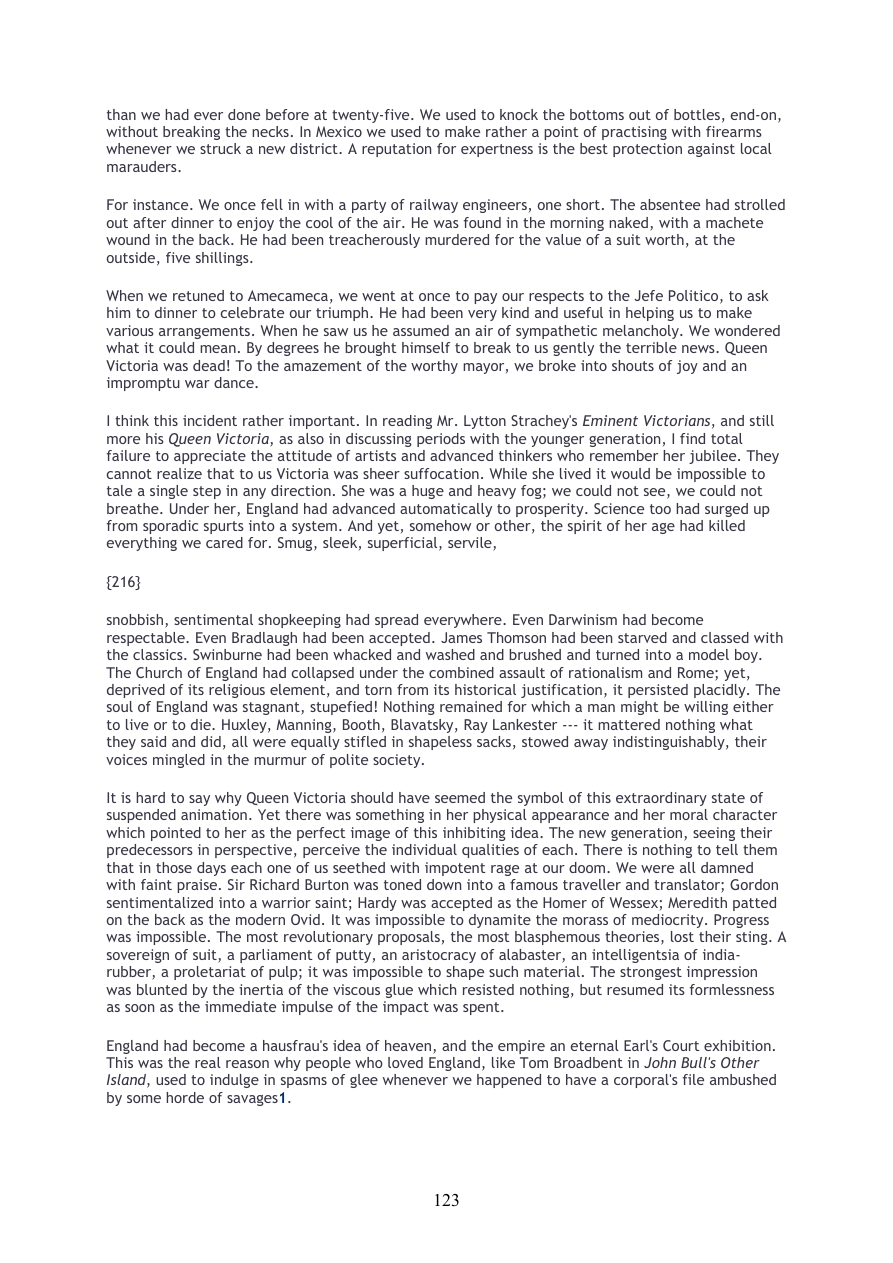
Highlights use the original PDF text layer. OCR-only matches may not be visible on the scan.
Transcription
Download text ↓raw extractionoriginal embedded textReview: unreviewed
123
than we had ever done before at twenty-five. We used to knock the bottoms out of bottles, end-on,
without breaking the necks. In Mexico we used to make rather a point of practising with firearms
whenever we struck a new district. A reputation for expertness is the best protection against local
marauders.
For instance. We once fell in with a party of railway engineers, one short. The absentee had strolled
out after dinner to enjoy the cool of the air. He was found in the morning naked, with a machete
wound in the back. He had been treacherously murdered for the value of a suit worth, at the
outside, five shillings.
When we retuned to Amecameca, we went at once to pay our respects to the Jefe Politico, to ask
him to dinner to celebrate our triumph. He had been very kind and useful in helping us to make
various arrangements. When he saw us he assumed an air of sympathetic melancholy. We wondered
what it could mean. By degrees he brought himself to break to us gently the terrible news. Queen
Victoria was dead! To the amazement of the worthy mayor, we broke into shouts of joy and an
impromptu war dance.
I think this incident rather important. In reading Mr. Lytton Strachey's Eminent Victorians, and still
more his Queen Victoria, as also in discussing periods with the younger generation, I find total
failure to appreciate the attitude of artists and advanced thinkers who remember her jubilee. They
cannot realize that to us Victoria was sheer suffocation. While she lived it would be impossible to
tale a single step in any direction. She was a huge and heavy fog; we could not see, we could not
breathe. Under her, England had advanced automatically to prosperity. Science too had surged up
from sporadic spurts into a system. And yet, somehow or other, the spirit of her age had killed
everything we cared for. Smug, sleek, superficial, servile,
{216}
snobbish, sentimental shopkeeping had spread everywhere. Even Darwinism had become
respectable. Even Bradlaugh had been accepted. James Thomson had been starved and classed with
the classics. Swinburne had been whacked and washed and brushed and turned into a model boy.
The Church of England had collapsed under the combined assault of rationalism and Rome; yet,
deprived of its religious element, and torn from its historical justification, it persisted placidly. The
soul of England was stagnant, stupefied! Nothing remained for which a man might be willing either
to live or to die. Huxley, Manning, Booth, Blavatsky, Ray Lankester --- it mattered nothing what
they said and did, all were equally stifled in shapeless sacks, stowed away indistinguishably, their
voices mingled in the murmur of polite society.
It is hard to say why Queen Victoria should have seemed the symbol of this extraordinary state of
suspended animation. Yet there was something in her physical appearance and her moral character
which pointed to her as the perfect image of this inhibiting idea. The new generation, seeing their
predecessors in perspective, perceive the individual qualities of each. There is nothing to tell them
that in those days each one of us seethed with impotent rage at our doom. We were all damned
with faint praise. Sir Richard Burton was toned down into a famous traveller and translator; Gordon
sentimentalized into a warrior saint; Hardy was accepted as the Homer of Wessex; Meredith patted
on the back as the modern Ovid. It was impossible to dynamite the morass of mediocrity. Progress
was impossible. The most revolutionary proposals, the most blasphemous theories, lost their sting. A
sovereign of suit, a parliament of putty, an aristocracy of alabaster, an intelligentsia of india-
rubber, a proletariat of pulp; it was impossible to shape such material. The strongest impression
was blunted by the inertia of the viscous glue which resisted nothing, but resumed its formlessness
as soon as the immediate impulse of the impact was spent.
England had become a hausfrau's idea of heaven, and the empire an eternal Earl's Court exhibition.
This was the real reason why people who loved England, like Tom Broadbent in John Bull's Other
Island, used to indulge in spasms of glee whenever we happened to have a corporal's file ambushed
by some horde of savages1.
Page provenance & review flags
Stable page ID: 5ef44b98d8f9c4af5f6f86e1:p00123
Line breaks are preserved. Reading order and OCR accuracy may need review.
Printed page label has not been verified.
- No automated review flags. This does not establish transcription accuracy.