1929 · CLOSE READING
Confessions of Aleister Crowley
Confessions of Aleister Crowley (1929), PDF p. 137
Original page
Enlarge ↗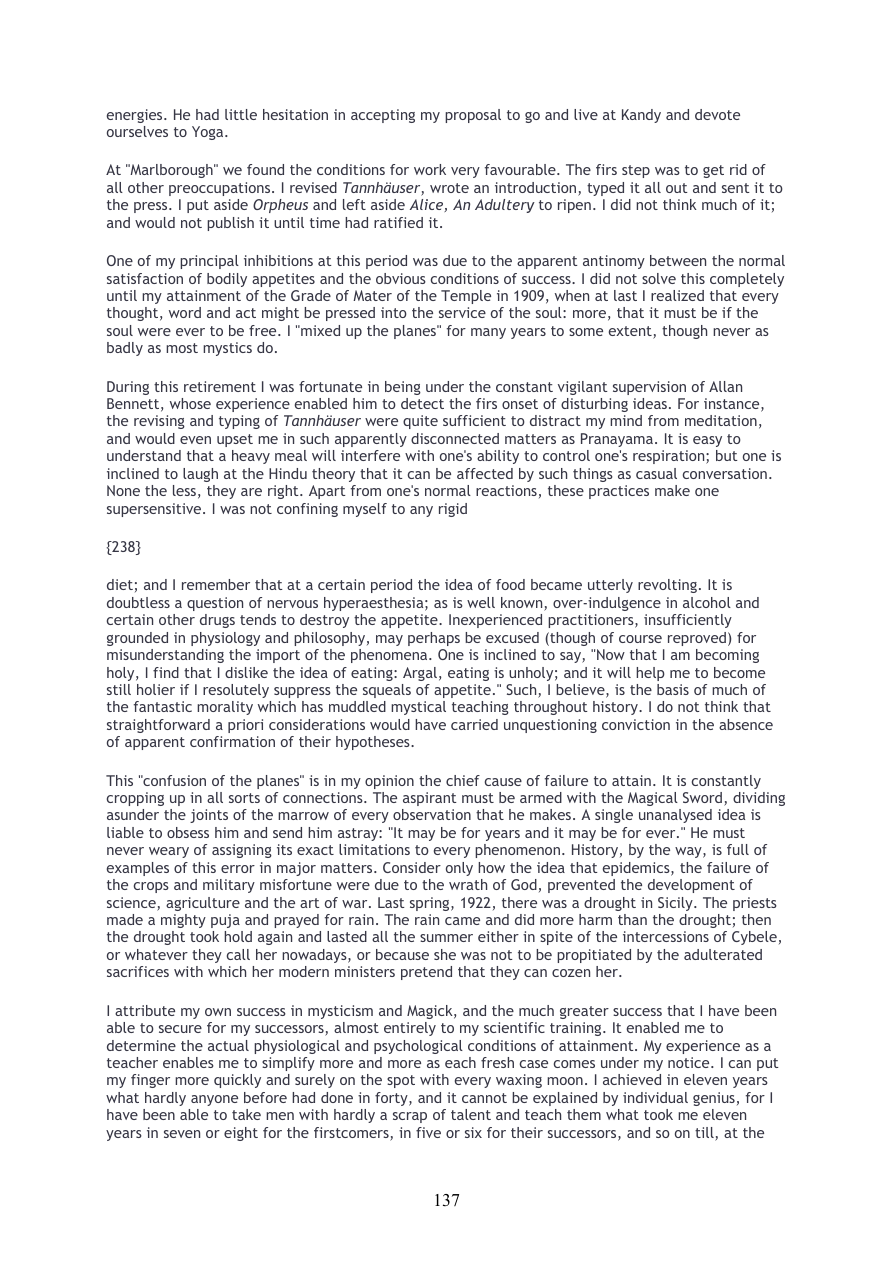
Highlights use the original PDF text layer. OCR-only matches may not be visible on the scan.
Transcription
Download text ↓raw extractionoriginal embedded textReview: unreviewed
137
energies. He had little hesitation in accepting my proposal to go and live at Kandy and devote
ourselves to Yoga.
At "Marlborough" we found the conditions for work very favourable. The firs step was to get rid of
all other preoccupations. I revised Tannhäuser, wrote an introduction, typed it all out and sent it to
the press. I put aside Orpheus and left aside Alice, An Adultery to ripen. I did not think much of it;
and would not publish it until time had ratified it.
One of my principal inhibitions at this period was due to the apparent antinomy between the normal
satisfaction of bodily appetites and the obvious conditions of success. I did not solve this completely
until my attainment of the Grade of Mater of the Temple in 1909, when at last I realized that every
thought, word and act might be pressed into the service of the soul: more, that it must be if the
soul were ever to be free. I "mixed up the planes" for many years to some extent, though never as
badly as most mystics do.
During this retirement I was fortunate in being under the constant vigilant supervision of Allan
Bennett, whose experience enabled him to detect the firs onset of disturbing ideas. For instance,
the revising and typing of Tannhäuser were quite sufficient to distract my mind from meditation,
and would even upset me in such apparently disconnected matters as Pranayama. It is easy to
understand that a heavy meal will interfere with one's ability to control one's respiration; but one is
inclined to laugh at the Hindu theory that it can be affected by such things as casual conversation.
None the less, they are right. Apart from one's normal reactions, these practices make one
supersensitive. I was not confining myself to any rigid
{238}
diet; and I remember that at a certain period the idea of food became utterly revolting. It is
doubtless a question of nervous hyperaesthesia; as is well known, over-indulgence in alcohol and
certain other drugs tends to destroy the appetite. Inexperienced practitioners, insufficiently
grounded in physiology and philosophy, may perhaps be excused (though of course reproved) for
misunderstanding the import of the phenomena. One is inclined to say, "Now that I am becoming
holy, I find that I dislike the idea of eating: Argal, eating is unholy; and it will help me to become
still holier if I resolutely suppress the squeals of appetite." Such, I believe, is the basis of much of
the fantastic morality which has muddled mystical teaching throughout history. I do not think that
straightforward a priori considerations would have carried unquestioning conviction in the absence
of apparent confirmation of their hypotheses.
This "confusion of the planes" is in my opinion the chief cause of failure to attain. It is constantly
cropping up in all sorts of connections. The aspirant must be armed with the Magical Sword, dividing
asunder the joints of the marrow of every observation that he makes. A single unanalysed idea is
liable to obsess him and send him astray: "It may be for years and it may be for ever." He must
never weary of assigning its exact limitations to every phenomenon. History, by the way, is full of
examples of this error in major matters. Consider only how the idea that epidemics, the failure of
the crops and military misfortune were due to the wrath of God, prevented the development of
science, agriculture and the art of war. Last spring, 1922, there was a drought in Sicily. The priests
made a mighty puja and prayed for rain. The rain came and did more harm than the drought; then
the drought took hold again and lasted all the summer either in spite of the intercessions of Cybele,
or whatever they call her nowadays, or because she was not to be propitiated by the adulterated
sacrifices with which her modern ministers pretend that they can cozen her.
I attribute my own success in mysticism and Magick, and the much greater success that I have been
able to secure for my successors, almost entirely to my scientific training. It enabled me to
determine the actual physiological and psychological conditions of attainment. My experience as a
teacher enables me to simplify more and more as each fresh case comes under my notice. I can put
my finger more quickly and surely on the spot with every waxing moon. I achieved in eleven years
what hardly anyone before had done in forty, and it cannot be explained by individual genius, for I
have been able to take men with hardly a scrap of talent and teach them what took me eleven
years in seven or eight for the firstcomers, in five or six for their successors, and so on till, at the
Page provenance & review flags
Stable page ID: 5ef44b98d8f9c4af5f6f86e1:p00137
Line breaks are preserved. Reading order and OCR accuracy may need review.
Printed page label has not been verified.
- No automated review flags. This does not establish transcription accuracy.