1929 · CLOSE READING
Confessions of Aleister Crowley
Confessions of Aleister Crowley (1929), PDF p. 139
Original page
Enlarge ↗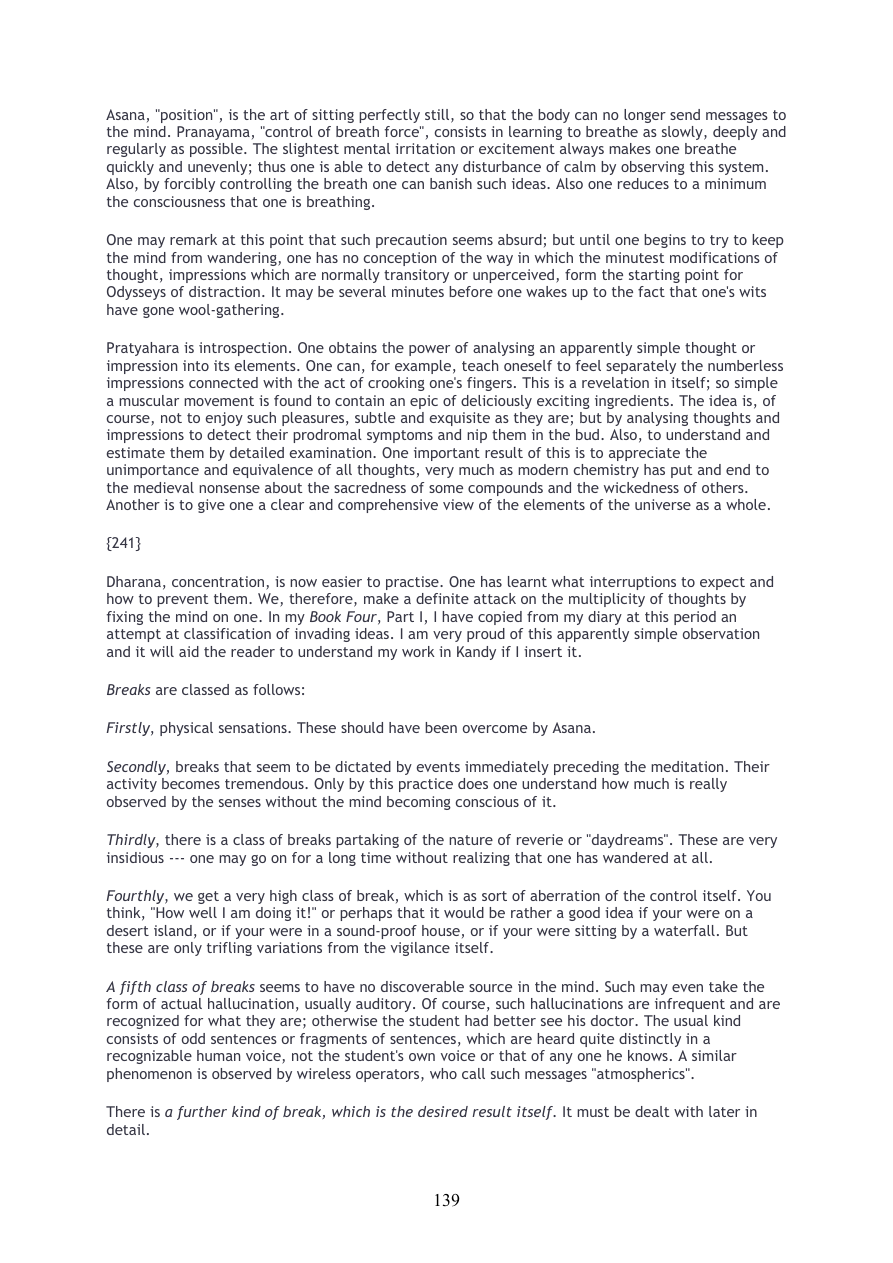
Highlights use the original PDF text layer. OCR-only matches may not be visible on the scan.
Transcription
Download text ↓raw extractionoriginal embedded textReview: unreviewed
139
Asana, "position", is the art of sitting perfectly still, so that the body can no longer send messages to
the mind. Pranayama, "control of breath force", consists in learning to breathe as slowly, deeply and
regularly as possible. The slightest mental irritation or excitement always makes one breathe
quickly and unevenly; thus one is able to detect any disturbance of calm by observing this system.
Also, by forcibly controlling the breath one can banish such ideas. Also one reduces to a minimum
the consciousness that one is breathing.
One may remark at this point that such precaution seems absurd; but until one begins to try to keep
the mind from wandering, one has no conception of the way in which the minutest modifications of
thought, impressions which are normally transitory or unperceived, form the starting point for
Odysseys of distraction. It may be several minutes before one wakes up to the fact that one's wits
have gone wool-gathering.
Pratyahara is introspection. One obtains the power of analysing an apparently simple thought or
impression into its elements. One can, for example, teach oneself to feel separately the numberless
impressions connected with the act of crooking one's fingers. This is a revelation in itself; so simple
a muscular movement is found to contain an epic of deliciously exciting ingredients. The idea is, of
course, not to enjoy such pleasures, subtle and exquisite as they are; but by analysing thoughts and
impressions to detect their prodromal symptoms and nip them in the bud. Also, to understand and
estimate them by detailed examination. One important result of this is to appreciate the
unimportance and equivalence of all thoughts, very much as modern chemistry has put and end to
the medieval nonsense about the sacredness of some compounds and the wickedness of others.
Another is to give one a clear and comprehensive view of the elements of the universe as a whole.
{241}
Dharana, concentration, is now easier to practise. One has learnt what interruptions to expect and
how to prevent them. We, therefore, make a definite attack on the multiplicity of thoughts by
fixing the mind on one. In my Book Four, Part I, I have copied from my diary at this period an
attempt at classification of invading ideas. I am very proud of this apparently simple observation
and it will aid the reader to understand my work in Kandy if I insert it.
Breaks are classed as follows:
Firstly, physical sensations. These should have been overcome by Asana.
Secondly, breaks that seem to be dictated by events immediately preceding the meditation. Their
activity becomes tremendous. Only by this practice does one understand how much is really
observed by the senses without the mind becoming conscious of it.
Thirdly, there is a class of breaks partaking of the nature of reverie or "daydreams". These are very
insidious --- one may go on for a long time without realizing that one has wandered at all.
Fourthly, we get a very high class of break, which is as sort of aberration of the control itself. You
think, "How well I am doing it!" or perhaps that it would be rather a good idea if your were on a
desert island, or if your were in a sound-proof house, or if your were sitting by a waterfall. But
these are only trifling variations from the vigilance itself.
A fifth class of breaks seems to have no discoverable source in the mind. Such may even take the
form of actual hallucination, usually auditory. Of course, such hallucinations are infrequent and are
recognized for what they are; otherwise the student had better see his doctor. The usual kind
consists of odd sentences or fragments of sentences, which are heard quite distinctly in a
recognizable human voice, not the student's own voice or that of any one he knows. A similar
phenomenon is observed by wireless operators, who call such messages "atmospherics".
There is a further kind of break, which is the desired result itself. It must be dealt with later in
detail.
Page provenance & review flags
Stable page ID: 5ef44b98d8f9c4af5f6f86e1:p00139
Line breaks are preserved. Reading order and OCR accuracy may need review.
Printed page label has not been verified.
- No automated review flags. This does not establish transcription accuracy.