1929 · CLOSE READING
Confessions of Aleister Crowley
Confessions of Aleister Crowley (1929), PDF p. 14
Original page
Enlarge ↗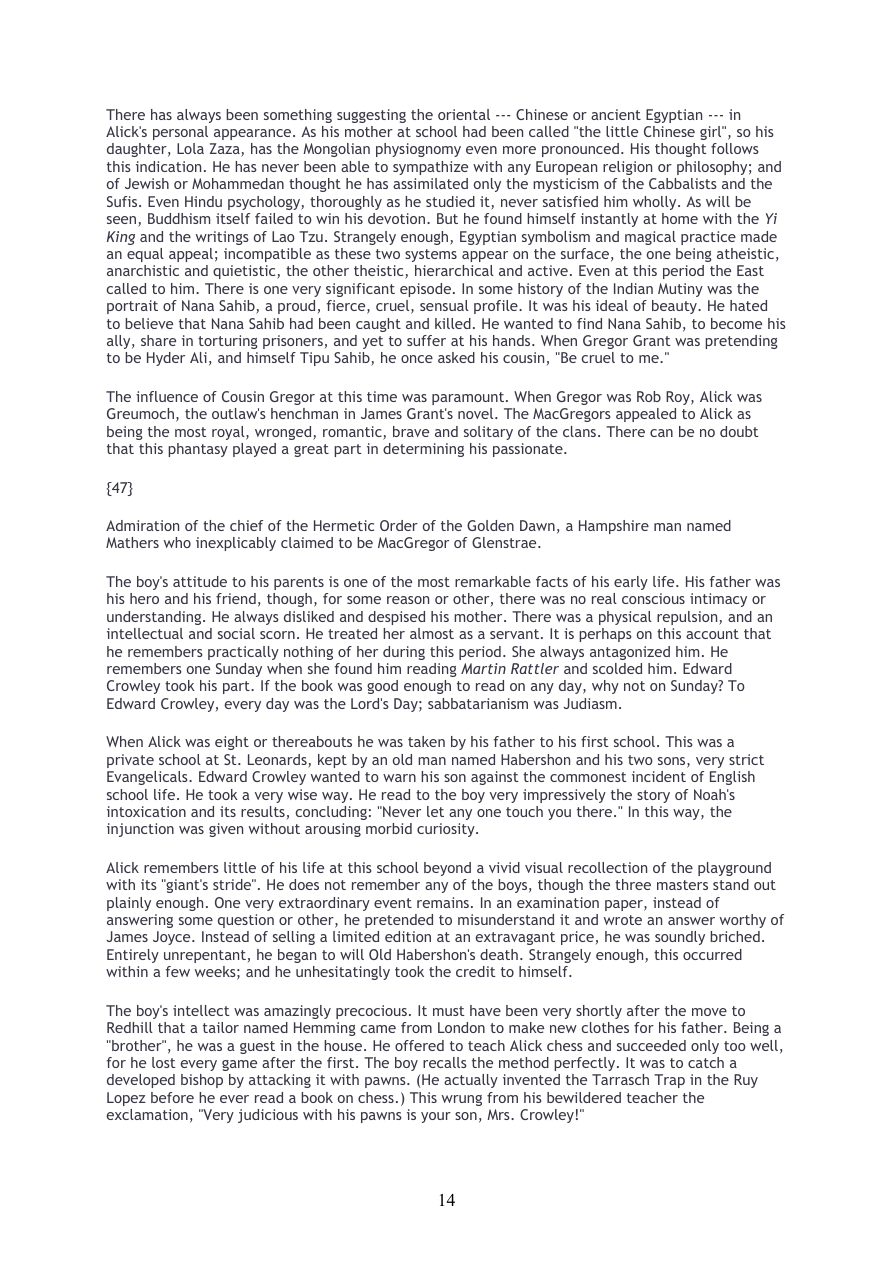
Highlights use the original PDF text layer. OCR-only matches may not be visible on the scan.
Transcription
Download text ↓raw extractionoriginal embedded textReview: unreviewed
14
There has always been something suggesting the oriental --- Chinese or ancient Egyptian --- in
Alick's personal appearance. As his mother at school had been called "the little Chinese girl", so his
daughter, Lola Zaza, has the Mongolian physiognomy even more pronounced. His thought follows
this indication. He has never been able to sympathize with any European religion or philosophy; and
of Jewish or Mohammedan thought he has assimilated only the mysticism of the Cabbalists and the
Sufis. Even Hindu psychology, thoroughly as he studied it, never satisfied him wholly. As will be
seen, Buddhism itself failed to win his devotion. But he found himself instantly at home with the Yi
King and the writings of Lao Tzu. Strangely enough, Egyptian symbolism and magical practice made
an equal appeal; incompatible as these two systems appear on the surface, the one being atheistic,
anarchistic and quietistic, the other theistic, hierarchical and active. Even at this period the East
called to him. There is one very significant episode. In some history of the Indian Mutiny was the
portrait of Nana Sahib, a proud, fierce, cruel, sensual profile. It was his ideal of beauty. He hated
to believe that Nana Sahib had been caught and killed. He wanted to find Nana Sahib, to become his
ally, share in torturing prisoners, and yet to suffer at his hands. When Gregor Grant was pretending
to be Hyder Ali, and himself Tipu Sahib, he once asked his cousin, "Be cruel to me."
The influence of Cousin Gregor at this time was paramount. When Gregor was Rob Roy, Alick was
Greumoch, the outlaw's henchman in James Grant's novel. The MacGregors appealed to Alick as
being the most royal, wronged, romantic, brave and solitary of the clans. There can be no doubt
that this phantasy played a great part in determining his passionate.
{47}
Admiration of the chief of the Hermetic Order of the Golden Dawn, a Hampshire man named
Mathers who inexplicably claimed to be MacGregor of Glenstrae.
The boy's attitude to his parents is one of the most remarkable facts of his early life. His father was
his hero and his friend, though, for some reason or other, there was no real conscious intimacy or
understanding. He always disliked and despised his mother. There was a physical repulsion, and an
intellectual and social scorn. He treated her almost as a servant. It is perhaps on this account that
he remembers practically nothing of her during this period. She always antagonized him. He
remembers one Sunday when she found him reading Martin Rattler and scolded him. Edward
Crowley took his part. If the book was good enough to read on any day, why not on Sunday? To
Edward Crowley, every day was the Lord's Day; sabbatarianism was Judiasm.
When Alick was eight or thereabouts he was taken by his father to his first school. This was a
private school at St. Leonards, kept by an old man named Habershon and his two sons, very strict
Evangelicals. Edward Crowley wanted to warn his son against the commonest incident of English
school life. He took a very wise way. He read to the boy very impressively the story of Noah's
intoxication and its results, concluding: "Never let any one touch you there." In this way, the
injunction was given without arousing morbid curiosity.
Alick remembers little of his life at this school beyond a vivid visual recollection of the playground
with its "giant's stride". He does not remember any of the boys, though the three masters stand out
plainly enough. One very extraordinary event remains. In an examination paper, instead of
answering some question or other, he pretended to misunderstand it and wrote an answer worthy of
James Joyce. Instead of selling a limited edition at an extravagant price, he was soundly briched.
Entirely unrepentant, he began to will Old Habershon's death. Strangely enough, this occurred
within a few weeks; and he unhesitatingly took the credit to himself.
The boy's intellect was amazingly precocious. It must have been very shortly after the move to
Redhill that a tailor named Hemming came from London to make new clothes for his father. Being a
"brother", he was a guest in the house. He offered to teach Alick chess and succeeded only too well,
for he lost every game after the first. The boy recalls the method perfectly. It was to catch a
developed bishop by attacking it with pawns. (He actually invented the Tarrasch Trap in the Ruy
Lopez before he ever read a book on chess.) This wrung from his bewildered teacher the
exclamation, "Very judicious with his pawns is your son, Mrs. Crowley!"
Page provenance & review flags
Stable page ID: 5ef44b98d8f9c4af5f6f86e1:p00014
Line breaks are preserved. Reading order and OCR accuracy may need review.
Printed page label has not been verified.
- No automated review flags. This does not establish transcription accuracy.