1929 · CLOSE READING
Confessions of Aleister Crowley
Confessions of Aleister Crowley (1929), PDF p. 140
Original page
Enlarge ↗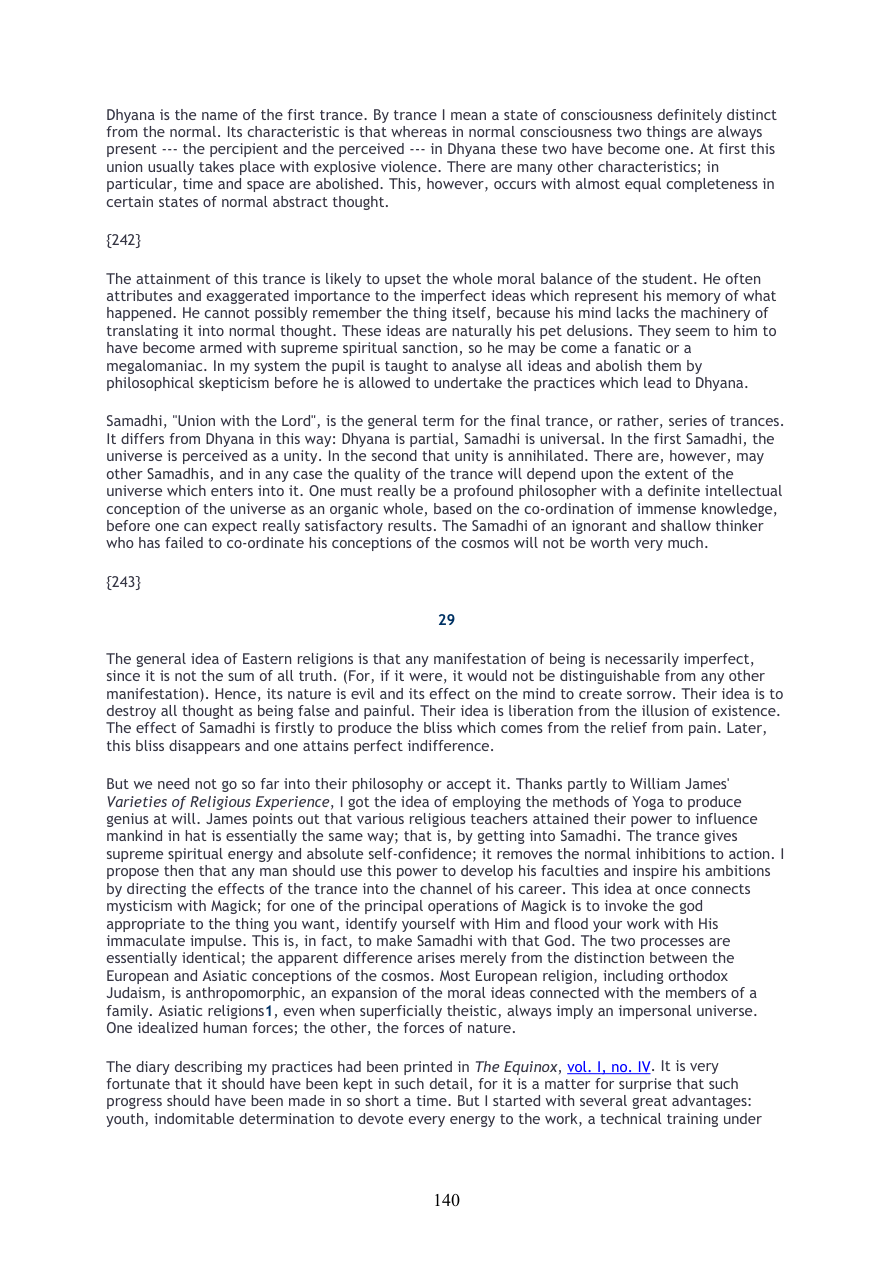
Highlights use the original PDF text layer. OCR-only matches may not be visible on the scan.
Transcription
Download text ↓raw extractionoriginal embedded textReview: unreviewed
140
Dhyana is the name of the first trance. By trance I mean a state of consciousness definitely distinct
from the normal. Its characteristic is that whereas in normal consciousness two things are always
present --- the percipient and the perceived --- in Dhyana these two have become one. At first this
union usually takes place with explosive violence. There are many other characteristics; in
particular, time and space are abolished. This, however, occurs with almost equal completeness in
certain states of normal abstract thought.
{242}
The attainment of this trance is likely to upset the whole moral balance of the student. He often
attributes and exaggerated importance to the imperfect ideas which represent his memory of what
happened. He cannot possibly remember the thing itself, because his mind lacks the machinery of
translating it into normal thought. These ideas are naturally his pet delusions. They seem to him to
have become armed with supreme spiritual sanction, so he may be come a fanatic or a
megalomaniac. In my system the pupil is taught to analyse all ideas and abolish them by
philosophical skepticism before he is allowed to undertake the practices which lead to Dhyana.
Samadhi, "Union with the Lord", is the general term for the final trance, or rather, series of trances.
It differs from Dhyana in this way: Dhyana is partial, Samadhi is universal. In the first Samadhi, the
universe is perceived as a unity. In the second that unity is annihilated. There are, however, may
other Samadhis, and in any case the quality of the trance will depend upon the extent of the
universe which enters into it. One must really be a profound philosopher with a definite intellectual
conception of the universe as an organic whole, based on the co-ordination of immense knowledge,
before one can expect really satisfactory results. The Samadhi of an ignorant and shallow thinker
who has failed to co-ordinate his conceptions of the cosmos will not be worth very much.
{243}
29
The general idea of Eastern religions is that any manifestation of being is necessarily imperfect,
since it is not the sum of all truth. (For, if it were, it would not be distinguishable from any other
manifestation). Hence, its nature is evil and its effect on the mind to create sorrow. Their idea is to
destroy all thought as being false and painful. Their idea is liberation from the illusion of existence.
The effect of Samadhi is firstly to produce the bliss which comes from the relief from pain. Later,
this bliss disappears and one attains perfect indifference.
But we need not go so far into their philosophy or accept it. Thanks partly to William James'
Varieties of Religious Experience, I got the idea of employing the methods of Yoga to produce
genius at will. James points out that various religious teachers attained their power to influence
mankind in hat is essentially the same way; that is, by getting into Samadhi. The trance gives
supreme spiritual energy and absolute self-confidence; it removes the normal inhibitions to action. I
propose then that any man should use this power to develop his faculties and inspire his ambitions
by directing the effects of the trance into the channel of his career. This idea at once connects
mysticism with Magick; for one of the principal operations of Magick is to invoke the god
appropriate to the thing you want, identify yourself with Him and flood your work with His
immaculate impulse. This is, in fact, to make Samadhi with that God. The two processes are
essentially identical; the apparent difference arises merely from the distinction between the
European and Asiatic conceptions of the cosmos. Most European religion, including orthodox
Judaism, is anthropomorphic, an expansion of the moral ideas connected with the members of a
family. Asiatic religions1, even when superficially theistic, always imply an impersonal universe.
One idealized human forces; the other, the forces of nature.
The diary describing my practices had been printed in The Equinox, vol. I, no. IV. It is very
fortunate that it should have been kept in such detail, for it is a matter for surprise that such
progress should have been made in so short a time. But I started with several great advantages:
youth, indomitable determination to devote every energy to the work, a technical training under
Page provenance & review flags
Stable page ID: 5ef44b98d8f9c4af5f6f86e1:p00140
Line breaks are preserved. Reading order and OCR accuracy may need review.
Printed page label has not been verified.
- No automated review flags. This does not establish transcription accuracy.