1929 · CLOSE READING
Confessions of Aleister Crowley
Confessions of Aleister Crowley (1929), PDF p. 145
Original page
Enlarge ↗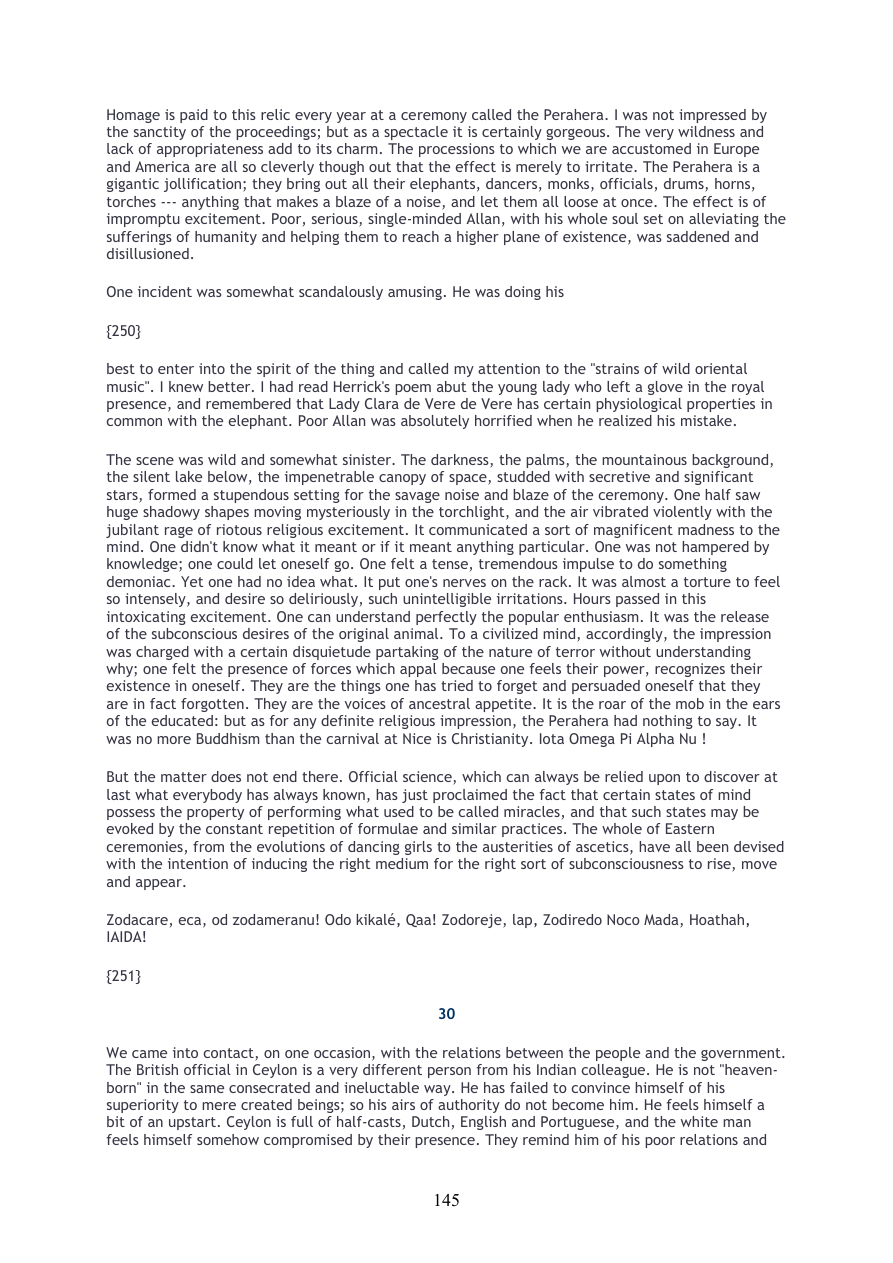
Highlights use the original PDF text layer. OCR-only matches may not be visible on the scan.
Transcription
Download text ↓raw extractionoriginal embedded textReview: unreviewed
145
Homage is paid to this relic every year at a ceremony called the Perahera. I was not impressed by
the sanctity of the proceedings; but as a spectacle it is certainly gorgeous. The very wildness and
lack of appropriateness add to its charm. The processions to which we are accustomed in Europe
and America are all so cleverly though out that the effect is merely to irritate. The Perahera is a
gigantic jollification; they bring out all their elephants, dancers, monks, officials, drums, horns,
torches --- anything that makes a blaze of a noise, and let them all loose at once. The effect is of
impromptu excitement. Poor, serious, single-minded Allan, with his whole soul set on alleviating the
sufferings of humanity and helping them to reach a higher plane of existence, was saddened and
disillusioned.
One incident was somewhat scandalously amusing. He was doing his
{250}
best to enter into the spirit of the thing and called my attention to the "strains of wild oriental
music". I knew better. I had read Herrick's poem abut the young lady who left a glove in the royal
presence, and remembered that Lady Clara de Vere de Vere has certain physiological properties in
common with the elephant. Poor Allan was absolutely horrified when he realized his mistake.
The scene was wild and somewhat sinister. The darkness, the palms, the mountainous background,
the silent lake below, the impenetrable canopy of space, studded with secretive and significant
stars, formed a stupendous setting for the savage noise and blaze of the ceremony. One half saw
huge shadowy shapes moving mysteriously in the torchlight, and the air vibrated violently with the
jubilant rage of riotous religious excitement. It communicated a sort of magnificent madness to the
mind. One didn't know what it meant or if it meant anything particular. One was not hampered by
knowledge; one could let oneself go. One felt a tense, tremendous impulse to do something
demoniac. Yet one had no idea what. It put one's nerves on the rack. It was almost a torture to feel
so intensely, and desire so deliriously, such unintelligible irritations. Hours passed in this
intoxicating excitement. One can understand perfectly the popular enthusiasm. It was the release
of the subconscious desires of the original animal. To a civilized mind, accordingly, the impression
was charged with a certain disquietude partaking of the nature of terror without understanding
why; one felt the presence of forces which appal because one feels their power, recognizes their
existence in oneself. They are the things one has tried to forget and persuaded oneself that they
are in fact forgotten. They are the voices of ancestral appetite. It is the roar of the mob in the ears
of the educated: but as for any definite religious impression, the Perahera had nothing to say. It
was no more Buddhism than the carnival at Nice is Christianity. Iota Omega Pi Alpha Nu !
But the matter does not end there. Official science, which can always be relied upon to discover at
last what everybody has always known, has just proclaimed the fact that certain states of mind
possess the property of performing what used to be called miracles, and that such states may be
evoked by the constant repetition of formulae and similar practices. The whole of Eastern
ceremonies, from the evolutions of dancing girls to the austerities of ascetics, have all been devised
with the intention of inducing the right medium for the right sort of subconsciousness to rise, move
and appear.
Zodacare, eca, od zodameranu! Odo kikalé Qaa! Zodoreje, lap Zodiredo Noco Mada, Hoathah
IAIDA!
{251}
30
We came into contact, on one occasion, with the relations between the people and the government.
The British official in Ceylon is a very different person from his Indian colleague. He is not "heaven-
born" in the same consecrated and ineluctable way. He has failed to convince himself of his
superiority to mere created beings; so his airs of authority do not become him. He feels himself a
bit of an upstart. Ceylon is full of half-casts, Dutch, English and Portuguese, and the white man
feels himself somehow compromised by their presence. They remind him of his poor relations and
Page provenance & review flags
Stable page ID: 5ef44b98d8f9c4af5f6f86e1:p00145
Line breaks are preserved. Reading order and OCR accuracy may need review.
Printed page label has not been verified.
- No automated review flags. This does not establish transcription accuracy.