1929 · CLOSE READING
Confessions of Aleister Crowley
Confessions of Aleister Crowley (1929), PDF p. 152
Original page
Enlarge ↗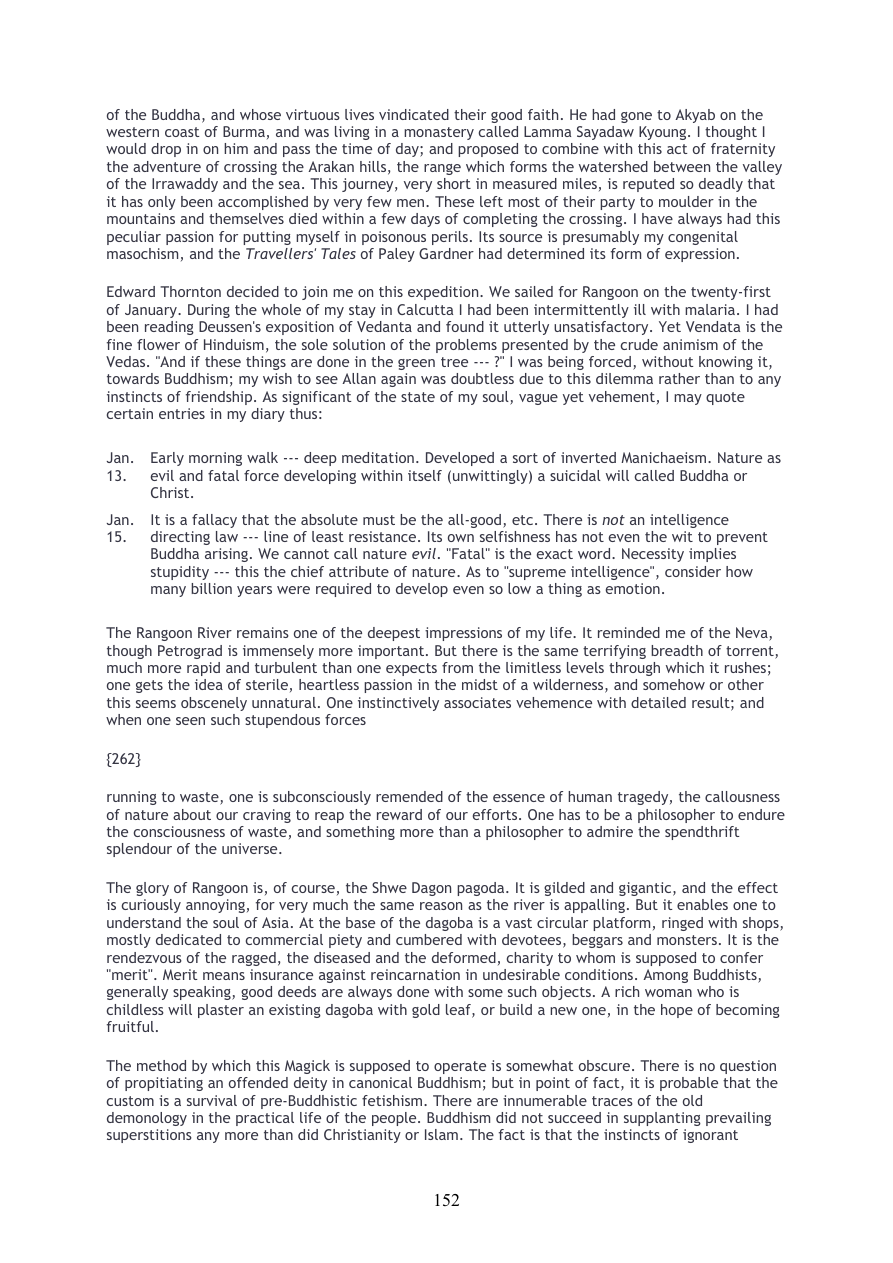
Highlights use the original PDF text layer. OCR-only matches may not be visible on the scan.
Transcription
Download text ↓raw extractionoriginal embedded textReview: unreviewed
152
of the Buddha, and whose virtuous lives vindicated their good faith. He had gone to Akyab on the
western coast of Burma, and was living in a monastery called Lamma Sayadaw Kyoung. I thought I
would drop in on him and pass the time of day; and proposed to combine with this act of fraternity
the adventure of crossing the Arakan hills, the range which forms the watershed between the valley
of the Irrawaddy and the sea. This journey, very short in measured miles, is reputed so deadly that
it has only been accomplished by very few men. These left most of their party to moulder in the
mountains and themselves died within a few days of completing the crossing. I have always had this
peculiar passion for putting myself in poisonous perils. Its source is presumably my congenital
masochism, and the Travellers' Tales of Paley Gardner had determined its form of expression.
Edward Thornton decided to join me on this expedition. We sailed for Rangoon on the twenty-first
of January. During the whole of my stay in Calcutta I had been intermittently ill with malaria. I had
been reading Deussen's exposition of Vedanta and found it utterly unsatisfactory. Yet Vendata is the
fine flower of Hinduism, the sole solution of the problems presented by the crude animism of the
Vedas. "And if these things are done in the green tree --- ?" I was being forced, without knowing it,
towards Buddhism; my wish to see Allan again was doubtless due to this dilemma rather than to any
instincts of friendship. As significant of the state of my soul, vague yet vehement, I may quote
certain entries in my diary thus:
Jan.
13.
Early morning walk --- deep meditation. Developed a sort of inverted Manichaeism. Nature as
evil and fatal force developing within itself (unwittingly) a suicidal will called Buddha or
Christ.
Jan.
15.
It is a fallacy that the absolute must be the all-good, etc. There is not an intelligence
directing law --- line of least resistance. Its own selfishness has not even the wit to prevent
Buddha arising. We cannot call nature evil. "Fatal" is the exact word. Necessity implies
stupidity --- this the chief attribute of nature. As to "supreme intelligence", consider how
many billion years were required to develop even so low a thing as emotion.
The Rangoon River remains one of the deepest impressions of my life. It reminded me of the Neva,
though Petrograd is immensely more important. But there is the same terrifying breadth of torrent,
much more rapid and turbulent than one expects from the limitless levels through which it rushes;
one gets the idea of sterile, heartless passion in the midst of a wilderness, and somehow or other
this seems obscenely unnatural. One instinctively associates vehemence with detailed result; and
when one seen such stupendous forces
{262}
running to waste, one is subconsciously remended of the essence of human tragedy, the callousness
of nature about our craving to reap the reward of our efforts. One has to be a philosopher to endure
the consciousness of waste, and something more than a philosopher to admire the spendthrift
splendour of the universe.
The glory of Rangoon is, of course, the Shwe Dagon pagoda. It is gilded and gigantic, and the effect
is curiously annoying, for very much the same reason as the river is appalling. But it enables one to
understand the soul of Asia. At the base of the dagoba is a vast circular platform, ringed with shops,
mostly dedicated to commercial piety and cumbered with devotees, beggars and monsters. It is the
rendezvous of the ragged, the diseased and the deformed, charity to whom is supposed to confer
"merit". Merit means insurance against reincarnation in undesirable conditions. Among Buddhists,
generally speaking, good deeds are always done with some such objects. A rich woman who is
childless will plaster an existing dagoba with gold leaf, or build a new one, in the hope of becoming
fruitful.
The method by which this Magick is supposed to operate is somewhat obscure. There is no question
of propitiating an offended deity in canonical Buddhism; but in point of fact, it is probable that the
custom is a survival of pre-Buddhistic fetishism. There are innumerable traces of the old
demonology in the practical life of the people. Buddhism did not succeed in supplanting prevailing
superstitions any more than did Christianity or Islam. The fact is that the instincts of ignorant
Page provenance & review flags
Stable page ID: 5ef44b98d8f9c4af5f6f86e1:p00152
Line breaks are preserved. Reading order and OCR accuracy may need review.
Printed page label has not been verified.
- No automated review flags. This does not establish transcription accuracy.