1929 · CLOSE READING
Confessions of Aleister Crowley
Confessions of Aleister Crowley (1929), PDF p. 17
Original page
Enlarge ↗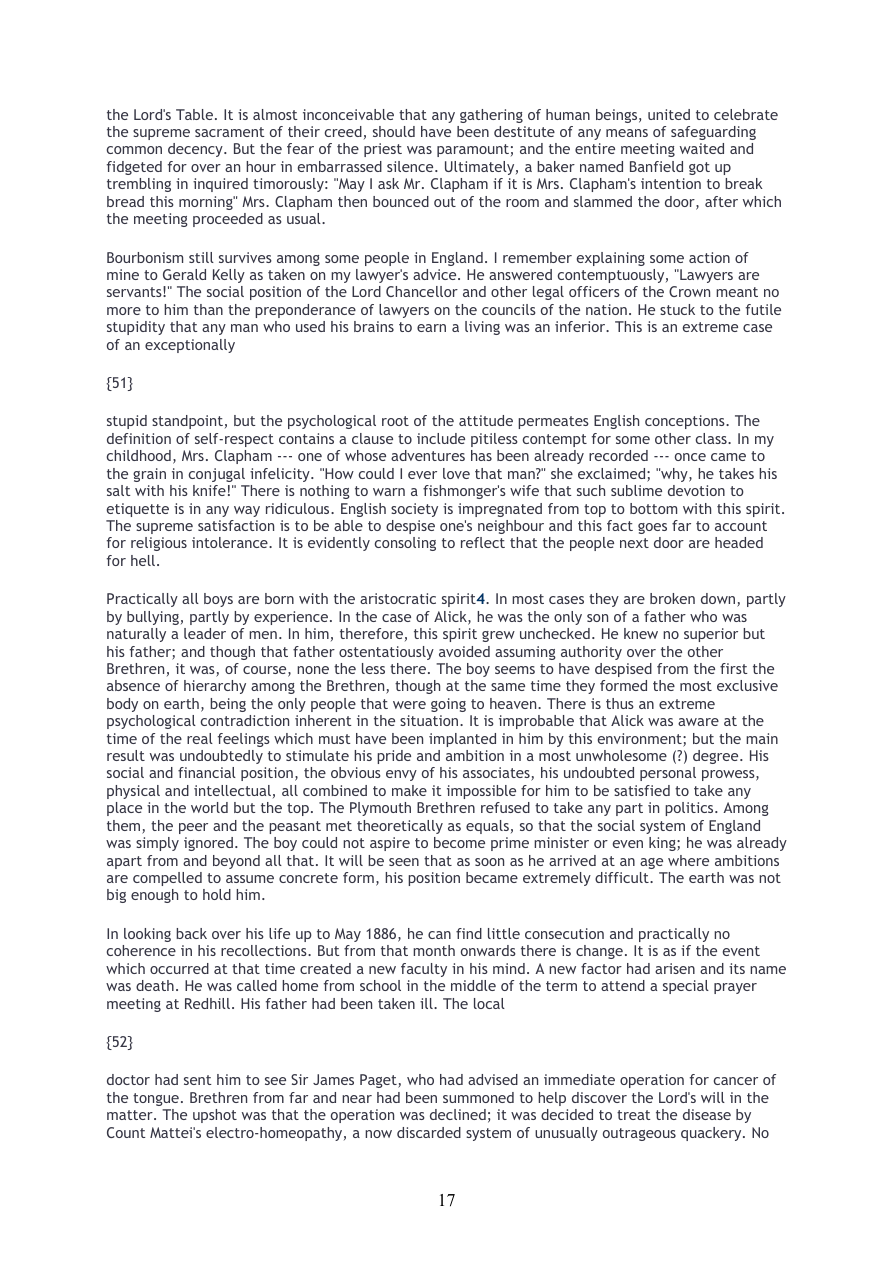
Highlights use the original PDF text layer. OCR-only matches may not be visible on the scan.
Transcription
Download text ↓raw extractionoriginal embedded textReview: unreviewed
17
the Lord's Table. It is almost inconceivable that any gathering of human beings, united to celebrate
the supreme sacrament of their creed, should have been destitute of any means of safeguarding
common decency. But the fear of the priest was paramount; and the entire meeting waited and
fidgeted for over an hour in embarrassed silence. Ultimately, a baker named Banfield got up
trembling in inquired timorously: "May I ask Mr. Clapham if it is Mrs. Clapham's intention to break
bread this morning" Mrs. Clapham then bounced out of the room and slammed the door, after which
the meeting proceeded as usual.
Bourbonism still survives among some people in England. I remember explaining some action of
mine to Gerald Kelly as taken on my lawyer's advice. He answered contemptuously, "Lawyers are
servants!" The social position of the Lord Chancellor and other legal officers of the Crown meant no
more to him than the preponderance of lawyers on the councils of the nation. He stuck to the futile
stupidity that any man who used his brains to earn a living was an inferior. This is an extreme case
of an exceptionally
{51}
stupid standpoint, but the psychological root of the attitude permeates English conceptions. The
definition of self-respect contains a clause to include pitiless contempt for some other class. In my
childhood, Mrs. Clapham --- one of whose adventures has been already recorded --- once came to
the grain in conjugal infelicity. "How could I ever love that man?" she exclaimed; "why, he takes his
salt with his knife!" There is nothing to warn a fishmonger's wife that such sublime devotion to
etiquette is in any way ridiculous. English society is impregnated from top to bottom with this spirit.
The supreme satisfaction is to be able to despise one's neighbour and this fact goes far to account
for religious intolerance. It is evidently consoling to reflect that the people next door are headed
for hell.
Practically all boys are born with the aristocratic spirit4. In most cases they are broken down, partly
by bullying, partly by experience. In the case of Alick, he was the only son of a father who was
naturally a leader of men. In him, therefore, this spirit grew unchecked. He knew no superior but
his father; and though that father ostentatiously avoided assuming authority over the other
Brethren, it was, of course, none the less there. The boy seems to have despised from the first the
absence of hierarchy among the Brethren, though at the same time they formed the most exclusive
body on earth, being the only people that were going to heaven. There is thus an extreme
psychological contradiction inherent in the situation. It is improbable that Alick was aware at the
time of the real feelings which must have been implanted in him by this environment; but the main
result was undoubtedly to stimulate his pride and ambition in a most unwholesome (?) degree. His
social and financial position, the obvious envy of his associates, his undoubted personal prowess,
physical and intellectual, all combined to make it impossible for him to be satisfied to take any
place in the world but the top. The Plymouth Brethren refused to take any part in politics. Among
them, the peer and the peasant met theoretically as equals, so that the social system of England
was simply ignored. The boy could not aspire to become prime minister or even king; he was already
apart from and beyond all that. It will be seen that as soon as he arrived at an age where ambitions
are compelled to assume concrete form, his position became extremely difficult. The earth was not
big enough to hold him.
In looking back over his life up to May 1886, he can find little consecution and practically no
coherence in his recollections. But from that month onwards there is change. It is as if the event
which occurred at that time created a new faculty in his mind. A new factor had arisen and its name
was death. He was called home from school in the middle of the term to attend a special prayer
meeting at Redhill. His father had been taken ill. The local
{52}
doctor had sent him to see Sir James Paget, who had advised an immediate operation for cancer of
the tongue. Brethren from far and near had been summoned to help discover the Lord's will in the
matter. The upshot was that the operation was declined; it was decided to treat the disease by
Count Mattei's electro-homeopathy, a now discarded system of unusually outrageous quackery. No
Page provenance & review flags
Stable page ID: 5ef44b98d8f9c4af5f6f86e1:p00017
Line breaks are preserved. Reading order and OCR accuracy may need review.
Printed page label has not been verified.
- No automated review flags. This does not establish transcription accuracy.