1929 · CLOSE READING
Confessions of Aleister Crowley
Confessions of Aleister Crowley (1929), PDF p. 172
Original page
Enlarge ↗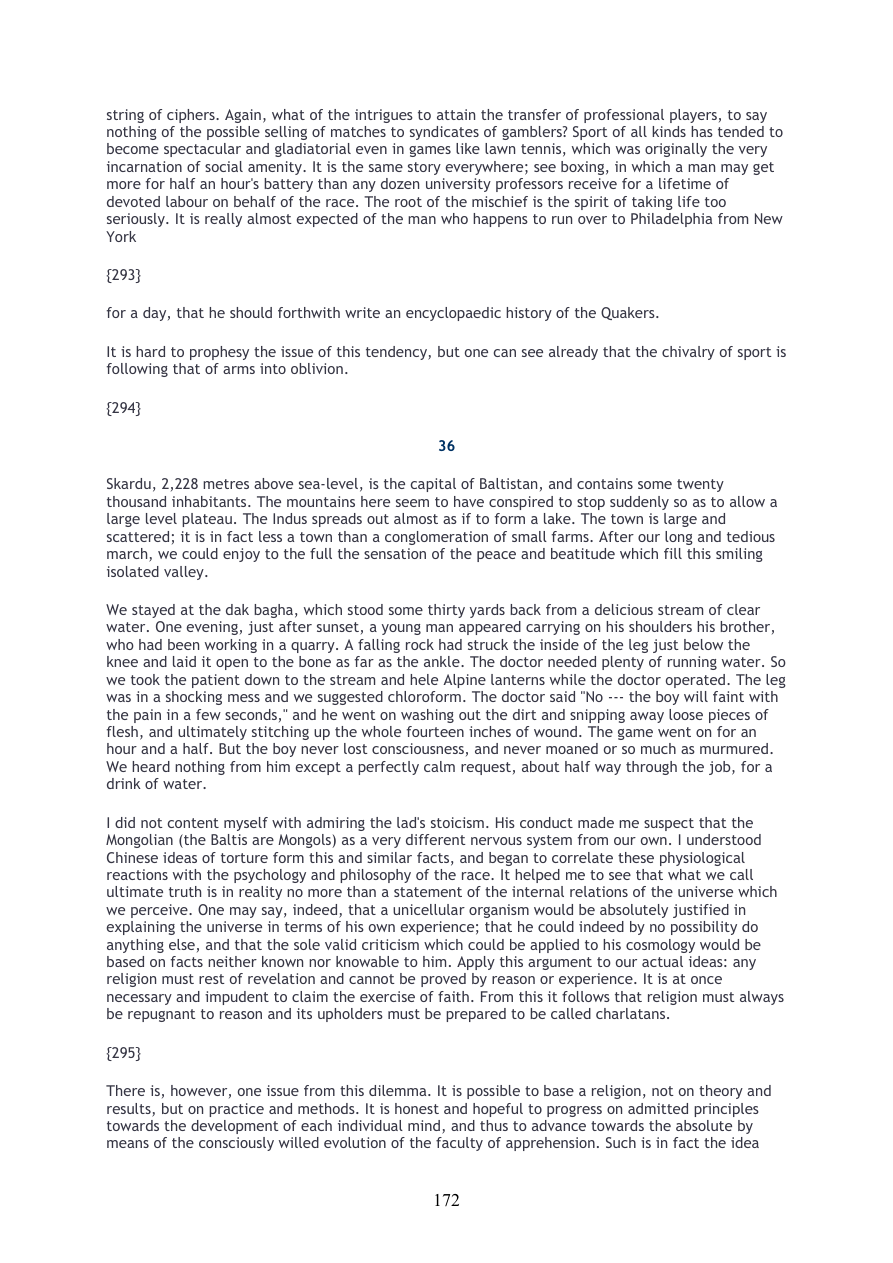
Highlights use the original PDF text layer. OCR-only matches may not be visible on the scan.
Transcription
Download text ↓raw extractionoriginal embedded textReview: unreviewed
172
string of ciphers. Again, what of the intrigues to attain the transfer of professional players, to say
nothing of the possible selling of matches to syndicates of gamblers? Sport of all kinds has tended to
become spectacular and gladiatorial even in games like lawn tennis, which was originally the very
incarnation of social amenity. It is the same story everywhere; see boxing, in which a man may get
more for half an hour's battery than any dozen university professors receive for a lifetime of
devoted labour on behalf of the race. The root of the mischief is the spirit of taking life too
seriously. It is really almost expected of the man who happens to run over to Philadelphia from New
York
{293}
for a day, that he should forthwith write an encyclopaedic history of the Quakers.
It is hard to prophesy the issue of this tendency, but one can see already that the chivalry of sport is
following that of arms into oblivion.
{294}
36
Skardu, 2,228 metres above sea-level, is the capital of Baltistan, and contains some twenty
thousand inhabitants. The mountains here seem to have conspired to stop suddenly so as to allow a
large level plateau. The Indus spreads out almost as if to form a lake. The town is large and
scattered; it is in fact less a town than a conglomeration of small farms. After our long and tedious
march, we could enjoy to the full the sensation of the peace and beatitude which fill this smiling
isolated valley.
We stayed at the dak bagha, which stood some thirty yards back from a delicious stream of clear
water. One evening, just after sunset, a young man appeared carrying on his shoulders his brother,
who had been working in a quarry. A falling rock had struck the inside of the leg just below the
knee and laid it open to the bone as far as the ankle. The doctor needed plenty of running water. So
we took the patient down to the stream and hele Alpine lanterns while the doctor operated. The leg
was in a shocking mess and we suggested chloroform. The doctor said "No --- the boy will faint with
the pain in a few seconds," and he went on washing out the dirt and snipping away loose pieces of
flesh, and ultimately stitching up the whole fourteen inches of wound. The game went on for an
hour and a half. But the boy never lost consciousness, and never moaned or so much as murmured.
We heard nothing from him except a perfectly calm request, about half way through the job, for a
drink of water.
I did not content myself with admiring the lad's stoicism. His conduct made me suspect that the
Mongolian (the Baltis are Mongols) as a very different nervous system from our own. I understood
Chinese ideas of torture form this and similar facts, and began to correlate these physiological
reactions with the psychology and philosophy of the race. It helped me to see that what we call
ultimate truth is in reality no more than a statement of the internal relations of the universe which
we perceive. One may say, indeed, that a unicellular organism would be absolutely justified in
explaining the universe in terms of his own experience; that he could indeed by no possibility do
anything else, and that the sole valid criticism which could be applied to his cosmology would be
based on facts neither known nor knowable to him. Apply this argument to our actual ideas: any
religion must rest of revelation and cannot be proved by reason or experience. It is at once
necessary and impudent to claim the exercise of faith. From this it follows that religion must always
be repugnant to reason and its upholders must be prepared to be called charlatans.
{295}
There is, however, one issue from this dilemma. It is possible to base a religion, not on theory and
results, but on practice and methods. It is honest and hopeful to progress on admitted principles
towards the development of each individual mind, and thus to advance towards the absolute by
means of the consciously willed evolution of the faculty of apprehension. Such is in fact the idea
Page provenance & review flags
Stable page ID: 5ef44b98d8f9c4af5f6f86e1:p00172
Line breaks are preserved. Reading order and OCR accuracy may need review.
Printed page label has not been verified.
- No automated review flags. This does not establish transcription accuracy.