1929 · CLOSE READING
Confessions of Aleister Crowley
Confessions of Aleister Crowley (1929), PDF p. 181
Original page
Enlarge ↗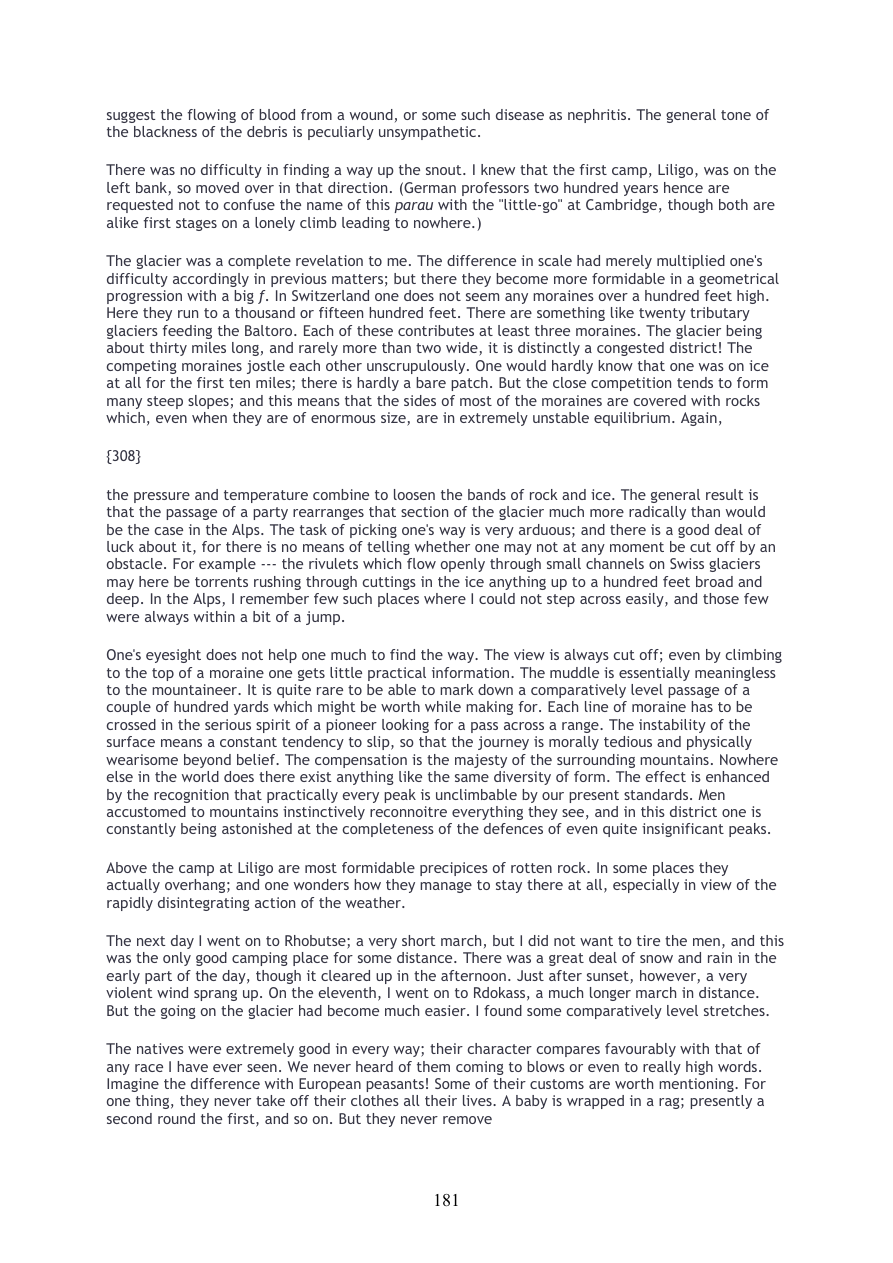
Highlights use the original PDF text layer. OCR-only matches may not be visible on the scan.
Transcription
Download text ↓raw extractionoriginal embedded textReview: unreviewed
181
suggest the flowing of blood from a wound, or some such disease as nephritis. The general tone of
the blackness of the debris is peculiarly unsympathetic.
There was no difficulty in finding a way up the snout. I knew that the first camp, Liligo, was on the
left bank, so moved over in that direction. (German professors two hundred years hence are
requested not to confuse the name of this parau with the "little-go" at Cambridge, though both are
alike first stages on a lonely climb leading to nowhere.)
The glacier was a complete revelation to me. The difference in scale had merely multiplied one's
difficulty accordingly in previous matters; but there they become more formidable in a geometrical
progression with a big f. In Switzerland one does not seem any moraines over a hundred feet high.
Here they run to a thousand or fifteen hundred feet. There are something like twenty tributary
glaciers feeding the Baltoro. Each of these contributes at least three moraines. The glacier being
about thirty miles long, and rarely more than two wide, it is distinctly a congested district! The
competing moraines jostle each other unscrupulously. One would hardly know that one was on ice
at all for the first ten miles; there is hardly a bare patch. But the close competition tends to form
many steep slopes; and this means that the sides of most of the moraines are covered with rocks
which, even when they are of enormous size, are in extremely unstable equilibrium. Again,
{308}
the pressure and temperature combine to loosen the bands of rock and ice. The general result is
that the passage of a party rearranges that section of the glacier much more radically than would
be the case in the Alps. The task of picking one's way is very arduous; and there is a good deal of
luck about it, for there is no means of telling whether one may not at any moment be cut off by an
obstacle. For example --- the rivulets which flow openly through small channels on Swiss glaciers
may here be torrents rushing through cuttings in the ice anything up to a hundred feet broad and
deep. In the Alps, I remember few such places where I could not step across easily, and those few
were always within a bit of a jump.
One's eyesight does not help one much to find the way. The view is always cut off; even by climbing
to the top of a moraine one gets little practical information. The muddle is essentially meaningless
to the mountaineer. It is quite rare to be able to mark down a comparatively level passage of a
couple of hundred yards which might be worth while making for. Each line of moraine has to be
crossed in the serious spirit of a pioneer looking for a pass across a range. The instability of the
surface means a constant tendency to slip, so that the journey is morally tedious and physically
wearisome beyond belief. The compensation is the majesty of the surrounding mountains. Nowhere
else in the world does there exist anything like the same diversity of form. The effect is enhanced
by the recognition that practically every peak is unclimbable by our present standards. Men
accustomed to mountains instinctively reconnoitre everything they see, and in this district one is
constantly being astonished at the completeness of the defences of even quite insignificant peaks.
Above the camp at Liligo are most formidable precipices of rotten rock. In some places they
actually overhang; and one wonders how they manage to stay there at all, especially in view of the
rapidly disintegrating action of the weather.
The next day I went on to Rhobutse; a very short march, but I did not want to tire the men, and this
was the only good camping place for some distance. There was a great deal of snow and rain in the
early part of the day, though it cleared up in the afternoon. Just after sunset, however, a very
violent wind sprang up. On the eleventh, I went on to Rdokass, a much longer march in distance.
But the going on the glacier had become much easier. I found some comparatively level stretches.
The natives were extremely good in every way; their character compares favourably with that of
any race I have ever seen. We never heard of them coming to blows or even to really high words.
Imagine the difference with European peasants! Some of their customs are worth mentioning. For
one thing, they never take off their clothes all their lives. A baby is wrapped in a rag; presently a
second round the first, and so on. But they never remove
Page provenance & review flags
Stable page ID: 5ef44b98d8f9c4af5f6f86e1:p00181
Line breaks are preserved. Reading order and OCR accuracy may need review.
Printed page label has not been verified.
- No automated review flags. This does not establish transcription accuracy.