1929 · CLOSE READING
Confessions of Aleister Crowley
Confessions of Aleister Crowley (1929), PDF p. 20
Original page
Enlarge ↗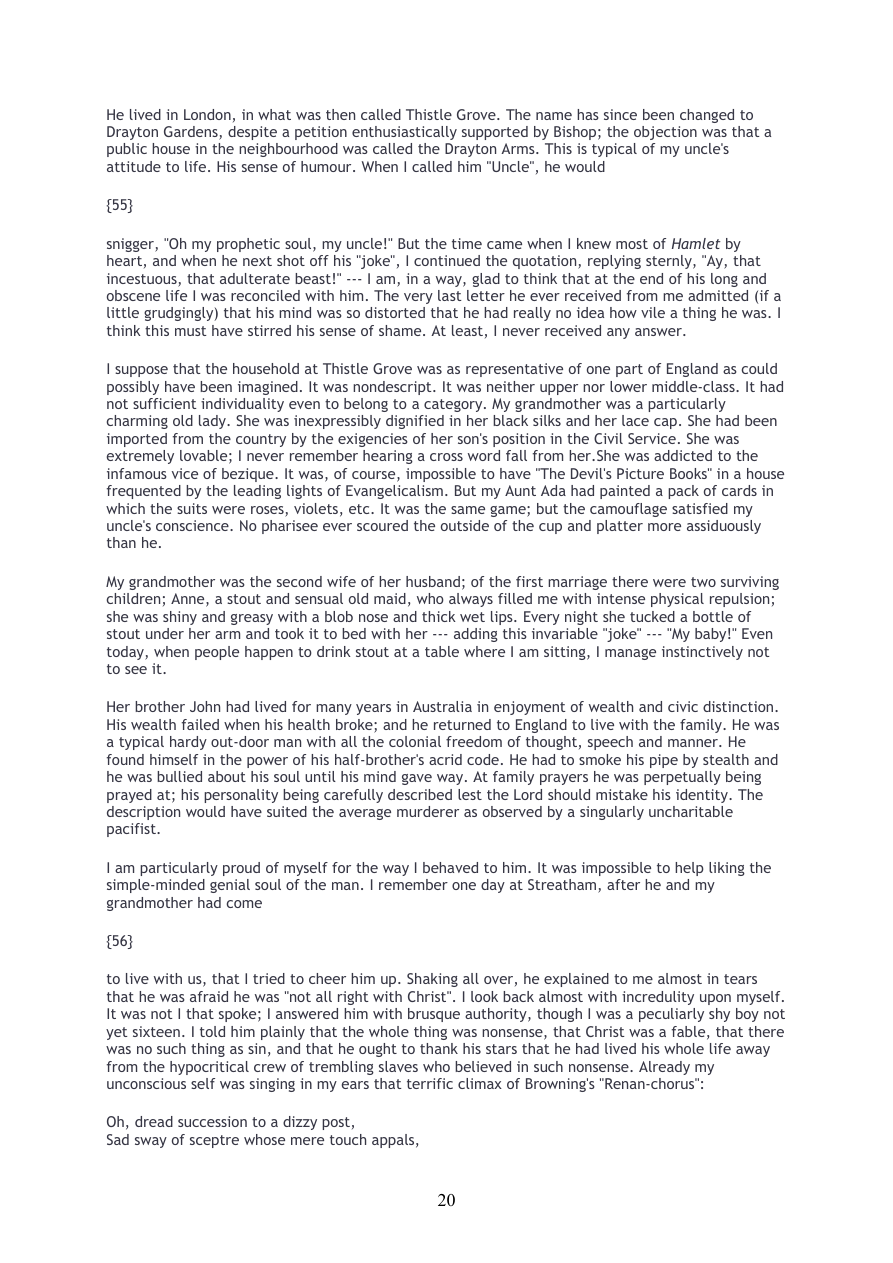
Highlights use the original PDF text layer. OCR-only matches may not be visible on the scan.
Transcription
Download text ↓raw extractionoriginal embedded textReview: unreviewed
20
He lived in London, in what was then called Thistle Grove. The name has since been changed to
Drayton Gardens, despite a petition enthusiastically supported by Bishop; the objection was that a
public house in the neighbourhood was called the Drayton Arms. This is typical of my uncle's
attitude to life. His sense of humour. When I called him "Uncle", he would
{55}
snigger, "Oh my prophetic soul, my uncle!" But the time came when I knew most of Hamlet by
heart, and when he next shot off his "joke", I continued the quotation, replying sternly, "Ay, that
incestuous, that adulterate beast!" --- I am, in a way, glad to think that at the end of his long and
obscene life I was reconciled with him. The very last letter he ever received from me admitted (if a
little grudgingly) that his mind was so distorted that he had really no idea how vile a thing he was. I
think this must have stirred his sense of shame. At least, I never received any answer.
I suppose that the household at Thistle Grove was as representative of one part of England as could
possibly have been imagined. It was nondescript. It was neither upper nor lower middle-class. It had
not sufficient individuality even to belong to a category. My grandmother was a particularly
charming old lady. She was inexpressibly dignified in her black silks and her lace cap. She had been
imported from the country by the exigencies of her son's position in the Civil Service. She was
extremely lovable; I never remember hearing a cross word fall from her.She was addicted to the
infamous vice of bezique. It was, of course, impossible to have "The Devil's Picture Books" in a house
frequented by the leading lights of Evangelicalism. But my Aunt Ada had painted a pack of cards in
which the suits were roses, violets, etc. It was the same game; but the camouflage satisfied my
uncle's conscience. No pharisee ever scoured the outside of the cup and platter more assiduously
than he.
My grandmother was the second wife of her husband; of the first marriage there were two surviving
children; Anne, a stout and sensual old maid, who always filled me with intense physical repulsion;
she was shiny and greasy with a blob nose and thick wet lips. Every night she tucked a bottle of
stout under her arm and took it to bed with her --- adding this invariable "joke" --- "My baby!" Even
today, when people happen to drink stout at a table where I am sitting, I manage instinctively not
to see it.
Her brother John had lived for many years in Australia in enjoyment of wealth and civic distinction.
His wealth failed when his health broke; and he returned to England to live with the family. He was
a typical hardy out-door man with all the colonial freedom of thought, speech and manner. He
found himself in the power of his half-brother's acrid code. He had to smoke his pipe by stealth and
he was bullied about his soul until his mind gave way. At family prayers he was perpetually being
prayed at; his personality being carefully described lest the Lord should mistake his identity. The
description would have suited the average murderer as observed by a singularly uncharitable
pacifist.
I am particularly proud of myself for the way I behaved to him. It was impossible to help liking the
simple-minded genial soul of the man. I remember one day at Streatham, after he and my
grandmother had come
{56}
to live with us, that I tried to cheer him up. Shaking all over, he explained to me almost in tears
that he was afraid he was "not all right with Christ". I look back almost with incredulity upon myself.
It was not I that spoke; I answered him with brusque authority, though I was a peculiarly shy boy not
yet sixteen. I told him plainly that the whole thing was nonsense, that Christ was a fable, that there
was no such thing as sin, and that he ought to thank his stars that he had lived his whole life away
from the hypocritical crew of trembling slaves who believed in such nonsense. Already my
unconscious self was singing in my ears that terrific climax of Browning's "Renan-chorus":
Oh, dread succession to a dizzy post,
Sad sway of sceptre whose mere touch appals,
Page provenance & review flags
Stable page ID: 5ef44b98d8f9c4af5f6f86e1:p00020
Line breaks are preserved. Reading order and OCR accuracy may need review.
Printed page label has not been verified.
- No automated review flags. This does not establish transcription accuracy.