1929 · CLOSE READING
Confessions of Aleister Crowley
Confessions of Aleister Crowley (1929), PDF p. 201
Original page
Enlarge ↗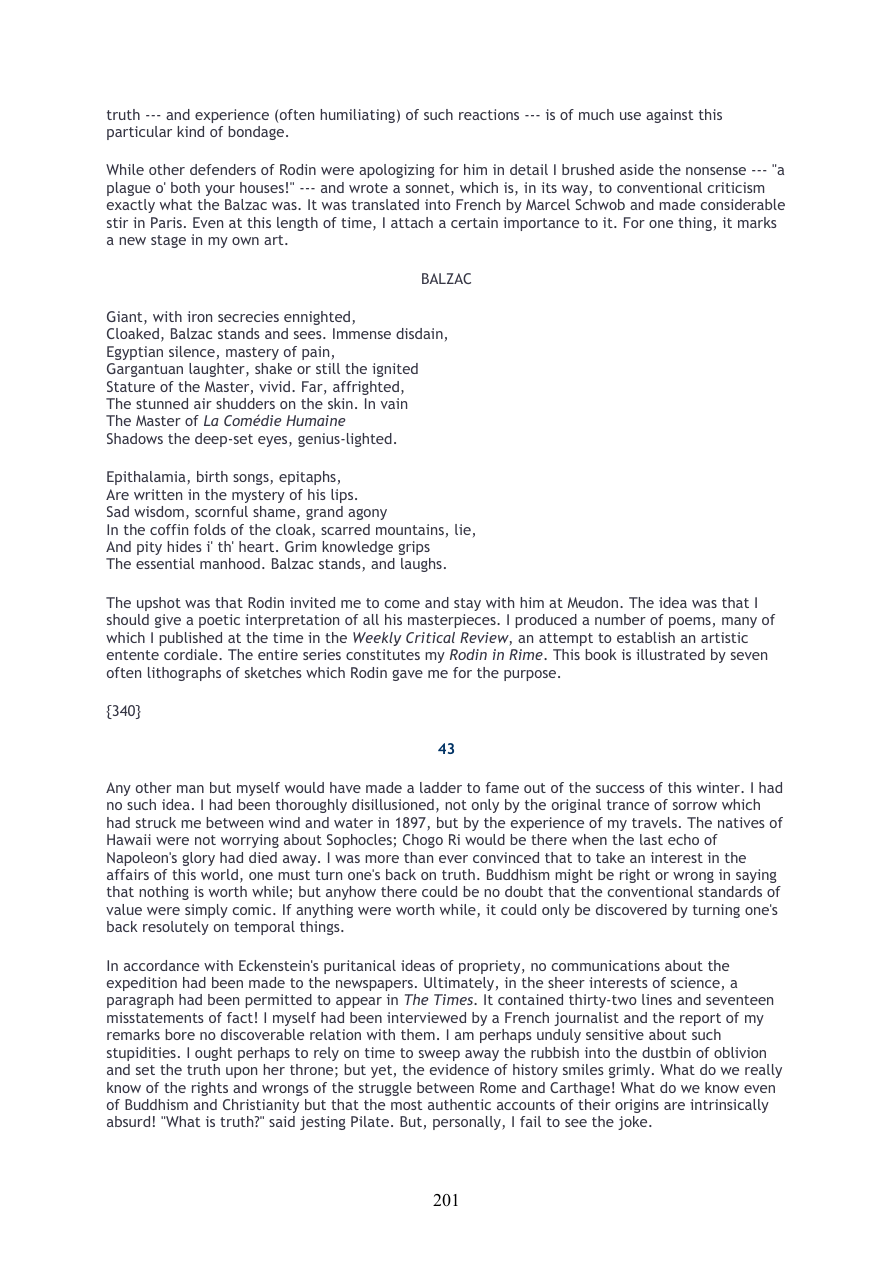
Highlights use the original PDF text layer. OCR-only matches may not be visible on the scan.
Transcription
Download text ↓raw extractionoriginal embedded textReview: unreviewed
201
truth --- and experience (often humiliating) of such reactions --- is of much use against this
particular kind of bondage.
While other defenders of Rodin were apologizing for him in detail I brushed aside the nonsense --- "a
plague o' both your houses!" --- and wrote a sonnet, which is, in its way, to conventional criticism
exactly what the Balzac was. It was translated into French by Marcel Schwob and made considerable
stir in Paris. Even at this length of time, I attach a certain importance to it. For one thing, it marks
a new stage in my own art.
BALZAC
Giant, with iron secrecies ennighted,
Cloaked, Balzac stands and sees. Immense disdain,
Egyptian silence, mastery of pain,
Gargantuan laughter, shake or still the ignited
Stature of the Master, vivid. Far, affrighted,
The stunned air shudders on the skin. In vain
The Master of La Comédie Humaine
Shadows the deep-set eyes, genius-lighted.
Epithalamia, birth songs, epitaphs,
Are written in the mystery of his lips.
Sad wisdom, scornful shame, grand agony
In the coffin folds of the cloak, scarred mountains, lie,
And pity hides i' th' heart. Grim knowledge grips
The essential manhood. Balzac stands, and laughs.
The upshot was that Rodin invited me to come and stay with him at Meudon. The idea was that I
should give a poetic interpretation of all his masterpieces. I produced a number of poems, many of
which I published at the time in the Weekly Critical Review, an attempt to establish an artistic
entente cordiale. The entire series constitutes my Rodin in Rime. This book is illustrated by seven
often lithographs of sketches which Rodin gave me for the purpose.
{340}
43
Any other man but myself would have made a ladder to fame out of the success of this winter. I had
no such idea. I had been thoroughly disillusioned, not only by the original trance of sorrow which
had struck me between wind and water in 1897, but by the experience of my travels. The natives of
Hawaii were not worrying about Sophocles; Chogo Ri would be there when the last echo of
Napoleon's glory had died away. I was more than ever convinced that to take an interest in the
affairs of this world, one must turn one's back on truth. Buddhism might be right or wrong in saying
that nothing is worth while; but anyhow there could be no doubt that the conventional standards of
value were simply comic. If anything were worth while, it could only be discovered by turning one's
back resolutely on temporal things.
In accordance with Eckenstein's puritanical ideas of propriety, no communications about the
expedition had been made to the newspapers. Ultimately, in the sheer interests of science, a
paragraph had been permitted to appear in The Times. It contained thirty-two lines and seventeen
misstatements of fact! I myself had been interviewed by a French journalist and the report of my
remarks bore no discoverable relation with them. I am perhaps unduly sensitive about such
stupidities. I ought perhaps to rely on time to sweep away the rubbish into the dustbin of oblivion
and set the truth upon her throne; but yet, the evidence of history smiles grimly. What do we really
know of the rights and wrongs of the struggle between Rome and Carthage! What do we know even
of Buddhism and Christianity but that the most authentic accounts of their origins are intrinsically
absurd! "What is truth?" said jesting Pilate. But, personally, I fail to see the joke.
Page provenance & review flags
Stable page ID: 5ef44b98d8f9c4af5f6f86e1:p00201
Line breaks are preserved. Reading order and OCR accuracy may need review.
Printed page label has not been verified.
- No automated review flags. This does not establish transcription accuracy.