1929 · CLOSE READING
Confessions of Aleister Crowley
Confessions of Aleister Crowley (1929), PDF p. 203
Original page
Enlarge ↗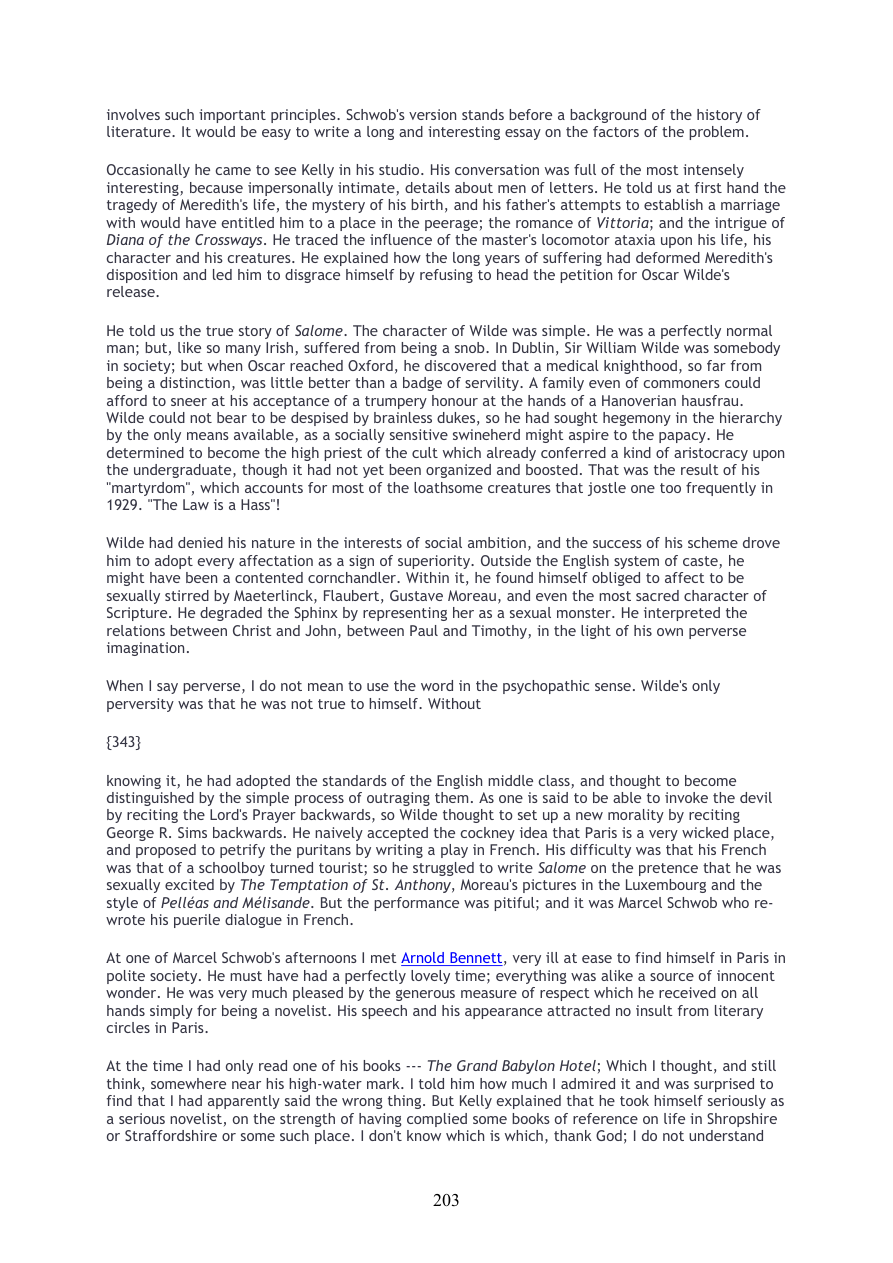
Highlights use the original PDF text layer. OCR-only matches may not be visible on the scan.
Transcription
Download text ↓raw extractionoriginal embedded textReview: unreviewed
203
involves such important principles. Schwob's version stands before a background of the history of
literature. It would be easy to write a long and interesting essay on the factors of the problem.
Occasionally he came to see Kelly in his studio. His conversation was full of the most intensely
interesting, because impersonally intimate, details about men of letters. He told us at first hand the
tragedy of Meredith's life, the mystery of his birth, and his father's attempts to establish a marriage
with would have entitled him to a place in the peerage; the romance of Vittoria; and the intrigue of
Diana of the Crossways. He traced the influence of the master's locomotor ataxia upon his life, his
character and his creatures. He explained how the long years of suffering had deformed Meredith's
disposition and led him to disgrace himself by refusing to head the petition for Oscar Wilde's
release.
He told us the true story of Salome. The character of Wilde was simple. He was a perfectly normal
man; but, like so many Irish, suffered from being a snob. In Dublin, Sir William Wilde was somebody
in society; but when Oscar reached Oxford, he discovered that a medical knighthood, so far from
being a distinction, was little better than a badge of servility. A family even of commoners could
afford to sneer at his acceptance of a trumpery honour at the hands of a Hanoverian hausfrau.
Wilde could not bear to be despised by brainless dukes, so he had sought hegemony in the hierarchy
by the only means available, as a socially sensitive swineherd might aspire to the papacy. He
determined to become the high priest of the cult which already conferred a kind of aristocracy upon
the undergraduate, though it had not yet been organized and boosted. That was the result of his
"martyrdom", which accounts for most of the loathsome creatures that jostle one too frequently in
1929. "The Law is a Hass"!
Wilde had denied his nature in the interests of social ambition, and the success of his scheme drove
him to adopt every affectation as a sign of superiority. Outside the English system of caste, he
might have been a contented cornchandler. Within it, he found himself obliged to affect to be
sexually stirred by Maeterlinck, Flaubert, Gustave Moreau, and even the most sacred character of
Scripture. He degraded the Sphinx by representing her as a sexual monster. He interpreted the
relations between Christ and John, between Paul and Timothy, in the light of his own perverse
imagination.
When I say perverse, I do not mean to use the word in the psychopathic sense. Wilde's only
perversity was that he was not true to himself. Without
{343}
knowing it, he had adopted the standards of the English middle class, and thought to become
distinguished by the simple process of outraging them. As one is said to be able to invoke the devil
by reciting the Lord's Prayer backwards, so Wilde thought to set up a new morality by reciting
George R. Sims backwards. He naively accepted the cockney idea that Paris is a very wicked place,
and proposed to petrify the puritans by writing a play in French. His difficulty was that his French
was that of a schoolboy turned tourist; so he struggled to write Salome on the pretence that he was
sexually excited by The Temptation of St. Anthony, Moreau's pictures in the Luxembourg and the
style of Pelléas and Mélisande. But the performance was pitiful; and it was Marcel Schwob who re-
wrote his puerile dialogue in French.
At one of Marcel Schwob's afternoons I met Arnold Bennett, very ill at ease to find himself in Paris in
polite society. He must have had a perfectly lovely time; everything was alike a source of innocent
wonder. He was very much pleased by the generous measure of respect which he received on all
hands simply for being a novelist. His speech and his appearance attracted no insult from literary
circles in Paris.
At the time I had only read one of his books --- The Grand Babylon Hotel; Which I thought, and still
think, somewhere near his high-water mark. I told him how much I admired it and was surprised to
find that I had apparently said the wrong thing. But Kelly explained that he took himself seriously as
a serious novelist, on the strength of having complied some books of reference on life in Shropshire
or Straffordshire or some such place. I don't know which is which, thank God; I do not understand
Page provenance & review flags
Stable page ID: 5ef44b98d8f9c4af5f6f86e1:p00203
Line breaks are preserved. Reading order and OCR accuracy may need review.
Printed page label has not been verified.
- No automated review flags. This does not establish transcription accuracy.