1929 · CLOSE READING
Confessions of Aleister Crowley
Confessions of Aleister Crowley (1929), PDF p. 210
Original page
Enlarge ↗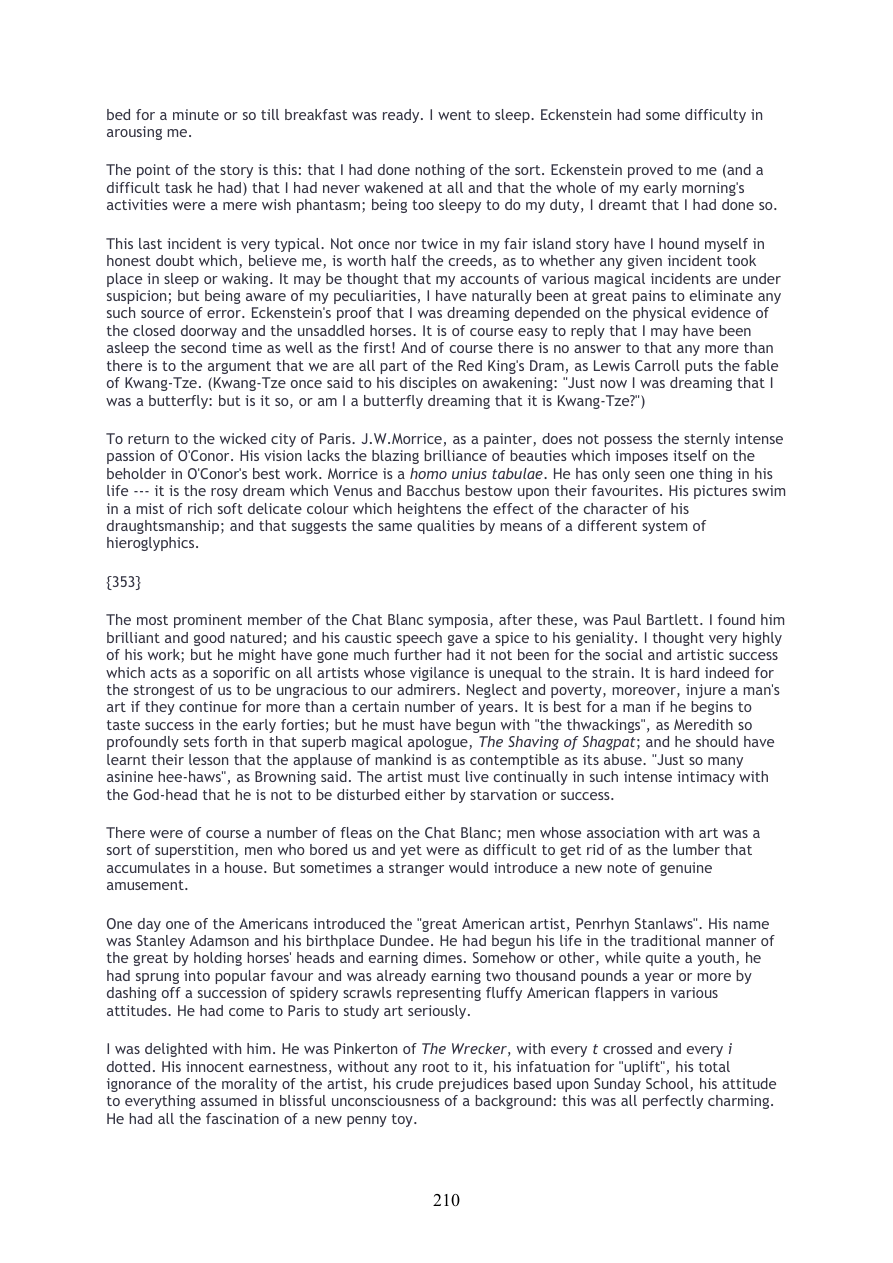
Highlights use the original PDF text layer. OCR-only matches may not be visible on the scan.
Transcription
Download text ↓raw extractionoriginal embedded textReview: unreviewed
210
bed for a minute or so till breakfast was ready. I went to sleep. Eckenstein had some difficulty in
arousing me.
The point of the story is this: that I had done nothing of the sort. Eckenstein proved to me (and a
difficult task he had) that I had never wakened at all and that the whole of my early morning's
activities were a mere wish phantasm; being too sleepy to do my duty, I dreamt that I had done so.
This last incident is very typical. Not once nor twice in my fair island story have I hound myself in
honest doubt which, believe me, is worth half the creeds, as to whether any given incident took
place in sleep or waking. It may be thought that my accounts of various magical incidents are under
suspicion; but being aware of my peculiarities, I have naturally been at great pains to eliminate any
such source of error. Eckenstein's proof that I was dreaming depended on the physical evidence of
the closed doorway and the unsaddled horses. It is of course easy to reply that I may have been
asleep the second time as well as the first! And of course there is no answer to that any more than
there is to the argument that we are all part of the Red King's Dram, as Lewis Carroll puts the fable
of Kwang-Tze. (Kwang-Tze once said to his disciples on awakening: "Just now I was dreaming that I
was a butterfly: but is it so, or am I a butterfly dreaming that it is Kwang-Tze?")
To return to the wicked city of Paris. J.W.Morrice, as a painter, does not possess the sternly intense
passion of O'Conor. His vision lacks the blazing brilliance of beauties which imposes itself on the
beholder in O'Conor's best work. Morrice is a homo unius tabulae. He has only seen one thing in his
life --- it is the rosy dream which Venus and Bacchus bestow upon their favourites. His pictures swim
in a mist of rich soft delicate colour which heightens the effect of the character of his
draughtsmanship; and that suggests the same qualities by means of a different system of
hieroglyphics.
{353}
The most prominent member of the Chat Blanc symposia, after these, was Paul Bartlett. I found him
brilliant and good natured; and his caustic speech gave a spice to his geniality. I thought very highly
of his work; but he might have gone much further had it not been for the social and artistic success
which acts as a soporific on all artists whose vigilance is unequal to the strain. It is hard indeed for
the strongest of us to be ungracious to our admirers. Neglect and poverty, moreover, injure a man's
art if they continue for more than a certain number of years. It is best for a man if he begins to
taste success in the early forties; but he must have begun with "the thwackings", as Meredith so
profoundly sets forth in that superb magical apologue, The Shaving of Shagpat; and he should have
learnt their lesson that the applause of mankind is as contemptible as its abuse. "Just so many
asinine hee-haws", as Browning said. The artist must live continually in such intense intimacy with
the God-head that he is not to be disturbed either by starvation or success.
There were of course a number of fleas on the Chat Blanc; men whose association with art was a
sort of superstition, men who bored us and yet were as difficult to get rid of as the lumber that
accumulates in a house. But sometimes a stranger would introduce a new note of genuine
amusement.
One day one of the Americans introduced the "great American artist, Penrhyn Stanlaws". His name
was Stanley Adamson and his birthplace Dundee. He had begun his life in the traditional manner of
the great by holding horses' heads and earning dimes. Somehow or other, while quite a youth, he
had sprung into popular favour and was already earning two thousand pounds a year or more by
dashing off a succession of spidery scrawls representing fluffy American flappers in various
attitudes. He had come to Paris to study art seriously.
I was delighted with him. He was Pinkerton of The Wrecker, with every t crossed and every i
dotted. His innocent earnestness, without any root to it, his infatuation for "uplift", his total
ignorance of the morality of the artist, his crude prejudices based upon Sunday School, his attitude
to everything assumed in blissful unconsciousness of a background: this was all perfectly charming.
He had all the fascination of a new penny toy.
Page provenance & review flags
Stable page ID: 5ef44b98d8f9c4af5f6f86e1:p00210
Line breaks are preserved. Reading order and OCR accuracy may need review.
Printed page label has not been verified.
- No automated review flags. This does not establish transcription accuracy.