1929 · CLOSE READING
Confessions of Aleister Crowley
Confessions of Aleister Crowley (1929), PDF p. 23
Original page
Enlarge ↗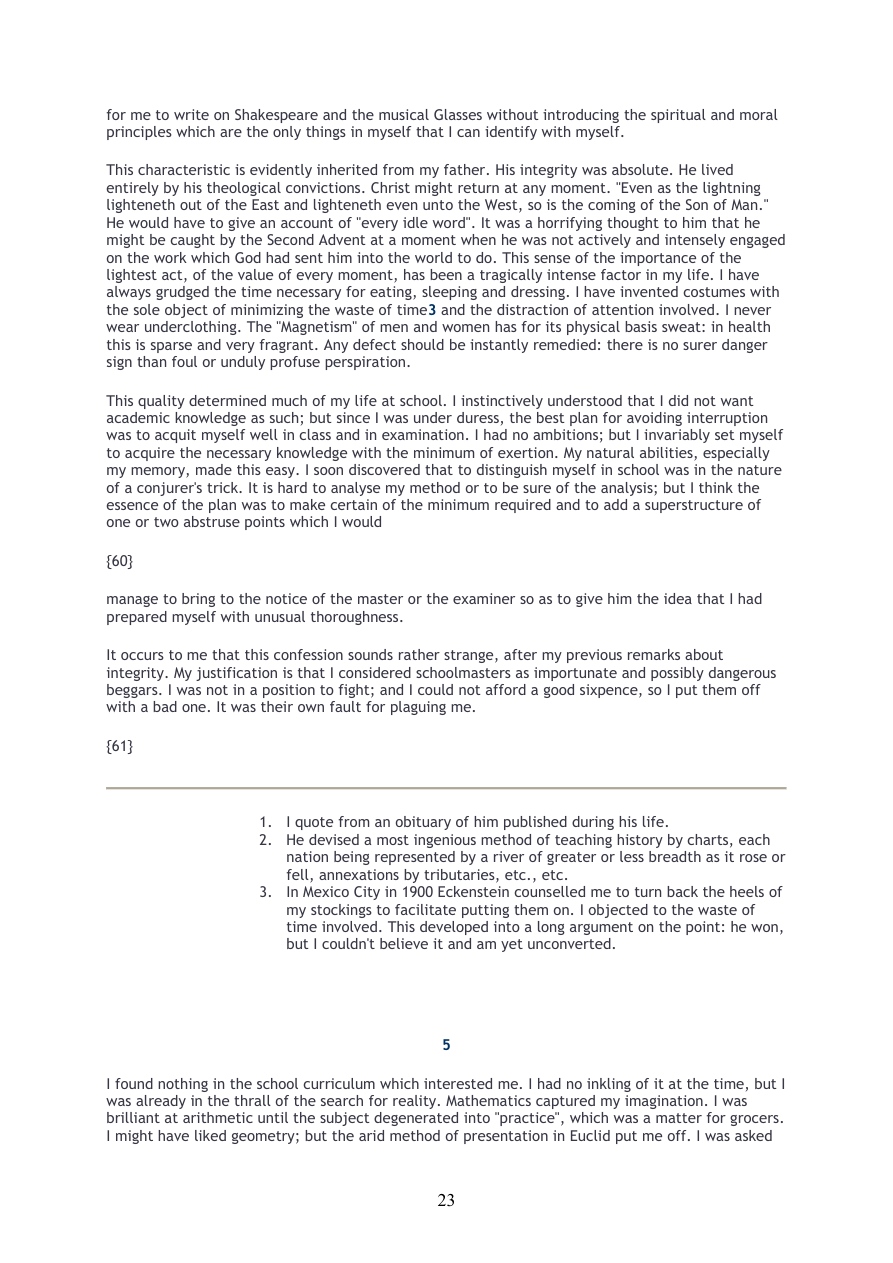
Highlights use the original PDF text layer. OCR-only matches may not be visible on the scan.
Transcription
Download text ↓raw extractionoriginal embedded textReview: unreviewed
23
for me to write on Shakespeare and the musical Glasses without introducing the spiritual and moral
principles which are the only things in myself that I can identify with myself.
This characteristic is evidently inherited from my father. His integrity was absolute. He lived
entirely by his theological convictions. Christ might return at any moment. "Even as the lightning
lighteneth out of the East and lighteneth even unto the West, so is the coming of the Son of Man."
He would have to give an account of "every idle word". It was a horrifying thought to him that he
might be caught by the Second Advent at a moment when he was not actively and intensely engaged
on the work which God had sent him into the world to do. This sense of the importance of the
lightest act, of the value of every moment, has been a tragically intense factor in my life. I have
always grudged the time necessary for eating, sleeping and dressing. I have invented costumes with
the sole object of minimizing the waste of time3 and the distraction of attention involved. I never
wear underclothing. The "Magnetism" of men and women has for its physical basis sweat: in health
this is sparse and very fragrant. Any defect should be instantly remedied: there is no surer danger
sign than foul or unduly profuse perspiration.
This quality determined much of my life at school. I instinctively understood that I did not want
academic knowledge as such; but since I was under duress, the best plan for avoiding interruption
was to acquit myself well in class and in examination. I had no ambitions; but I invariably set myself
to acquire the necessary knowledge with the minimum of exertion. My natural abilities, especially
my memory, made this easy. I soon discovered that to distinguish myself in school was in the nature
of a conjurer's trick. It is hard to analyse my method or to be sure of the analysis; but I think the
essence of the plan was to make certain of the minimum required and to add a superstructure of
one or two abstruse points which I would
{60}
manage to bring to the notice of the master or the examiner so as to give him the idea that I had
prepared myself with unusual thoroughness.
It occurs to me that this confession sounds rather strange, after my previous remarks about
integrity. My justification is that I considered schoolmasters as importunate and possibly dangerous
beggars. I was not in a position to fight; and I could not afford a good sixpence, so I put them off
with a bad one. It was their own fault for plaguing me.
{61}
1. I quote from an obituary of him published during his life.
2. He devised a most ingenious method of teaching history by charts, each
nation being represented by a river of greater or less breadth as it rose or
fell, annexations by tributaries, etc., etc.
3. In Mexico City in 1900 Eckenstein counselled me to turn back the heels of
my stockings to facilitate putting them on. I objected to the waste of
time involved. This developed into a long argument on the point: he won,
but I couldn't believe it and am yet unconverted.
5
I found nothing in the school curriculum which interested me. I had no inkling of it at the time, but I
was already in the thrall of the search for reality. Mathematics captured my imagination. I was
brilliant at arithmetic until the subject degenerated into "practice", which was a matter for grocers.
I might have liked geometry; but the arid method of presentation in Euclid put me off. I was asked
Page provenance & review flags
Stable page ID: 5ef44b98d8f9c4af5f6f86e1:p00023
Line breaks are preserved. Reading order and OCR accuracy may need review.
Printed page label has not been verified.
- No automated review flags. This does not establish transcription accuracy.