1929 · CLOSE READING
Confessions of Aleister Crowley
Confessions of Aleister Crowley (1929), PDF p. 24
Original page
Enlarge ↗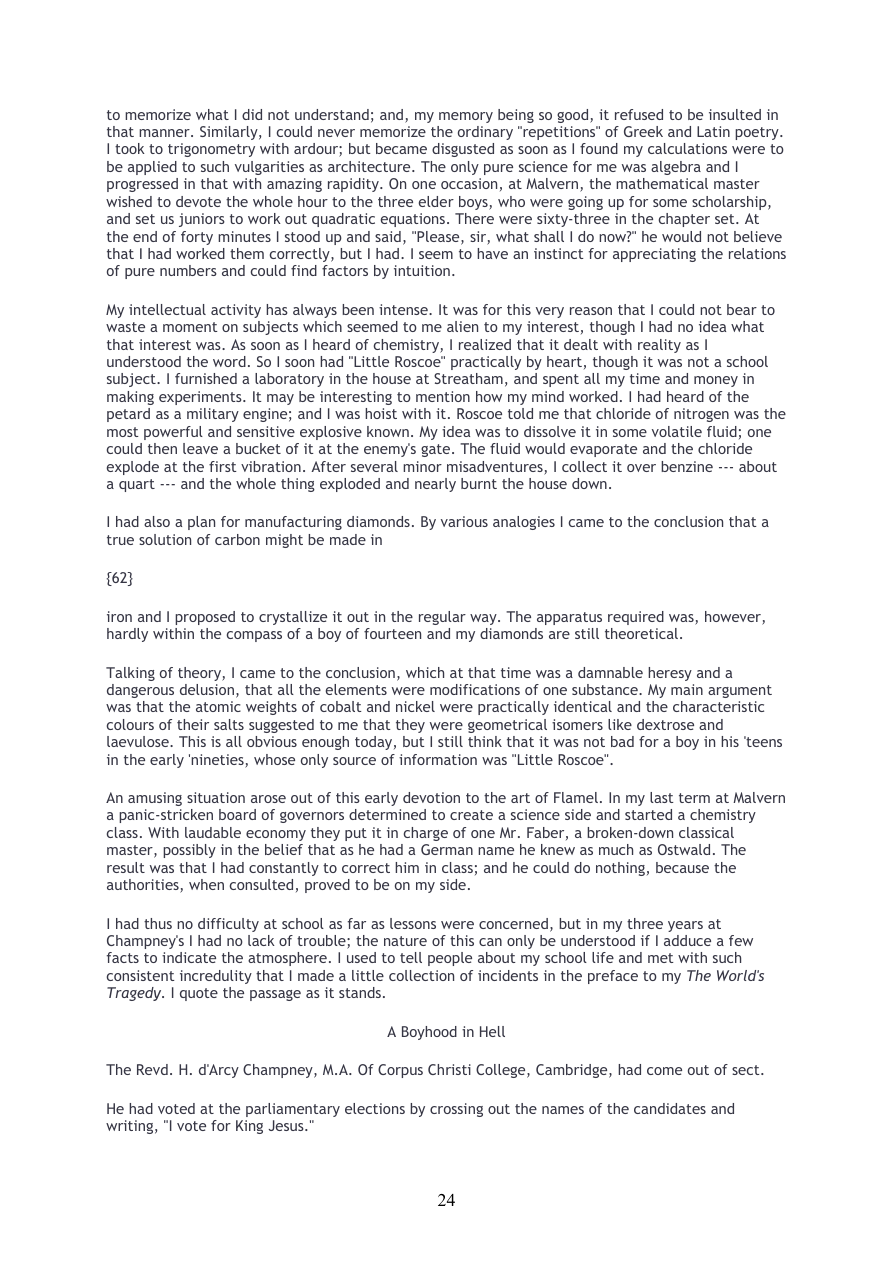
Highlights use the original PDF text layer. OCR-only matches may not be visible on the scan.
Transcription
Download text ↓raw extractionoriginal embedded textReview: unreviewed
24
to memorize what I did not understand; and, my memory being so good, it refused to be insulted in
that manner. Similarly, I could never memorize the ordinary "repetitions" of Greek and Latin poetry.
I took to trigonometry with ardour; but became disgusted as soon as I found my calculations were to
be applied to such vulgarities as architecture. The only pure science for me was algebra and I
progressed in that with amazing rapidity. On one occasion, at Malvern, the mathematical master
wished to devote the whole hour to the three elder boys, who were going up for some scholarship,
and set us juniors to work out quadratic equations. There were sixty-three in the chapter set. At
the end of forty minutes I stood up and said, "Please, sir, what shall I do now?" he would not believe
that I had worked them correctly, but I had. I seem to have an instinct for appreciating the relations
of pure numbers and could find factors by intuition.
My intellectual activity has always been intense. It was for this very reason that I could not bear to
waste a moment on subjects which seemed to me alien to my interest, though I had no idea what
that interest was. As soon as I heard of chemistry, I realized that it dealt with reality as I
understood the word. So I soon had "Little Roscoe" practically by heart, though it was not a school
subject. I furnished a laboratory in the house at Streatham, and spent all my time and money in
making experiments. It may be interesting to mention how my mind worked. I had heard of the
petard as a military engine; and I was hoist with it. Roscoe told me that chloride of nitrogen was the
most powerful and sensitive explosive known. My idea was to dissolve it in some volatile fluid; one
could then leave a bucket of it at the enemy's gate. The fluid would evaporate and the chloride
explode at the first vibration. After several minor misadventures, I collect it over benzine --- about
a quart --- and the whole thing exploded and nearly burnt the house down.
I had also a plan for manufacturing diamonds. By various analogies I came to the conclusion that a
true solution of carbon might be made in
{62}
iron and I proposed to crystallize it out in the regular way. The apparatus required was, however,
hardly within the compass of a boy of fourteen and my diamonds are still theoretical.
Talking of theory, I came to the conclusion, which at that time was a damnable heresy and a
dangerous delusion, that all the elements were modifications of one substance. My main argument
was that the atomic weights of cobalt and nickel were practically identical and the characteristic
colours of their salts suggested to me that they were geometrical isomers like dextrose and
laevulose. This is all obvious enough today, but I still think that it was not bad for a boy in his 'teens
in the early 'nineties, whose only source of information was "Little Roscoe".
An amusing situation arose out of this early devotion to the art of Flamel. In my last term at Malvern
a panic-stricken board of governors determined to create a science side and started a chemistry
class. With laudable economy they put it in charge of one Mr. Faber, a broken-down classical
master, possibly in the belief that as he had a German name he knew as much as Ostwald. The
result was that I had constantly to correct him in class; and he could do nothing, because the
authorities, when consulted, proved to be on my side.
I had thus no difficulty at school as far as lessons were concerned, but in my three years at
Champney's I had no lack of trouble; the nature of this can only be understood if I adduce a few
facts to indicate the atmosphere. I used to tell people about my school life and met with such
consistent incredulity that I made a little collection of incidents in the preface to my The World's
Tragedy. I quote the passage as it stands.
A Boyhood in Hell
The Revd. H. d'Arcy Champney, M.A. Of Corpus Christi College, Cambridge, had come out of sect.
He had voted at the parliamentary elections by crossing out the names of the candidates and
writing, "I vote for King Jesus."
Page provenance & review flags
Stable page ID: 5ef44b98d8f9c4af5f6f86e1:p00024
Line breaks are preserved. Reading order and OCR accuracy may need review.
Printed page label has not been verified.
- No automated review flags. This does not establish transcription accuracy.