1929 · CLOSE READING
Confessions of Aleister Crowley
Confessions of Aleister Crowley (1929), PDF p. 250
Original page
Enlarge ↗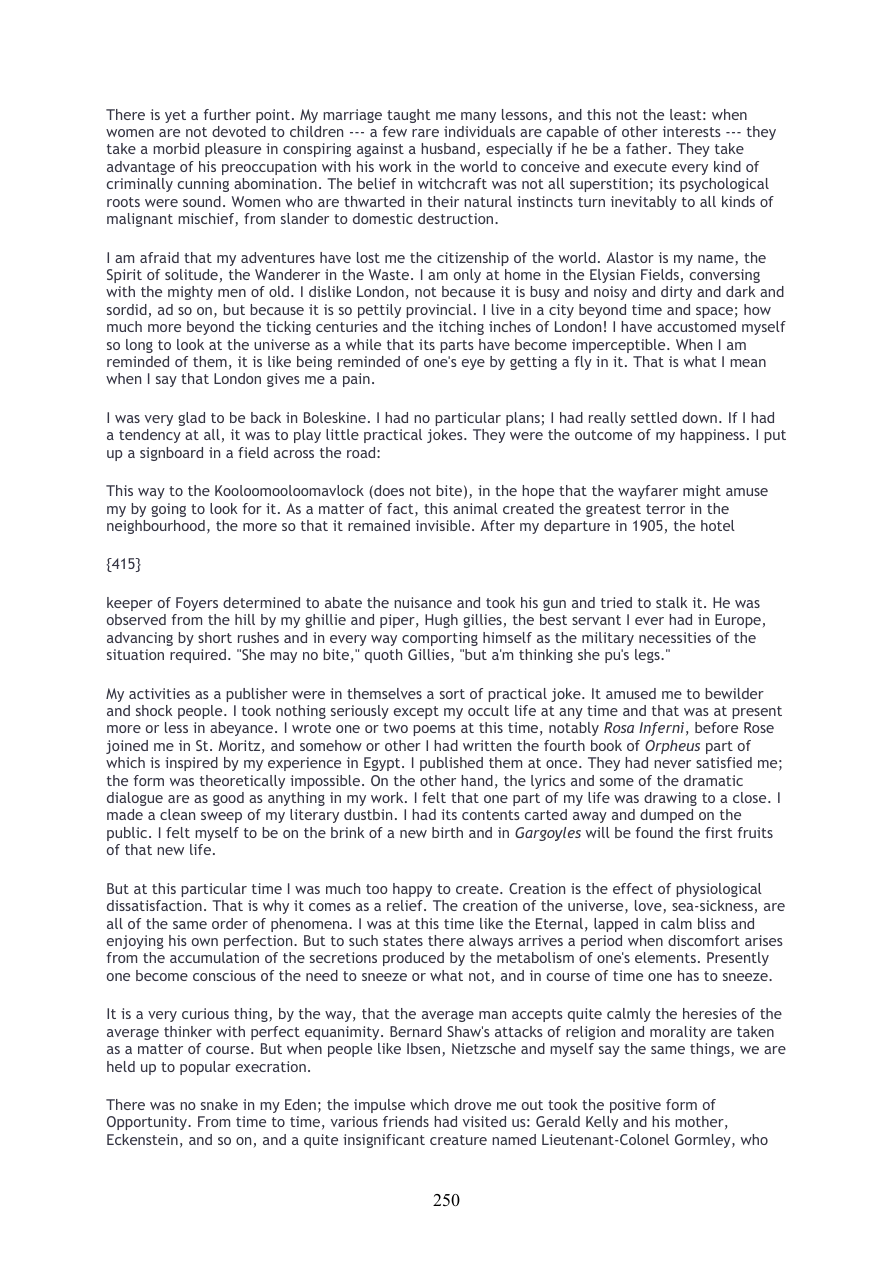
Highlights use the original PDF text layer. OCR-only matches may not be visible on the scan.
Transcription
Download text ↓raw extractionoriginal embedded textReview: unreviewed
250
There is yet a further point. My marriage taught me many lessons, and this not the least: when
women are not devoted to children --- a few rare individuals are capable of other interests --- they
take a morbid pleasure in conspiring against a husband, especially if he be a father. They take
advantage of his preoccupation with his work in the world to conceive and execute every kind of
criminally cunning abomination. The belief in witchcraft was not all superstition; its psychological
roots were sound. Women who are thwarted in their natural instincts turn inevitably to all kinds of
malignant mischief, from slander to domestic destruction.
I am afraid that my adventures have lost me the citizenship of the world. Alastor is my name, the
Spirit of solitude, the Wanderer in the Waste. I am only at home in the Elysian Fields, conversing
with the mighty men of old. I dislike London, not because it is busy and noisy and dirty and dark and
sordid, ad so on, but because it is so pettily provincial. I live in a city beyond time and space; how
much more beyond the ticking centuries and the itching inches of London! I have accustomed myself
so long to look at the universe as a while that its parts have become imperceptible. When I am
reminded of them, it is like being reminded of one's eye by getting a fly in it. That is what I mean
when I say that London gives me a pain.
I was very glad to be back in Boleskine. I had no particular plans; I had really settled down. If I had
a tendency at all, it was to play little practical jokes. They were the outcome of my happiness. I put
up a signboard in a field across the road:
This way to the Kooloomooloomavlock (does not bite), in the hope that the wayfarer might amuse
my by going to look for it. As a matter of fact, this animal created the greatest terror in the
neighbourhood, the more so that it remained invisible. After my departure in 1905, the hotel
{415}
keeper of Foyers determined to abate the nuisance and took his gun and tried to stalk it. He was
observed from the hill by my ghillie and piper, Hugh gillies, the best servant I ever had in Europe,
advancing by short rushes and in every way comporting himself as the military necessities of the
situation required. "She may no bite," quoth Gillies, "but a'm thinking she pu's legs."
My activities as a publisher were in themselves a sort of practical joke. It amused me to bewilder
and shock people. I took nothing seriously except my occult life at any time and that was at present
more or less in abeyance. I wrote one or two poems at this time, notably Rosa Inferni, before Rose
joined me in St. Moritz, and somehow or other I had written the fourth book of Orpheus part of
which is inspired by my experience in Egypt. I published them at once. They had never satisfied me;
the form was theoretically impossible. On the other hand, the lyrics and some of the dramatic
dialogue are as good as anything in my work. I felt that one part of my life was drawing to a close. I
made a clean sweep of my literary dustbin. I had its contents carted away and dumped on the
public. I felt myself to be on the brink of a new birth and in Gargoyles will be found the first fruits
of that new life.
But at this particular time I was much too happy to create. Creation is the effect of physiological
dissatisfaction. That is why it comes as a relief. The creation of the universe, love, sea-sickness, are
all of the same order of phenomena. I was at this time like the Eternal, lapped in calm bliss and
enjoying his own perfection. But to such states there always arrives a period when discomfort arises
from the accumulation of the secretions produced by the metabolism of one's elements. Presently
one become conscious of the need to sneeze or what not, and in course of time one has to sneeze.
It is a very curious thing, by the way, that the average man accepts quite calmly the heresies of the
average thinker with perfect equanimity. Bernard Shaw's attacks of religion and morality are taken
as a matter of course. But when people like Ibsen, Nietzsche and myself say the same things, we are
held up to popular execration.
There was no snake in my Eden; the impulse which drove me out took the positive form of
Opportunity. From time to time, various friends had visited us: Gerald Kelly and his mother,
Eckenstein, and so on, and a quite insignificant creature named Lieutenant-Colonel Gormley, who
Page provenance & review flags
Stable page ID: 5ef44b98d8f9c4af5f6f86e1:p00250
Line breaks are preserved. Reading order and OCR accuracy may need review.
Printed page label has not been verified.
- No automated review flags. This does not establish transcription accuracy.