1929 · CLOSE READING
Confessions of Aleister Crowley
Confessions of Aleister Crowley (1929), PDF p. 268
Original page
Enlarge ↗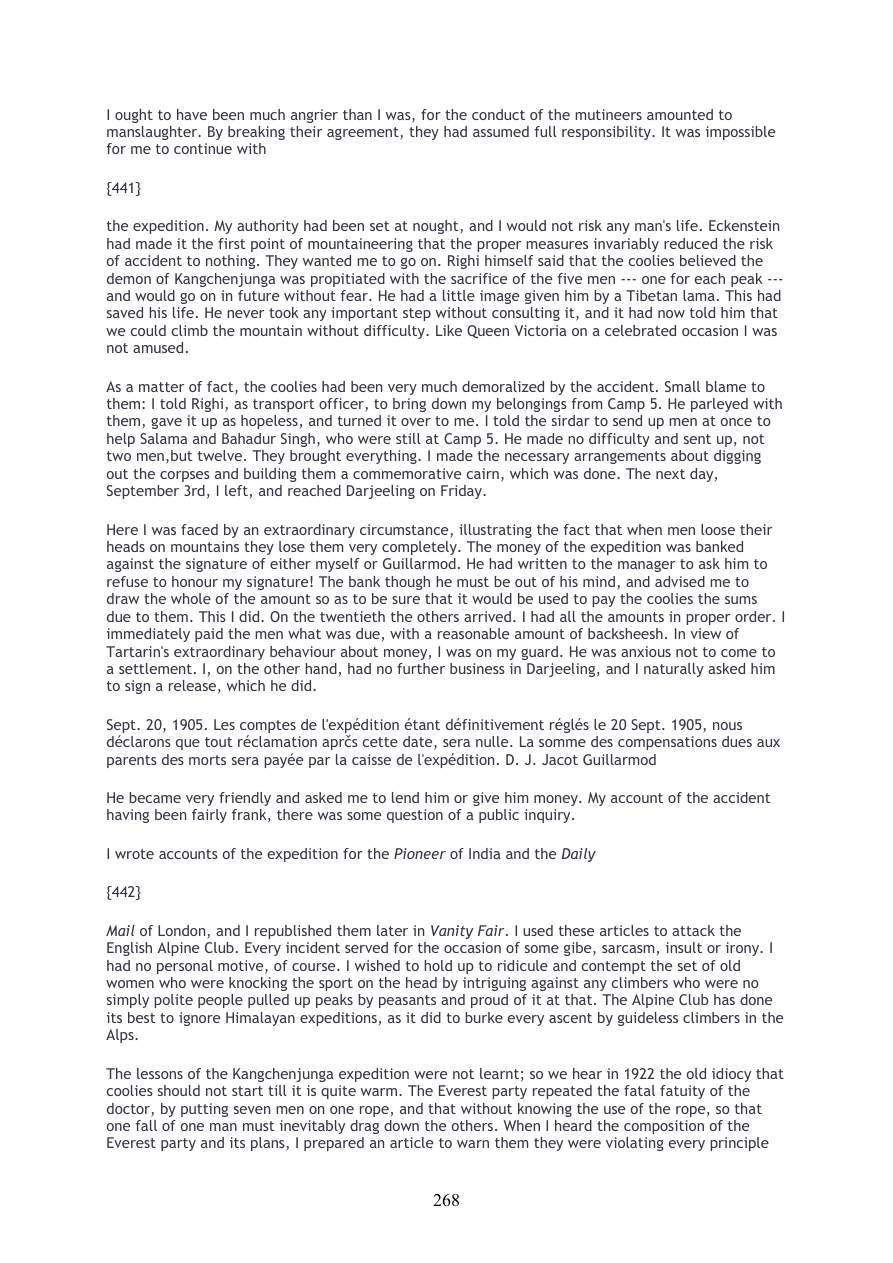
Highlights use the original PDF text layer. OCR-only matches may not be visible on the scan.
Transcription
Download text ↓raw extractionoriginal embedded textReview: unreviewed
268
I ought to have been much angrier than I was, for the conduct of the mutineers amounted to
manslaughter. By breaking their agreement, they had assumed full responsibility. It was impossible
for me to continue with
{441}
the expedition. My authority had been set at nought, and I would not risk any man's life. Eckenstein
had made it the first point of mountaineering that the proper measures invariably reduced the risk
of accident to nothing. They wanted me to go on. Righi himself said that the coolies believed the
demon of Kangchenjunga was propitiated with the sacrifice of the five men --- one for each peak ---
and would go on in future without fear. He had a little image given him by a Tibetan lama. This had
saved his life. He never took any important step without consulting it, and it had now told him that
we could climb the mountain without difficulty. Like Queen Victoria on a celebrated occasion I was
not amused.
As a matter of fact, the coolies had been very much demoralized by the accident. Small blame to
them: I told Righi, as transport officer, to bring down my belongings from Camp 5. He parleyed with
them, gave it up as hopeless, and turned it over to me. I told the sirdar to send up men at once to
help Salama and Bahadur Singh, who were still at Camp 5. He made no difficulty and sent up, not
two men,but twelve. They brought everything. I made the necessary arrangements about digging
out the corpses and building them a commemorative cairn, which was done. The next day,
September 3rd, I left, and reached Darjeeling on Friday.
Here I was faced by an extraordinary circumstance, illustrating the fact that when men loose their
heads on mountains they lose them very completely. The money of the expedition was banked
against the signature of either myself or Guillarmod. He had written to the manager to ask him to
refuse to honour my signature! The bank though he must be out of his mind, and advised me to
draw the whole of the amount so as to be sure that it would be used to pay the coolies the sums
due to them. This I did. On the twentieth the others arrived. I had all the amounts in proper order. I
immediately paid the men what was due, with a reasonable amount of backsheesh. In view of
Tartarin's extraordinary behaviour about money, I was on my guard. He was anxious not to come to
a settlement. I, on the other hand, had no further business in Darjeeling, and I naturally asked him
to sign a release, which he did.
Sept. 20, 1905. Les comptes de l'expédition étant définitivement réglés le 20 Sept. 1905, nous
déclarons que tout réclamation aprčs cette date, sera nulle. La somme des compensations dues aux
parents des morts sera payée par la caisse de l'expédition. D. J. Jacot Guillarmod
He became very friendly and asked me to lend him or give him money. My account of the accident
having been fairly frank, there was some question of a public inquiry.
I wrote accounts of the expedition for the Pioneer of India and the Daily
{442}
Mail of London, and I republished them later in Vanity Fair. I used these articles to attack the
English Alpine Club. Every incident served for the occasion of some gibe, sarcasm, insult or irony. I
had no personal motive, of course. I wished to hold up to ridicule and contempt the set of old
women who were knocking the sport on the head by intriguing against any climbers who were no
simply polite people pulled up peaks by peasants and proud of it at that. The Alpine Club has done
its best to ignore Himalayan expeditions, as it did to burke every ascent by guideless climbers in the
Alps.
The lessons of the Kangchenjunga expedition were not learnt; so we hear in 1922 the old idiocy that
coolies should not start till it is quite warm. The Everest party repeated the fatal fatuity of the
doctor, by putting seven men on one rope, and that without knowing the use of the rope, so that
one fall of one man must inevitably drag down the others. When I heard the composition of the
Everest party and its plans, I prepared an article to warn them they were violating every principle
Page provenance & review flags
Stable page ID: 5ef44b98d8f9c4af5f6f86e1:p00268
Line breaks are preserved. Reading order and OCR accuracy may need review.
Printed page label has not been verified.
- No automated review flags. This does not establish transcription accuracy.