1929 · CLOSE READING
Confessions of Aleister Crowley
Confessions of Aleister Crowley (1929), PDF p. 27
Original page
Enlarge ↗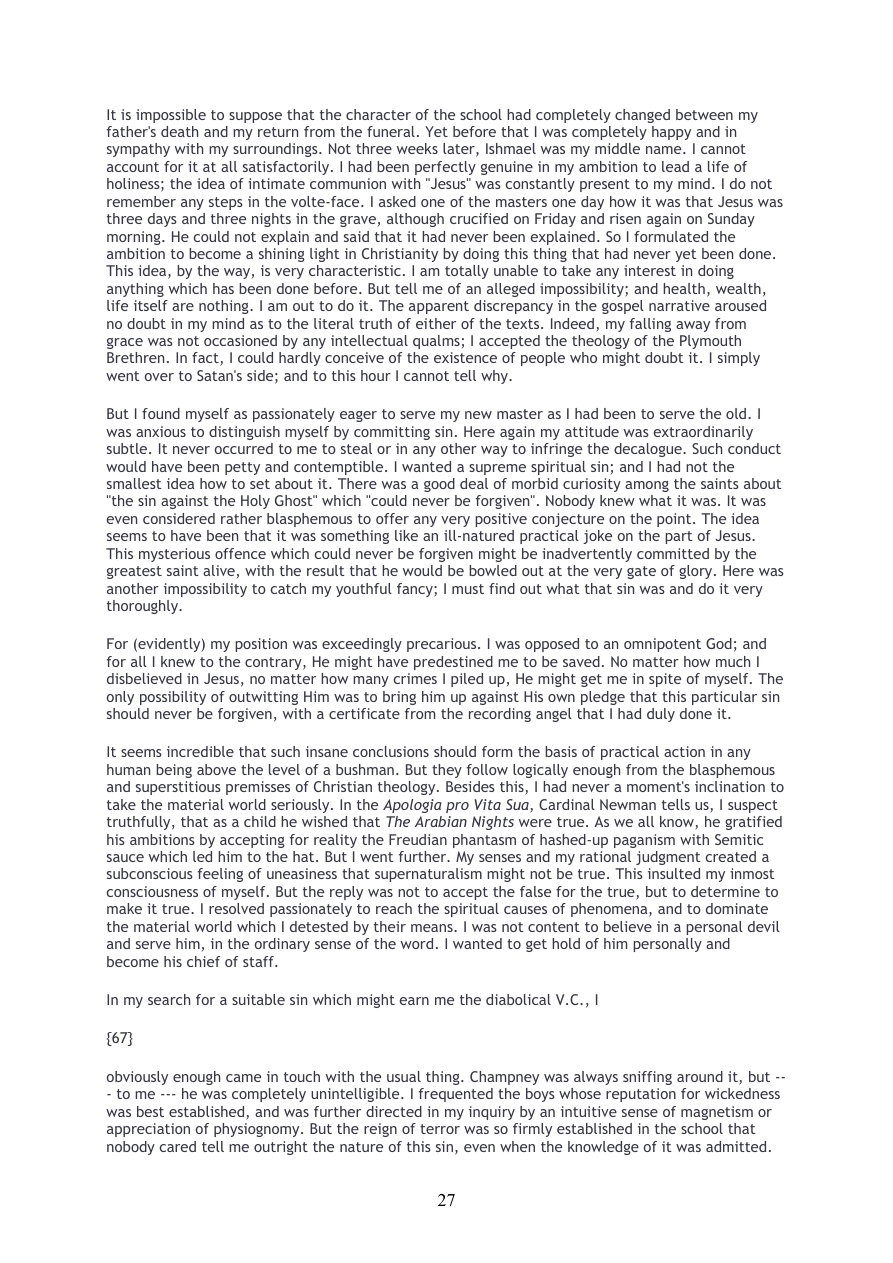
Highlights use the original PDF text layer. OCR-only matches may not be visible on the scan.
Transcription
Download text ↓raw extractionoriginal embedded textReview: unreviewed
27
It is impossible to suppose that the character of the school had completely changed between my
father's death and my return from the funeral. Yet before that I was completely happy and in
sympathy with my surroundings. Not three weeks later, Ishmael was my middle name. I cannot
account for it at all satisfactorily. I had been perfectly genuine in my ambition to lead a life of
holiness; the idea of intimate communion with "Jesus" was constantly present to my mind. I do not
remember any steps in the volte-face. I asked one of the masters one day how it was that Jesus was
three days and three nights in the grave, although crucified on Friday and risen again on Sunday
morning. He could not explain and said that it had never been explained. So I formulated the
ambition to become a shining light in Christianity by doing this thing that had never yet been done.
This idea, by the way, is very characteristic. I am totally unable to take any interest in doing
anything which has been done before. But tell me of an alleged impossibility; and health, wealth,
life itself are nothing. I am out to do it. The apparent discrepancy in the gospel narrative aroused
no doubt in my mind as to the literal truth of either of the texts. Indeed, my falling away from
grace was not occasioned by any intellectual qualms; I accepted the theology of the Plymouth
Brethren. In fact, I could hardly conceive of the existence of people who might doubt it. I simply
went over to Satan's side; and to this hour I cannot tell why.
But I found myself as passionately eager to serve my new master as I had been to serve the old. I
was anxious to distinguish myself by committing sin. Here again my attitude was extraordinarily
subtle. It never occurred to me to steal or in any other way to infringe the decalogue. Such conduct
would have been petty and contemptible. I wanted a supreme spiritual sin; and I had not the
smallest idea how to set about it. There was a good deal of morbid curiosity among the saints about
"the sin against the Holy Ghost" which "could never be forgiven". Nobody knew what it was. It was
even considered rather blasphemous to offer any very positive conjecture on the point. The idea
seems to have been that it was something like an ill-natured practical joke on the part of Jesus.
This mysterious offence which could never be forgiven might be inadvertently committed by the
greatest saint alive, with the result that he would be bowled out at the very gate of glory. Here was
another impossibility to catch my youthful fancy; I must find out what that sin was and do it very
thoroughly.
For (evidently) my position was exceedingly precarious. I was opposed to an omnipotent God; and
for all I knew to the contrary, He might have predestined me to be saved. No matter how much I
disbelieved in Jesus, no matter how many crimes I piled up, He might get me in spite of myself. The
only possibility of outwitting Him was to bring him up against His own pledge that this particular sin
should never be forgiven, with a certificate from the recording angel that I had duly done it.
It seems incredible that such insane conclusions should form the basis of practical action in any
human being above the level of a bushman. But they follow logically enough from the blasphemous
and superstitious premisses of Christian theology. Besides this, I had never a moment's inclination to
take the material world seriously. In the Apologia pro Vita Sua, Cardinal Newman tells us, I suspect
truthfully, that as a child he wished that The Arabian Nights were true. As we all know, he gratified
his ambitions by accepting for reality the Freudian phantasm of hashed-up paganism with Semitic
sauce which led him to the hat. But I went further. My senses and my rational judgment created a
subconscious feeling of uneasiness that supernaturalism might not be true. This insulted my inmost
consciousness of myself. But the reply was not to accept the false for the true, but to determine to
make it true. I resolved passionately to reach the spiritual causes of phenomena, and to dominate
the material world which I detested by their means. I was not content to believe in a personal devil
and serve him, in the ordinary sense of the word. I wanted to get hold of him personally and
become his chief of staff.
In my search for a suitable sin which might earn me the diabolical V.C., I
{67}
obviously enough came in touch with the usual thing. Champney was always sniffing around it, but --
- to me --- he was completely unintelligible. I frequented the boys whose reputation for wickedness
was best established, and was further directed in my inquiry by an intuitive sense of magnetism or
appreciation of physiognomy. But the reign of terror was so firmly established in the school that
nobody cared tell me outright the nature of this sin, even when the knowledge of it was admitted.
Page provenance & review flags
Stable page ID: 5ef44b98d8f9c4af5f6f86e1:p00027
Line breaks are preserved. Reading order and OCR accuracy may need review.
Printed page label has not been verified.
- No automated review flags. This does not establish transcription accuracy.