1929 · CLOSE READING
Confessions of Aleister Crowley
Confessions of Aleister Crowley (1929), PDF p. 288
Original page
Enlarge ↗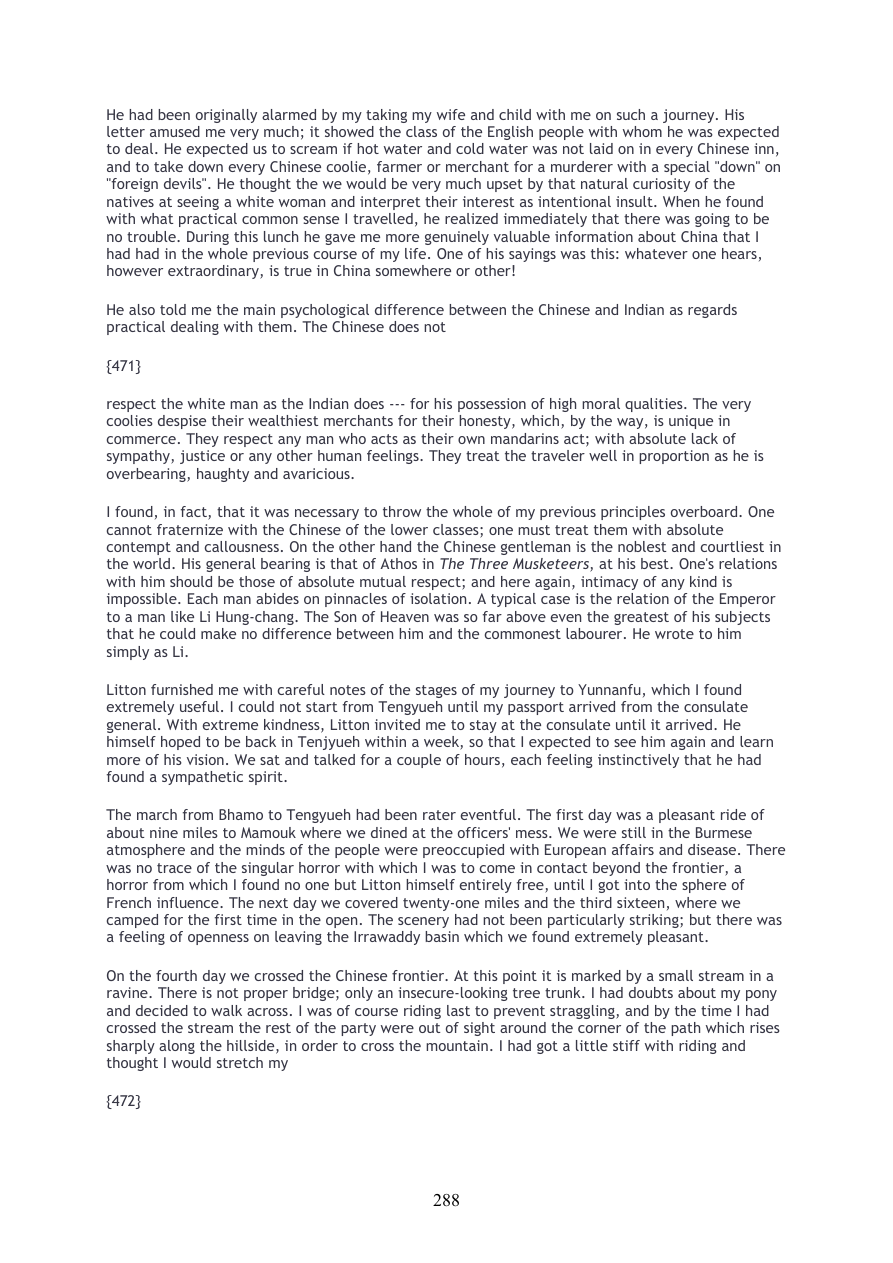
Highlights use the original PDF text layer. OCR-only matches may not be visible on the scan.
Transcription
Download text ↓raw extractionoriginal embedded textReview: unreviewed
288
He had been originally alarmed by my taking my wife and child with me on such a journey. His
letter amused me very much; it showed the class of the English people with whom he was expected
to deal. He expected us to scream if hot water and cold water was not laid on in every Chinese inn,
and to take down every Chinese coolie, farmer or merchant for a murderer with a special "down" on
"foreign devils". He thought the we would be very much upset by that natural curiosity of the
natives at seeing a white woman and interpret their interest as intentional insult. When he found
with what practical common sense I travelled, he realized immediately that there was going to be
no trouble. During this lunch he gave me more genuinely valuable information about China that I
had had in the whole previous course of my life. One of his sayings was this: whatever one hears,
however extraordinary, is true in China somewhere or other!
He also told me the main psychological difference between the Chinese and Indian as regards
practical dealing with them. The Chinese does not
{471}
respect the white man as the Indian does --- for his possession of high moral qualities. The very
coolies despise their wealthiest merchants for their honesty, which, by the way, is unique in
commerce. They respect any man who acts as their own mandarins act; with absolute lack of
sympathy, justice or any other human feelings. They treat the traveler well in proportion as he is
overbearing, haughty and avaricious.
I found, in fact, that it was necessary to throw the whole of my previous principles overboard. One
cannot fraternize with the Chinese of the lower classes; one must treat them with absolute
contempt and callousness. On the other hand the Chinese gentleman is the noblest and courtliest in
the world. His general bearing is that of Athos in The Three Musketeers, at his best. One's relations
with him should be those of absolute mutual respect; and here again, intimacy of any kind is
impossible. Each man abides on pinnacles of isolation. A typical case is the relation of the Emperor
to a man like Li Hung-chang. The Son of Heaven was so far above even the greatest of his subjects
that he could make no difference between him and the commonest labourer. He wrote to him
simply as Li.
Litton furnished me with careful notes of the stages of my journey to Yunnanfu, which I found
extremely useful. I could not start from Tengyueh until my passport arrived from the consulate
general. With extreme kindness, Litton invited me to stay at the consulate until it arrived. He
himself hoped to be back in Tenjyueh within a week, so that I expected to see him again and learn
more of his vision. We sat and talked for a couple of hours, each feeling instinctively that he had
found a sympathetic spirit.
The march from Bhamo to Tengyueh had been rater eventful. The first day was a pleasant ride of
about nine miles to Mamouk where we dined at the officers' mess. We were still in the Burmese
atmosphere and the minds of the people were preoccupied with European affairs and disease. There
was no trace of the singular horror with which I was to come in contact beyond the frontier, a
horror from which I found no one but Litton himself entirely free, until I got into the sphere of
French influence. The next day we covered twenty-one miles and the third sixteen, where we
camped for the first time in the open. The scenery had not been particularly striking; but there was
a feeling of openness on leaving the Irrawaddy basin which we found extremely pleasant.
On the fourth day we crossed the Chinese frontier. At this point it is marked by a small stream in a
ravine. There is not proper bridge; only an insecure-looking tree trunk. I had doubts about my pony
and decided to walk across. I was of course riding last to prevent straggling, and by the time I had
crossed the stream the rest of the party were out of sight around the corner of the path which rises
sharply along the hillside, in order to cross the mountain. I had got a little stiff with riding and
thought I would stretch my
{472}
Page provenance & review flags
Stable page ID: 5ef44b98d8f9c4af5f6f86e1:p00288
Line breaks are preserved. Reading order and OCR accuracy may need review.
Printed page label has not been verified.
- No automated review flags. This does not establish transcription accuracy.