1929 · CLOSE READING
Confessions of Aleister Crowley
Confessions of Aleister Crowley (1929), PDF p. 312
Original page
Enlarge ↗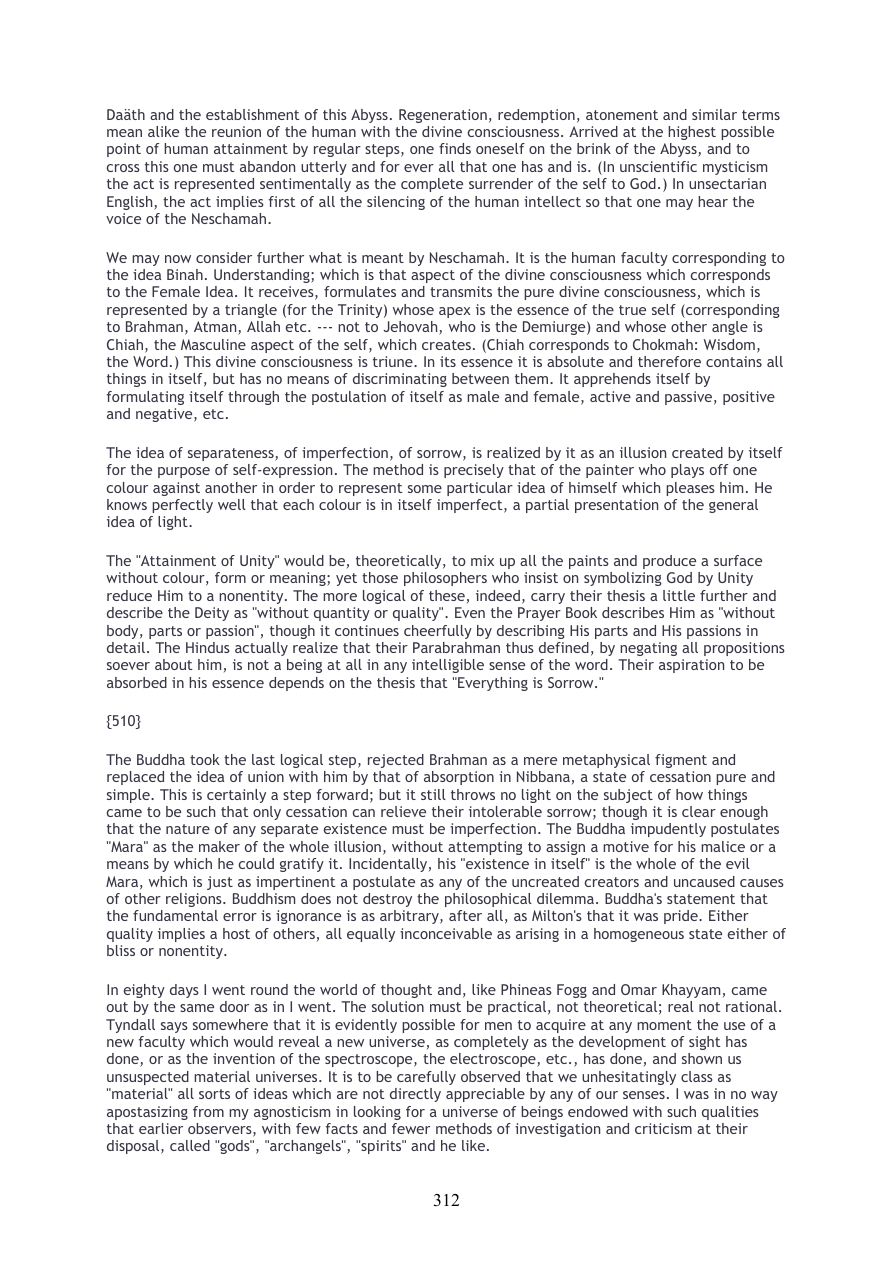
Highlights use the original PDF text layer. OCR-only matches may not be visible on the scan.
Transcription
Download text ↓raw extractionoriginal embedded textReview: unreviewed
312
Daäth and the establishment of this Abyss. Regeneration, redemption, atonement and similar terms
mean alike the reunion of the human with the divine consciousness. Arrived at the highest possible
point of human attainment by regular steps, one finds oneself on the brink of the Abyss, and to
cross this one must abandon utterly and for ever all that one has and is. (In unscientific mysticism
the act is represented sentimentally as the complete surrender of the self to God.) In unsectarian
English, the act implies first of all the silencing of the human intellect so that one may hear the
voice of the Neschamah.
We may now consider further what is meant by Neschamah. It is the human faculty corresponding to
the idea Binah. Understanding; which is that aspect of the divine consciousness which corresponds
to the Female Idea. It receives, formulates and transmits the pure divine consciousness, which is
represented by a triangle (for the Trinity) whose apex is the essence of the true self (corresponding
to Brahman, Atman, Allah etc. --- not to Jehovah, who is the Demiurge) and whose other angle is
Chiah, the Masculine aspect of the self, which creates. (Chiah corresponds to Chokmah: Wisdom,
the Word.) This divine consciousness is triune. In its essence it is absolute and therefore contains all
things in itself, but has no means of discriminating between them. It apprehends itself by
formulating itself through the postulation of itself as male and female, active and passive, positive
and negative, etc.
The idea of separateness, of imperfection, of sorrow, is realized by it as an illusion created by itself
for the purpose of self-expression. The method is precisely that of the painter who plays off one
colour against another in order to represent some particular idea of himself which pleases him. He
knows perfectly well that each colour is in itself imperfect, a partial presentation of the general
idea of light.
The "Attainment of Unity" would be, theoretically, to mix up all the paints and produce a surface
without colour, form or meaning; yet those philosophers who insist on symbolizing God by Unity
reduce Him to a nonentity. The more logical of these, indeed, carry their thesis a little further and
describe the Deity as "without quantity or quality". Even the Prayer Book describes Him as "without
body, parts or passion", though it continues cheerfully by describing His parts and His passions in
detail. The Hindus actually realize that their Parabrahman thus defined, by negating all propositions
soever about him, is not a being at all in any intelligible sense of the word. Their aspiration to be
absorbed in his essence depends on the thesis that "Everything is Sorrow."
{510}
The Buddha took the last logical step, rejected Brahman as a mere metaphysical figment and
replaced the idea of union with him by that of absorption in Nibbana, a state of cessation pure and
simple. This is certainly a step forward; but it still throws no light on the subject of how things
came to be such that only cessation can relieve their intolerable sorrow; though it is clear enough
that the nature of any separate existence must be imperfection. The Buddha impudently postulates
"Mara" as the maker of the whole illusion, without attempting to assign a motive for his malice or a
means by which he could gratify it. Incidentally, his "existence in itself" is the whole of the evil
Mara, which is just as impertinent a postulate as any of the uncreated creators and uncaused causes
of other religions. Buddhism does not destroy the philosophical dilemma. Buddha's statement that
the fundamental error is ignorance is as arbitrary, after all, as Milton's that it was pride. Either
quality implies a host of others, all equally inconceivable as arising in a homogeneous state either of
bliss or nonentity.
In eighty days I went round the world of thought and, like Phineas Fogg and Omar Khayyam, came
out by the same door as in I went. The solution must be practical, not theoretical; real not rational.
Tyndall says somewhere that it is evidently possible for men to acquire at any moment the use of a
new faculty which would reveal a new universe, as completely as the development of sight has
done, or as the invention of the spectroscope, the electroscope, etc., has done, and shown us
unsuspected material universes. It is to be carefully observed that we unhesitatingly class as
"material" all sorts of ideas which are not directly appreciable by any of our senses. I was in no way
apostasizing from my agnosticism in looking for a universe of beings endowed with such qualities
that earlier observers, with few facts and fewer methods of investigation and criticism at their
disposal, called "gods", "archangels", "spirits" and he like.
Page provenance & review flags
Stable page ID: 5ef44b98d8f9c4af5f6f86e1:p00312
Line breaks are preserved. Reading order and OCR accuracy may need review.
Printed page label has not been verified.
- No automated review flags. This does not establish transcription accuracy.