1929 · CLOSE READING
Confessions of Aleister Crowley
Confessions of Aleister Crowley (1929), PDF p. 330
Original page
Enlarge ↗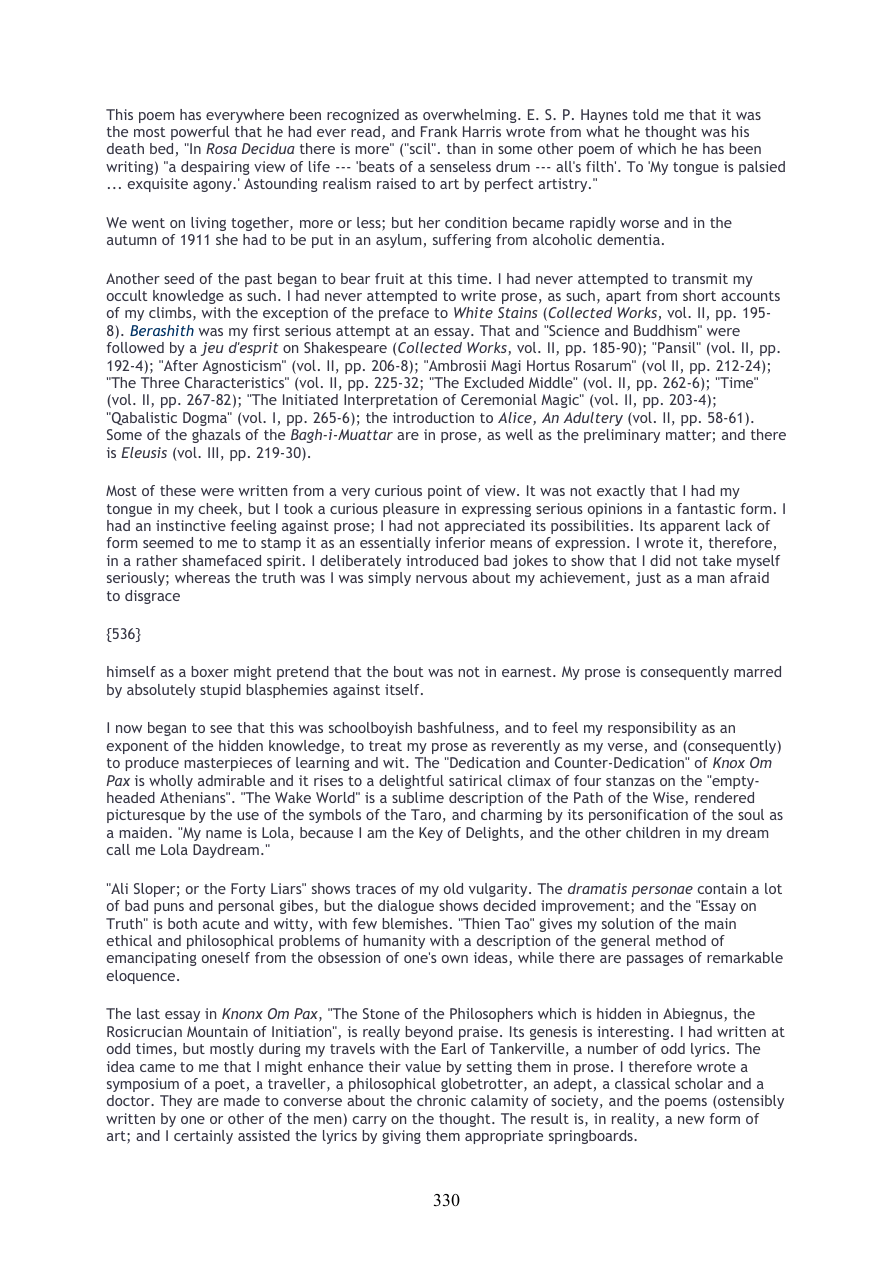
Highlights use the original PDF text layer. OCR-only matches may not be visible on the scan.
Transcription
Download text ↓raw extractionoriginal embedded textReview: unreviewed
330
This poem has everywhere been recognized as overwhelming. E. S. P. Haynes told me that it was
the most powerful that he had ever read, and Frank Harris wrote from what he thought was his
death bed, "In Rosa Decidua there is more" ("scil". than in some other poem of which he has been
writing) "a despairing view of life --- 'beats of a senseless drum --- all's filth'. To 'My tongue is palsied
... exquisite agony.' Astounding realism raised to art by perfect artistry."
We went on living together, more or less; but her condition became rapidly worse and in the
autumn of 1911 she had to be put in an asylum, suffering from alcoholic dementia.
Another seed of the past began to bear fruit at this time. I had never attempted to transmit my
occult knowledge as such. I had never attempted to write prose, as such, apart from short accounts
of my climbs, with the exception of the preface to White Stains (Collected Works, vol. II, pp. 195-
8). Berashith was my first serious attempt at an essay. That and "Science and Buddhism" were
followed by a jeu d'esprit on Shakespeare (Collected Works, vol. II, pp. 185-90); "Pansil" (vol. II, pp.
192-4); "After Agnosticism" (vol. II, pp. 206-8); "Ambrosii Magi Hortus Rosarum" (vol II, pp. 212-24);
"The Three Characteristics" (vol. II, pp. 225-32; "The Excluded Middle" (vol. II, pp. 262-6); "Time"
(vol. II, pp. 267-82); "The Initiated Interpretation of Ceremonial Magic" (vol. II, pp. 203-4);
"Qabalistic Dogma" (vol. I, pp. 265-6); the introduction to Alice, An Adultery (vol. II, pp. 58-61).
Some of the ghazals of the Bagh-i-Muattar are in prose, as well as the preliminary matter; and there
is Eleusis (vol. III, pp. 219-30).
Most of these were written from a very curious point of view. It was not exactly that I had my
tongue in my cheek, but I took a curious pleasure in expressing serious opinions in a fantastic form. I
had an instinctive feeling against prose; I had not appreciated its possibilities. Its apparent lack of
form seemed to me to stamp it as an essentially inferior means of expression. I wrote it, therefore,
in a rather shamefaced spirit. I deliberately introduced bad jokes to show that I did not take myself
seriously; whereas the truth was I was simply nervous about my achievement, just as a man afraid
to disgrace
{536}
himself as a boxer might pretend that the bout was not in earnest. My prose is consequently marred
by absolutely stupid blasphemies against itself.
I now began to see that this was schoolboyish bashfulness, and to feel my responsibility as an
exponent of the hidden knowledge, to treat my prose as reverently as my verse, and (consequently)
to produce masterpieces of learning and wit. The "Dedication and Counter-Dedication" of Knox Om
Pax is wholly admirable and it rises to a delightful satirical climax of four stanzas on the "empty-
headed Athenians". "The Wake World" is a sublime description of the Path of the Wise, rendered
picturesque by the use of the symbols of the Taro, and charming by its personification of the soul as
a maiden. "My name is Lola, because I am the Key of Delights, and the other children in my dream
call me Lola Daydream."
"Ali Sloper; or the Forty Liars" shows traces of my old vulgarity. The dramatis personae contain a lot
of bad puns and personal gibes, but the dialogue shows decided improvement; and the "Essay on
Truth" is both acute and witty, with few blemishes. "Thien Tao" gives my solution of the main
ethical and philosophical problems of humanity with a description of the general method of
emancipating oneself from the obsession of one's own ideas, while there are passages of remarkable
eloquence.
The last essay in Knonx Om Pax, "The Stone of the Philosophers which is hidden in Abiegnus, the
Rosicrucian Mountain of Initiation", is really beyond praise. Its genesis is interesting. I had written at
odd times, but mostly during my travels with the Earl of Tankerville, a number of odd lyrics. The
idea came to me that I might enhance their value by setting them in prose. I therefore wrote a
symposium of a poet, a traveller, a philosophical globetrotter, an adept, a classical scholar and a
doctor. They are made to converse about the chronic calamity of society, and the poems (ostensibly
written by one or other of the men) carry on the thought. The result is, in reality, a new form of
art; and I certainly assisted the lyrics by giving them appropriate springboards.
Page provenance & review flags
Stable page ID: 5ef44b98d8f9c4af5f6f86e1:p00330
Line breaks are preserved. Reading order and OCR accuracy may need review.
Printed page label has not been verified.
- No automated review flags. This does not establish transcription accuracy.