1929 · CLOSE READING
Confessions of Aleister Crowley
Confessions of Aleister Crowley (1929), PDF p. 345
Original page
Enlarge ↗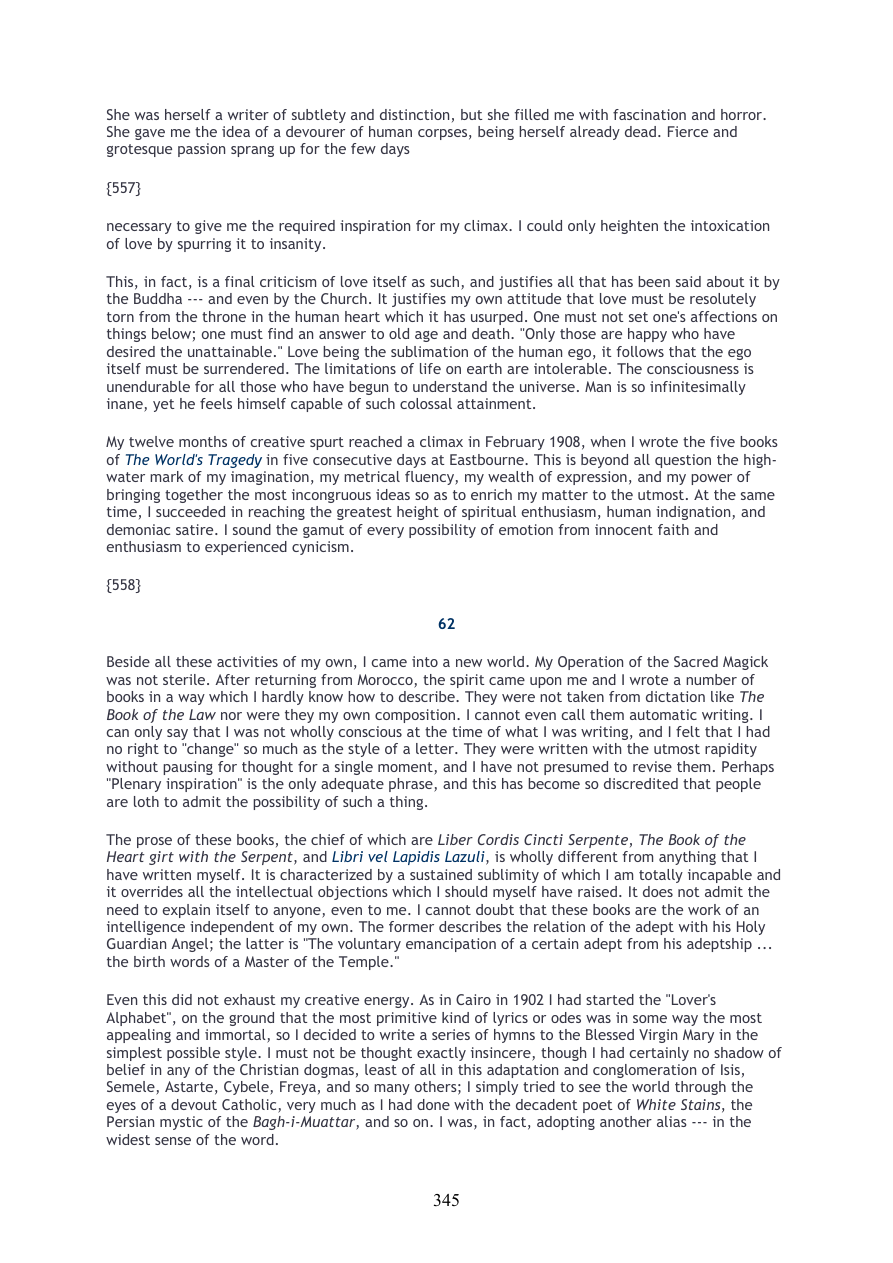
Highlights use the original PDF text layer. OCR-only matches may not be visible on the scan.
Transcription
Download text ↓raw extractionoriginal embedded textReview: unreviewed
345
She was herself a writer of subtlety and distinction, but she filled me with fascination and horror.
She gave me the idea of a devourer of human corpses, being herself already dead. Fierce and
grotesque passion sprang up for the few days
{557}
necessary to give me the required inspiration for my climax. I could only heighten the intoxication
of love by spurring it to insanity.
This, in fact, is a final criticism of love itself as such, and justifies all that has been said about it by
the Buddha --- and even by the Church. It justifies my own attitude that love must be resolutely
torn from the throne in the human heart which it has usurped. One must not set one's affections on
things below; one must find an answer to old age and death. "Only those are happy who have
desired the unattainable." Love being the sublimation of the human ego, it follows that the ego
itself must be surrendered. The limitations of life on earth are intolerable. The consciousness is
unendurable for all those who have begun to understand the universe. Man is so infinitesimally
inane, yet he feels himself capable of such colossal attainment.
My twelve months of creative spurt reached a climax in February 1908, when I wrote the five books
of The World's Tragedy in five consecutive days at Eastbourne. This is beyond all question the high-
water mark of my imagination, my metrical fluency, my wealth of expression, and my power of
bringing together the most incongruous ideas so as to enrich my matter to the utmost. At the same
time, I succeeded in reaching the greatest height of spiritual enthusiasm, human indignation, and
demoniac satire. I sound the gamut of every possibility of emotion from innocent faith and
enthusiasm to experienced cynicism.
{558}
62
Beside all these activities of my own, I came into a new world. My Operation of the Sacred Magick
was not sterile. After returning from Morocco, the spirit came upon me and I wrote a number of
books in a way which I hardly know how to describe. They were not taken from dictation like The
Book of the Law nor were they my own composition. I cannot even call them automatic writing. I
can only say that I was not wholly conscious at the time of what I was writing, and I felt that I had
no right to "change" so much as the style of a letter. They were written with the utmost rapidity
without pausing for thought for a single moment, and I have not presumed to revise them. Perhaps
"Plenary inspiration" is the only adequate phrase, and this has become so discredited that people
are loth to admit the possibility of such a thing.
The prose of these books, the chief of which are Liber Cordis Cincti Serpente, The Book of the
Heart girt with the Serpent, and Libri vel Lapidis Lazuli, is wholly different from anything that I
have written myself. It is characterized by a sustained sublimity of which I am totally incapable and
it overrides all the intellectual objections which I should myself have raised. It does not admit the
need to explain itself to anyone, even to me. I cannot doubt that these books are the work of an
intelligence independent of my own. The former describes the relation of the adept with his Holy
Guardian Angel; the latter is "The voluntary emancipation of a certain adept from his adeptship ...
the birth words of a Master of the Temple."
Even this did not exhaust my creative energy. As in Cairo in 1902 I had started the "Lover's
Alphabet", on the ground that the most primitive kind of lyrics or odes was in some way the most
appealing and immortal, so I decided to write a series of hymns to the Blessed Virgin Mary in the
simplest possible style. I must not be thought exactly insincere, though I had certainly no shadow of
belief in any of the Christian dogmas, least of all in this adaptation and conglomeration of Isis,
Semele, Astarte, Cybele, Freya, and so many others; I simply tried to see the world through the
eyes of a devout Catholic, very much as I had done with the decadent poet of White Stains, the
Persian mystic of the Bagh-i-Muattar, and so on. I was, in fact, adopting another alias --- in the
widest sense of the word.
Page provenance & review flags
Stable page ID: 5ef44b98d8f9c4af5f6f86e1:p00345
Line breaks are preserved. Reading order and OCR accuracy may need review.
Printed page label has not been verified.
- No automated review flags. This does not establish transcription accuracy.