1929 · CLOSE READING
Confessions of Aleister Crowley
Confessions of Aleister Crowley (1929), PDF p. 347
Original page
Enlarge ↗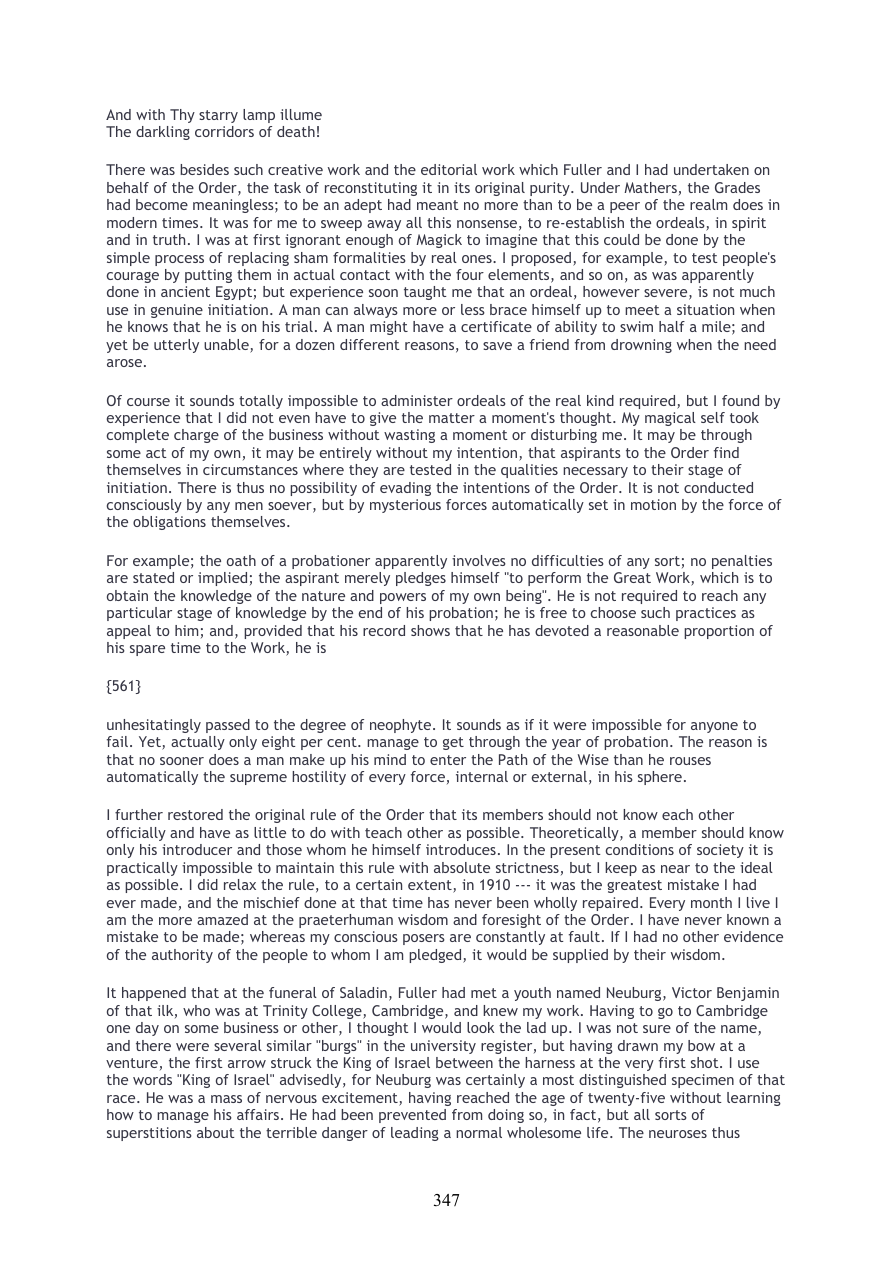
Highlights use the original PDF text layer. OCR-only matches may not be visible on the scan.
Transcription
Download text ↓raw extractionoriginal embedded textReview: unreviewed
347
And with Thy starry lamp illume
The darkling corridors of death!
There was besides such creative work and the editorial work which Fuller and I had undertaken on
behalf of the Order, the task of reconstituting it in its original purity. Under Mathers, the Grades
had become meaningless; to be an adept had meant no more than to be a peer of the realm does in
modern times. It was for me to sweep away all this nonsense, to re-establish the ordeals, in spirit
and in truth. I was at first ignorant enough of Magick to imagine that this could be done by the
simple process of replacing sham formalities by real ones. I proposed, for example, to test people's
courage by putting them in actual contact with the four elements, and so on, as was apparently
done in ancient Egypt; but experience soon taught me that an ordeal, however severe, is not much
use in genuine initiation. A man can always more or less brace himself up to meet a situation when
he knows that he is on his trial. A man might have a certificate of ability to swim half a mile; and
yet be utterly unable, for a dozen different reasons, to save a friend from drowning when the need
arose.
Of course it sounds totally impossible to administer ordeals of the real kind required, but I found by
experience that I did not even have to give the matter a moment's thought. My magical self took
complete charge of the business without wasting a moment or disturbing me. It may be through
some act of my own, it may be entirely without my intention, that aspirants to the Order find
themselves in circumstances where they are tested in the qualities necessary to their stage of
initiation. There is thus no possibility of evading the intentions of the Order. It is not conducted
consciously by any men soever, but by mysterious forces automatically set in motion by the force of
the obligations themselves.
For example; the oath of a probationer apparently involves no difficulties of any sort; no penalties
are stated or implied; the aspirant merely pledges himself "to perform the Great Work, which is to
obtain the knowledge of the nature and powers of my own being". He is not required to reach any
particular stage of knowledge by the end of his probation; he is free to choose such practices as
appeal to him; and, provided that his record shows that he has devoted a reasonable proportion of
his spare time to the Work, he is
{561}
unhesitatingly passed to the degree of neophyte. It sounds as if it were impossible for anyone to
fail. Yet, actually only eight per cent. manage to get through the year of probation. The reason is
that no sooner does a man make up his mind to enter the Path of the Wise than he rouses
automatically the supreme hostility of every force, internal or external, in his sphere.
I further restored the original rule of the Order that its members should not know each other
officially and have as little to do with teach other as possible. Theoretically, a member should know
only his introducer and those whom he himself introduces. In the present conditions of society it is
practically impossible to maintain this rule with absolute strictness, but I keep as near to the ideal
as possible. I did relax the rule, to a certain extent, in 1910 --- it was the greatest mistake I had
ever made, and the mischief done at that time has never been wholly repaired. Every month I live I
am the more amazed at the praeterhuman wisdom and foresight of the Order. I have never known a
mistake to be made; whereas my conscious posers are constantly at fault. If I had no other evidence
of the authority of the people to whom I am pledged, it would be supplied by their wisdom.
It happened that at the funeral of Saladin, Fuller had met a youth named Neuburg, Victor Benjamin
of that ilk, who was at Trinity College, Cambridge, and knew my work. Having to go to Cambridge
one day on some business or other, I thought I would look the lad up. I was not sure of the name,
and there were several similar "burgs" in the university register, but having drawn my bow at a
venture, the first arrow struck the King of Israel between the harness at the very first shot. I use
the words "King of Israel" advisedly, for Neuburg was certainly a most distinguished specimen of that
race. He was a mass of nervous excitement, having reached the age of twenty-five without learning
how to manage his affairs. He had been prevented from doing so, in fact, but all sorts of
superstitions about the terrible danger of leading a normal wholesome life. The neuroses thus
Page provenance & review flags
Stable page ID: 5ef44b98d8f9c4af5f6f86e1:p00347
Line breaks are preserved. Reading order and OCR accuracy may need review.
Printed page label has not been verified.
- No automated review flags. This does not establish transcription accuracy.