1929 · CLOSE READING
Confessions of Aleister Crowley
Confessions of Aleister Crowley (1929), PDF p. 350
Original page
Enlarge ↗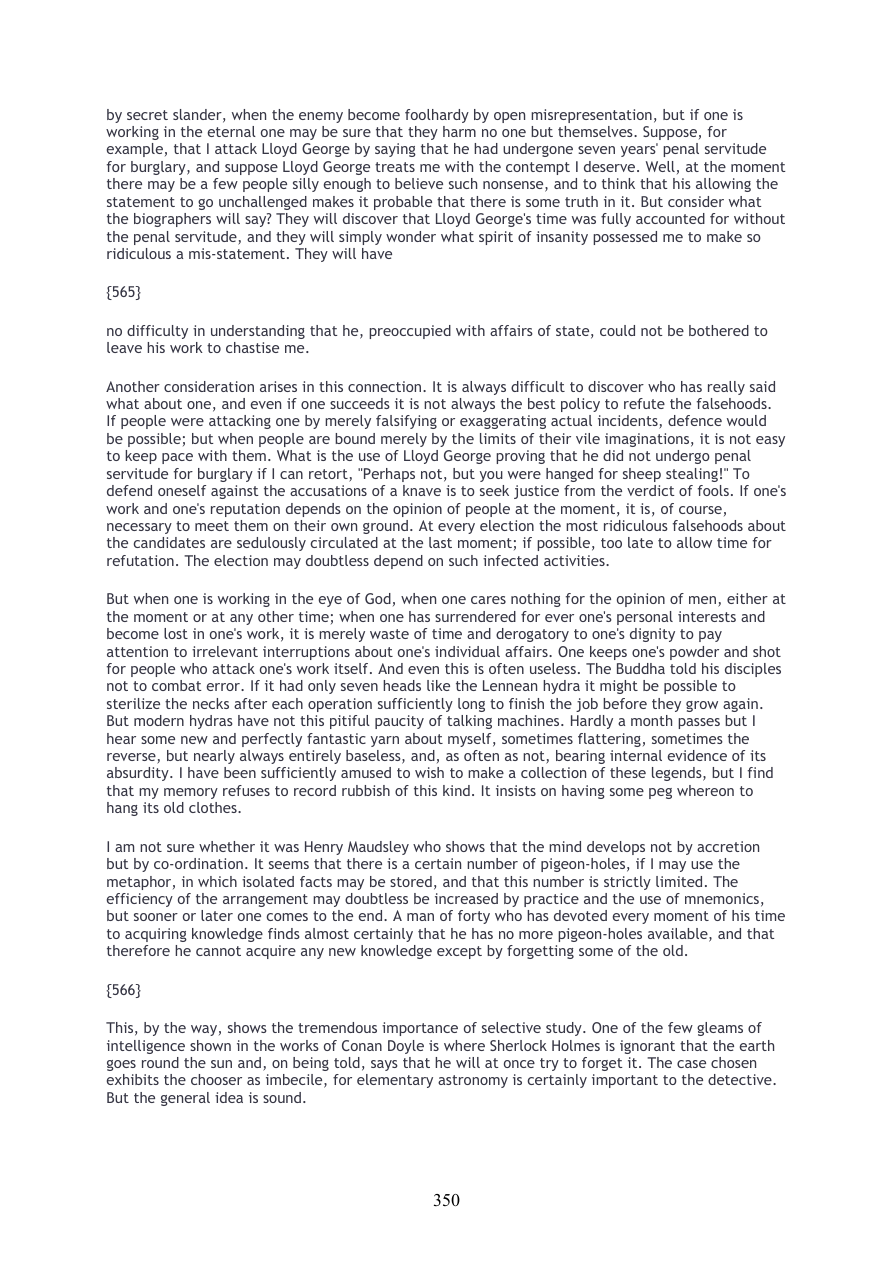
Highlights use the original PDF text layer. OCR-only matches may not be visible on the scan.
Transcription
Download text ↓raw extractionoriginal embedded textReview: unreviewed
350
by secret slander, when the enemy become foolhardy by open misrepresentation, but if one is
working in the eternal one may be sure that they harm no one but themselves. Suppose, for
example, that I attack Lloyd George by saying that he had undergone seven years' penal servitude
for burglary, and suppose Lloyd George treats me with the contempt I deserve. Well, at the moment
there may be a few people silly enough to believe such nonsense, and to think that his allowing the
statement to go unchallenged makes it probable that there is some truth in it. But consider what
the biographers will say? They will discover that Lloyd George's time was fully accounted for without
the penal servitude, and they will simply wonder what spirit of insanity possessed me to make so
ridiculous a mis-statement. They will have
{565}
no difficulty in understanding that he, preoccupied with affairs of state, could not be bothered to
leave his work to chastise me.
Another consideration arises in this connection. It is always difficult to discover who has really said
what about one, and even if one succeeds it is not always the best policy to refute the falsehoods.
If people were attacking one by merely falsifying or exaggerating actual incidents, defence would
be possible; but when people are bound merely by the limits of their vile imaginations, it is not easy
to keep pace with them. What is the use of Lloyd George proving that he did not undergo penal
servitude for burglary if I can retort, "Perhaps not, but you were hanged for sheep stealing!" To
defend oneself against the accusations of a knave is to seek justice from the verdict of fools. If one's
work and one's reputation depends on the opinion of people at the moment, it is, of course,
necessary to meet them on their own ground. At every election the most ridiculous falsehoods about
the candidates are sedulously circulated at the last moment; if possible, too late to allow time for
refutation. The election may doubtless depend on such infected activities.
But when one is working in the eye of God, when one cares nothing for the opinion of men, either at
the moment or at any other time; when one has surrendered for ever one's personal interests and
become lost in one's work, it is merely waste of time and derogatory to one's dignity to pay
attention to irrelevant interruptions about one's individual affairs. One keeps one's powder and shot
for people who attack one's work itself. And even this is often useless. The Buddha told his disciples
not to combat error. If it had only seven heads like the Lennean hydra it might be possible to
sterilize the necks after each operation sufficiently long to finish the job before they grow again.
But modern hydras have not this pitiful paucity of talking machines. Hardly a month passes but I
hear some new and perfectly fantastic yarn about myself, sometimes flattering, sometimes the
reverse, but nearly always entirely baseless, and, as often as not, bearing internal evidence of its
absurdity. I have been sufficiently amused to wish to make a collection of these legends, but I find
that my memory refuses to record rubbish of this kind. It insists on having some peg whereon to
hang its old clothes.
I am not sure whether it was Henry Maudsley who shows that the mind develops not by accretion
but by co-ordination. It seems that there is a certain number of pigeon-holes, if I may use the
metaphor, in which isolated facts may be stored, and that this number is strictly limited. The
efficiency of the arrangement may doubtless be increased by practice and the use of mnemonics,
but sooner or later one comes to the end. A man of forty who has devoted every moment of his time
to acquiring knowledge finds almost certainly that he has no more pigeon-holes available, and that
therefore he cannot acquire any new knowledge except by forgetting some of the old.
{566}
This, by the way, shows the tremendous importance of selective study. One of the few gleams of
intelligence shown in the works of Conan Doyle is where Sherlock Holmes is ignorant that the earth
goes round the sun and, on being told, says that he will at once try to forget it. The case chosen
exhibits the chooser as imbecile, for elementary astronomy is certainly important to the detective.
But the general idea is sound.
Page provenance & review flags
Stable page ID: 5ef44b98d8f9c4af5f6f86e1:p00350
Line breaks are preserved. Reading order and OCR accuracy may need review.
Printed page label has not been verified.
- No automated review flags. This does not establish transcription accuracy.