1929 · CLOSE READING
Confessions of Aleister Crowley
Confessions of Aleister Crowley (1929), PDF p. 368
Original page
Enlarge ↗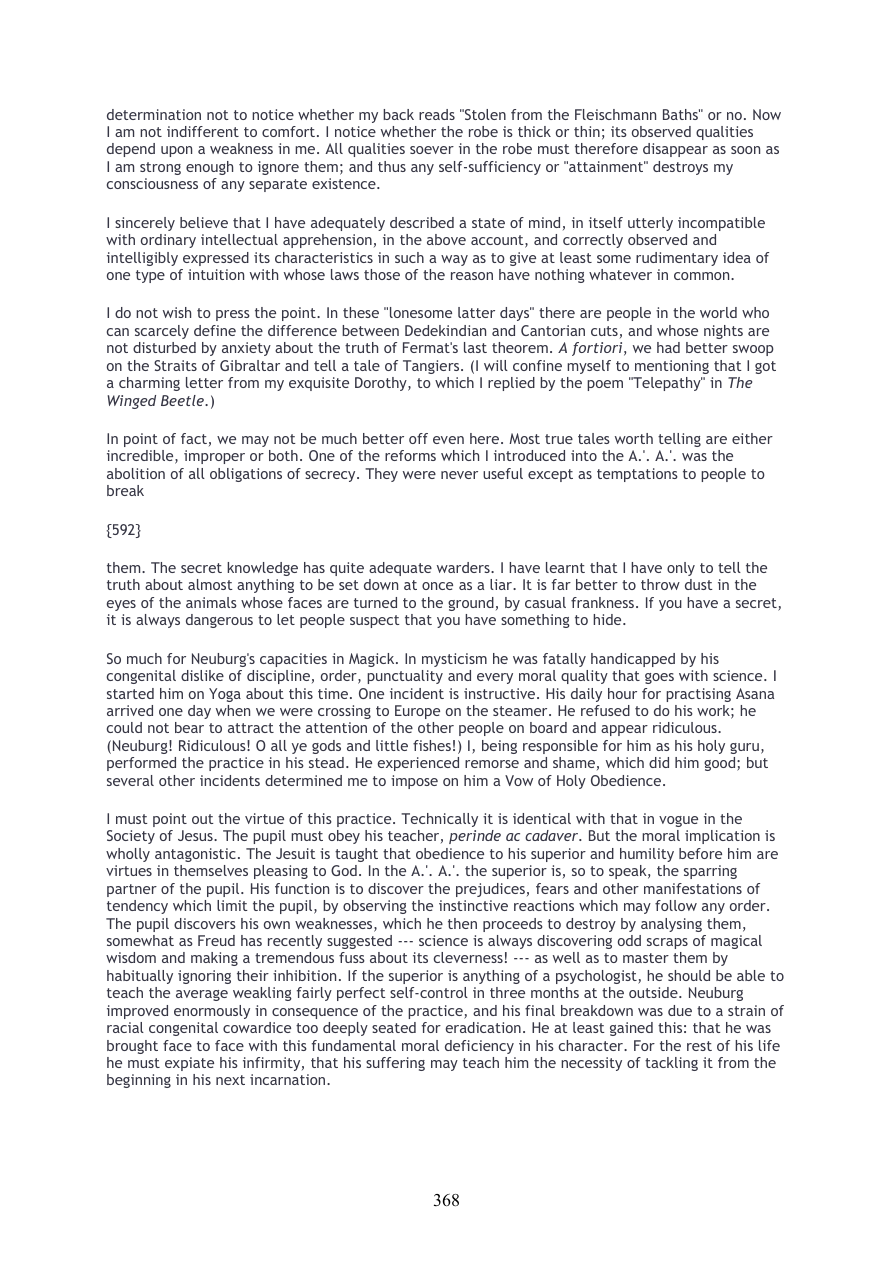
Highlights use the original PDF text layer. OCR-only matches may not be visible on the scan.
Transcription
Download text ↓raw extractionoriginal embedded textReview: unreviewed
368
determination not to notice whether my back reads "Stolen from the Fleischmann Baths" or no. Now
I am not indifferent to comfort. I notice whether the robe is thick or thin; its observed qualities
depend upon a weakness in me. All qualities soever in the robe must therefore disappear as soon as
I am strong enough to ignore them; and thus any self-sufficiency or "attainment" destroys my
consciousness of any separate existence.
I sincerely believe that I have adequately described a state of mind, in itself utterly incompatible
with ordinary intellectual apprehension, in the above account, and correctly observed and
intelligibly expressed its characteristics in such a way as to give at least some rudimentary idea of
one type of intuition with whose laws those of the reason have nothing whatever in common.
I do not wish to press the point. In these "lonesome latter days" there are people in the world who
can scarcely define the difference between Dedekindian and Cantorian cuts, and whose nights are
not disturbed by anxiety about the truth of Fermat's last theorem. A fortiori, we had better swoop
on the Straits of Gibraltar and tell a tale of Tangiers. (I will confine myself to mentioning that I got
a charming letter from my exquisite Dorothy, to which I replied by the poem "Telepathy" in The
Winged Beetle.)
In point of fact, we may not be much better off even here. Most true tales worth telling are either
incredible, improper or both. One of the reforms which I introduced into the A.'. A.'. was the
abolition of all obligations of secrecy. They were never useful except as temptations to people to
break
{592}
them. The secret knowledge has quite adequate warders. I have learnt that I have only to tell the
truth about almost anything to be set down at once as a liar. It is far better to throw dust in the
eyes of the animals whose faces are turned to the ground, by casual frankness. If you have a secret,
it is always dangerous to let people suspect that you have something to hide.
So much for Neuburg's capacities in Magick. In mysticism he was fatally handicapped by his
congenital dislike of discipline, order, punctuality and every moral quality that goes with science. I
started him on Yoga about this time. One incident is instructive. His daily hour for practising Asana
arrived one day when we were crossing to Europe on the steamer. He refused to do his work; he
could not bear to attract the attention of the other people on board and appear ridiculous.
(Neuburg! Ridiculous! O all ye gods and little fishes!) I, being responsible for him as his holy guru,
performed the practice in his stead. He experienced remorse and shame, which did him good; but
several other incidents determined me to impose on him a Vow of Holy Obedience.
I must point out the virtue of this practice. Technically it is identical with that in vogue in the
Society of Jesus. The pupil must obey his teacher, perinde ac cadaver. But the moral implication is
wholly antagonistic. The Jesuit is taught that obedience to his superior and humility before him are
virtues in themselves pleasing to God. In the A.'. A.'. the superior is, so to speak, the sparring
partner of the pupil. His function is to discover the prejudices, fears and other manifestations of
tendency which limit the pupil, by observing the instinctive reactions which may follow any order.
The pupil discovers his own weaknesses, which he then proceeds to destroy by analysing them,
somewhat as Freud has recently suggested --- science is always discovering odd scraps of magical
wisdom and making a tremendous fuss about its cleverness! --- as well as to master them by
habitually ignoring their inhibition. If the superior is anything of a psychologist, he should be able to
teach the average weakling fairly perfect self-control in three months at the outside. Neuburg
improved enormously in consequence of the practice, and his final breakdown was due to a strain of
racial congenital cowardice too deeply seated for eradication. He at least gained this: that he was
brought face to face with this fundamental moral deficiency in his character. For the rest of his life
he must expiate his infirmity, that his suffering may teach him the necessity of tackling it from the
beginning in his next incarnation.
Page provenance & review flags
Stable page ID: 5ef44b98d8f9c4af5f6f86e1:p00368
Line breaks are preserved. Reading order and OCR accuracy may need review.
Printed page label has not been verified.
- No automated review flags. This does not establish transcription accuracy.