1929 · CLOSE READING
Confessions of Aleister Crowley
Confessions of Aleister Crowley (1929), PDF p. 382
Original page
Enlarge ↗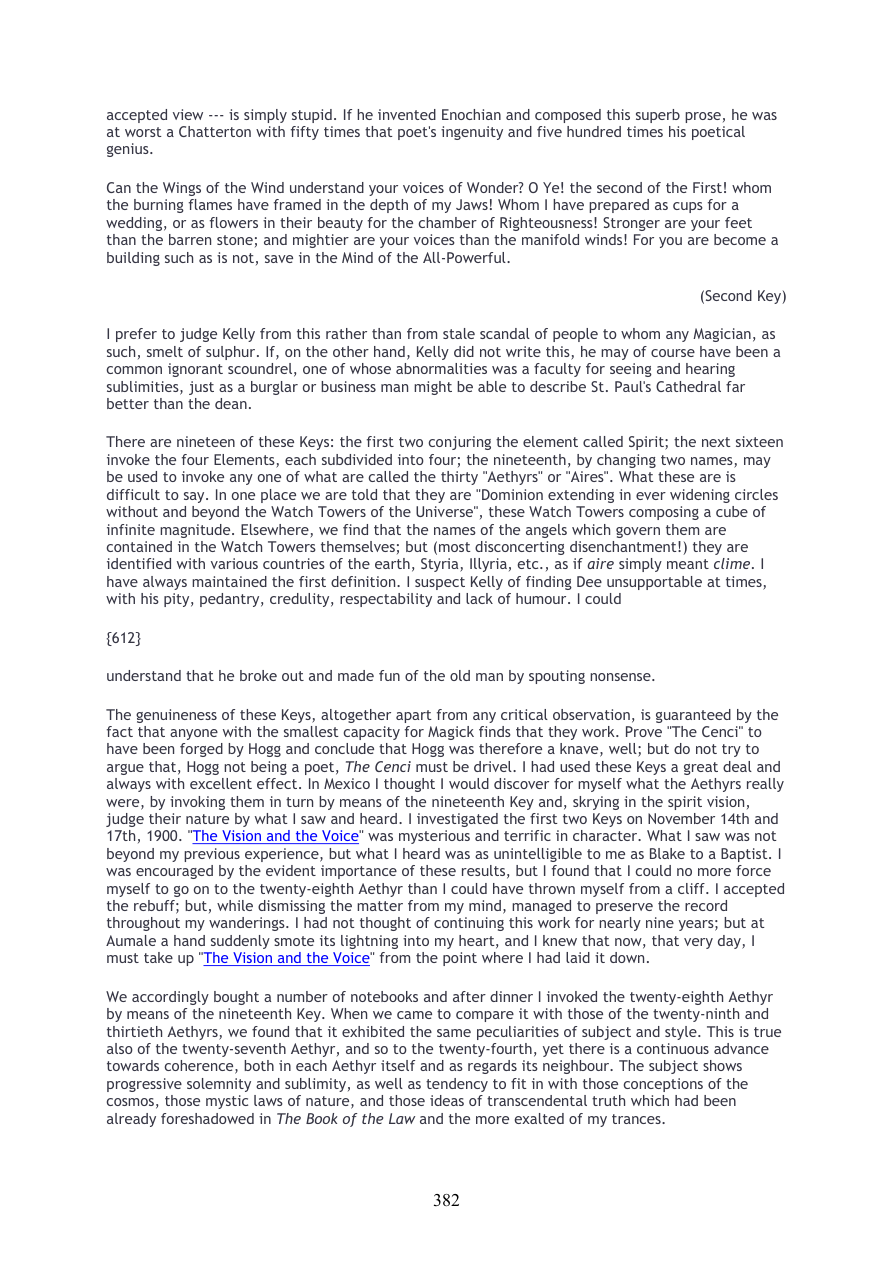
Highlights use the original PDF text layer. OCR-only matches may not be visible on the scan.
Transcription
Download text ↓raw extractionoriginal embedded textReview: unreviewed
382
accepted view --- is simply stupid. If he invented Enochian and composed this superb prose, he was
at worst a Chatterton with fifty times that poet's ingenuity and five hundred times his poetical
genius.
Can the Wings of the Wind understand your voices of Wonder? O Ye! the second of the First! whom
the burning flames have framed in the depth of my Jaws! Whom I have prepared as cups for a
wedding, or as flowers in their beauty for the chamber of Righteousness! Stronger are your feet
than the barren stone; and mightier are your voices than the manifold winds! For you are become a
building such as is not, save in the Mind of the All-Powerful.
(Second Key)
I prefer to judge Kelly from this rather than from stale scandal of people to whom any Magician, as
such, smelt of sulphur. If, on the other hand, Kelly did not write this, he may of course have been a
common ignorant scoundrel, one of whose abnormalities was a faculty for seeing and hearing
sublimities, just as a burglar or business man might be able to describe St. Paul's Cathedral far
better than the dean.
There are nineteen of these Keys: the first two conjuring the element called Spirit; the next sixteen
invoke the four Elements, each subdivided into four; the nineteenth, by changing two names, may
be used to invoke any one of what are called the thirty "Aethyrs" or "Aires". What these are is
difficult to say. In one place we are told that they are "Dominion extending in ever widening circles
without and beyond the Watch Towers of the Universe", these Watch Towers composing a cube of
infinite magnitude. Elsewhere, we find that the names of the angels which govern them are
contained in the Watch Towers themselves; but (most disconcerting disenchantment!) they are
identified with various countries of the earth, Styria, Illyria, etc., as if aire simply meant clime. I
have always maintained the first definition. I suspect Kelly of finding Dee unsupportable at times,
with his pity, pedantry, credulity, respectability and lack of humour. I could
{612}
understand that he broke out and made fun of the old man by spouting nonsense.
The genuineness of these Keys, altogether apart from any critical observation, is guaranteed by the
fact that anyone with the smallest capacity for Magick finds that they work. Prove "The Cenci" to
have been forged by Hogg and conclude that Hogg was therefore a knave, well; but do not try to
argue that, Hogg not being a poet, The Cenci must be drivel. I had used these Keys a great deal and
always with excellent effect. In Mexico I thought I would discover for myself what the Aethyrs really
were, by invoking them in turn by means of the nineteenth Key and, skrying in the spirit vision,
judge their nature by what I saw and heard. I investigated the first two Keys on November 14th and
17th, 1900. "The Vision and the Voice" was mysterious and terrific in character. What I saw was not
beyond my previous experience, but what I heard was as unintelligible to me as Blake to a Baptist. I
was encouraged by the evident importance of these results, but I found that I could no more force
myself to go on to the twenty-eighth Aethyr than I could have thrown myself from a cliff. I accepted
the rebuff; but, while dismissing the matter from my mind, managed to preserve the record
throughout my wanderings. I had not thought of continuing this work for nearly nine years; but at
Aumale a hand suddenly smote its lightning into my heart, and I knew that now, that very day, I
must take up "The Vision and the Voice" from the point where I had laid it down.
We accordingly bought a number of notebooks and after dinner I invoked the twenty-eighth Aethyr
by means of the nineteenth Key. When we came to compare it with those of the twenty-ninth and
thirtieth Aethyrs, we found that it exhibited the same peculiarities of subject and style. This is true
also of the twenty-seventh Aethyr, and so to the twenty-fourth, yet there is a continuous advance
towards coherence, both in each Aethyr itself and as regards its neighbour. The subject shows
progressive solemnity and sublimity, as well as tendency to fit in with those conceptions of the
cosmos, those mystic laws of nature, and those ideas of transcendental truth which had been
already foreshadowed in The Book of the Law and the more exalted of my trances.
Page provenance & review flags
Stable page ID: 5ef44b98d8f9c4af5f6f86e1:p00382
Line breaks are preserved. Reading order and OCR accuracy may need review.
Printed page label has not been verified.
- No automated review flags. This does not establish transcription accuracy.